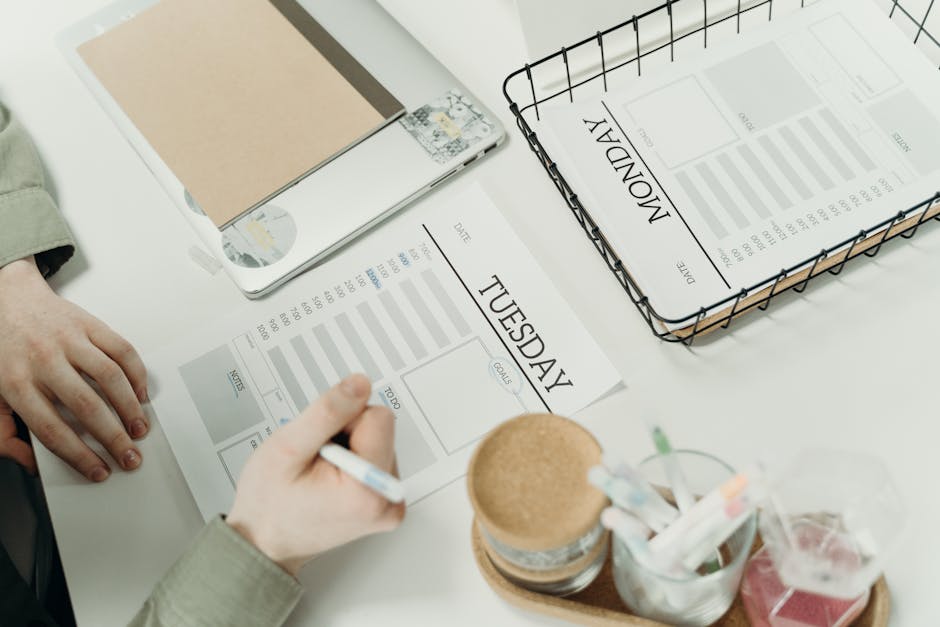
AI weekly routine for the COO — Monday-to-Friday cadence
TL;DR
- •The COO's AI routine is daily and operational — not weekly and strategic. That's the founder's job.
- •Five 30-minute blocks across Mon-Fri produce more compounding signal than one Friday hour.
- •BCG's 5-hour-per-week threshold is met inside this routine without adding meeting load.
After watching 30+ COOs of 30-500-person companies try to make AI part of their week, my conclusion is that the COO who treats AI as a Friday-only review tool gets less out of it than the one who has a Monday-to-Friday cadence with a clear job per day.
Why the COO needs a daily AI rhythm
The COO is the operational heartbeat. If AI lives in your week as "let me try ChatGPT Friday afternoon", you'll never internalize it as a tool — and the team will mirror you. Microsoft internal data: 89% of users who push past the productivity dip are still active 20 weeks later; the COO is the role most likely to abandon at day 8-10 because operational pressure crushes new habits.
The fix is to embed AI into work you already do, in 30-minute slots that you can't skip without breaking another commitment.
Definition: Productivity dip — the day-8-15 window in any new tool when the user is still slower than baseline. Past it, retention is high. Around it, abandonment is the default.
The Mon-Fri COO AI routine
Monday — 30 min: weekly ops review with AI synthesis
Open the weekly ops report (you already get one). Paste it into a sanctioned AI tool with a fixed prompt: "Synthesize the 3 biggest week-over-week changes, the 2 unexplained anomalies, and 1 question I should ask the leadership team." Read the synthesis BEFORE you read the raw report. The synthesis sharpens what you look for in the raw.
You are an ops analyst for a {industry} {size}-employee company.
From this weekly ops report, return:
- 3 biggest WoW changes (with magnitude)
- 2 unexplained anomalies (data + question)
- 1 question for the leadership team this week
Cite the source line for each. Do not invent numbers.
REPORT: {{paste}}
Tuesday — 30 min: exception triage
Pull the exception queue (refunds over X, escalations, churn-risk accounts, late deliveries). AI clusters them by root cause and proposes 3 grouped actions. You approve, delegate, or kill. The clustering is the value — most COOs are drowning in one-off exceptions and missing the pattern.
Wednesday — 30 min: vendor / contract escalation drafts
Wednesday is the day where one or two vendor issues need a written escalation. AI drafts: the timeline, the impact, the ask, the escalation path. You edit. Time-cost goes from ~45 minutes per escalation to ~10 minutes. Net week-over-week, that's 1-2 hours back.
Tool tip (Course for Business): In our 6-week program we run COO cohorts through Shoulder-to-Shoulder sessions on real escalation drafts. The principle is Augment, don't replace — the COO still owns the relationship and the send. We've found that COOs typically hit BCG's ~5-hour threshold by week 3 just through this Mon-Fri cadence, without scheduling a single training session. course.aiadvisoryboard.me/business.
Thursday — 30 min: cross-functional risk scan
Thursday is for what's about to break next. Have AI run a fixed prompt across the week's leadership Slack channels (sanctioned, retention-aware): "Pull every message that contains a risk signal — slipping deadline, missing vendor, regulatory mention, churn indicator. Return chronological with author." Read in 15 minutes; act on 1-2 in the remaining 15. This is the highest-leverage half hour of the COO week if done well.
Friday — 30 min: weekly retro
Friday is your weekly retro with AI: paste the week's leadership-team meeting notes, your Mon-Tue-Wed-Thu outputs, and ask: "What did I underweight? What did I miss? What should be on the leadership-team agenda Monday?" The output is a half-page Friday memo to your direct team. Send it before the laptop closes.
What NOT to do
- Don't replace the human ops report with AI synthesis. Read both. The synthesis is a lens, not a substitute.
- Don't generate net-new initiatives in this routine. The point is to make existing work sharper, not to add work.
- Don't share AI-drafted vendor escalations without the COO's edit. Tone is everything in vendor relationships; AI defaults are too cold or too warm.
- Don't skip Tuesday because the exception queue feels small. The clustering catches drift before it becomes a fire.
Team scan (what AI champions report after week 1)
- The COO held all 5 daily blocks at least 4 of 5 days.
- Monday's synthesis-then-raw order changed at least 1 leadership-meeting question.
- Tuesday's exception clustering surfaced 1 root cause that nobody had named.
- Wednesday's vendor escalations dropped from ~45 min/each to ~10-15 min/each.
- Thursday's cross-functional risk scan caught 1 signal that would have escalated next week.
- Friday's retro memo was sent before 6 pm.
- The COO crossed BCG's ~5-hour-per-week AI usage threshold without adding meetings.
- 1 leader started copying the COO's prompt structure unprompted.
- 1 prompt that wasn't working got rewritten or retired.
- The leadership team noticed the COO is engaging with AI daily — not as performative, but as visibly useful.
Tool tip (Course for Business): COO cohorts in our work run with an AI Champions (1:15-20) ratio across operations, finance, and people-ops. For a 200-person company that means 10-13 champions; the COO sponsors 2-3 directly and lets the rest cascade. The 6-week program is built so the COO's daily rhythm and the team's weekly clinics reinforce each other. course.aiadvisoryboard.me/business.
Micro-case (what changes after 7-14 days)
A typical 200-person logistics company COO runs this routine for two weeks. Week 1 Monday: synthesis catches a 12% margin slip on one product line that was buried in the raw report. Week 1 Wednesday: vendor escalation that would have eaten the afternoon takes 12 minutes; the COO uses the time saved to do a customer call she'd been postponing. Week 1 Friday: retro memo names a Thursday risk-signal pattern that spares Monday's leadership meeting from a surprise. Week 2: the COO has crossed BCG's 5-hour weekly threshold organically. Direct reports start adopting the same Mon-Tue prompt structure. By day 14 the operational rhythm of the company is visibly tighter without anyone having added a meeting or a tool.
Note on this case: This example is illustrative — based on typical patterns we observe with companies of 30-500 employees, not a single named client. Specific numbers are rounded approximations of common ranges, not guarantees.
FAQ
Why daily and not weekly like the founder?
The COO operates daily. A weekly cadence skips the actual operational signal that's worth catching mid-week. The founder is upstream of the COO's daily rhythm; the COO is inside it.
What if I get pulled into a fire on Tuesday?
Skip Tuesday's exception triage and double Wednesday or Thursday. Don't try to make all five blocks happen on a fire week. The point is the rhythm survives the fire week, not perfection.
How do I keep the AI synthesis from becoming a crutch?
Always read the raw report after the synthesis, not before. If you find yourself believing the synthesis without the raw, that's a signal to discipline the prompt: shorter synthesis, more citations, fewer adjectives.
What about confidential ops data?
Use a sanctioned tool with org access, EU-region storage if applicable, and a written DPA. The 46% shadow-AI figure is mostly people with no sanctioned path; the COO's job is to make sure their team has one.
Does this overlap with your daily-management product?
The daily-management OS surfaces what every team did, every day, at the company level — overlapping with Monday's synthesis. The Mon-Fri routine above is what a COO does inside their function. Use both, but the CTAs go to different products for different jobs.
Conclusion
Five 30-minute blocks. Synthesis on Monday, triage on Tuesday, drafts on Wednesday, risk scan on Thursday, retro on Friday. No new tools, no new headcount, no extra meetings. The COO who holds this for 4 weeks crosses BCG's 5-hour threshold and brings a tighter operational rhythm to the leadership team.
If you want every operations team member to ship their first AI automation in five days — book a 30-min call and we'll map your team's first week: course.aiadvisoryboard.me/business.
Ready to transform your team's daily workflow?
AI Advisory Board helps teams automate daily standups, prevent burnout, and make data-driven decisions. Join hundreds of teams already saving 2+ hours per week.
Get weekly insights on team management
Join 2,000+ leaders receiving our best tips on productivity, burnout prevention, and team efficiency.
No spam. Unsubscribe anytime.
Related Articles
COO AI Tools Stack 2026: Fireflies + Notion + Zapier + Claude
A neutral COO-level AI stack for 30-500-employee operations. What each tool earns, what it shouldn't replace, and where the four glue together.
Read more
COO Time Savings With AI: 6-10 Hrs/Week Reclaim Plan
Where COOs of 30-500-employee companies actually find 6-10 hours/week with AI. Concrete operating rituals — and where AI gives back nothing.
Read more
AI weekly routine for the founder — 90 minutes that compound
A 90-minute Friday routine for founders of 30-500-employee companies: review what worked, sharpen prompts, plan next week. Compounds over months without slowing the team.
Read more