Daybreak Red
At a glance
- Price per 1M tokens (input)
- $12.50
- Price per 1M tokens (output)
- $75.00
- Context
- 400,000 tokens
- Free access
- yes (see below)
Refreshed daily; data verified October 8, 2026. Published August 24, 2026.
Daybreak Red by OpenAI is a multimodal model designed for developers and enterprises that need to process images alongside text and execute complex, multi-step workflows. It combines visual understanding with tool calling, which allows the model to invoke external functions or APIs during a task, and step-by-step reasoning for transparent, traceable problem-solving. This model suits use cases like document analysis, automated customer support, and data extraction where both images and structured actions are required. The vendor's approach emphasizes reliability and integration, making the model a practical choice for production environments rather than experimental research.
Specifications & pricing
| Input (per 1M tokens) | $12.50 |
|---|---|
| Output (per 1M tokens) | $75.00 |
| Cache read (per 1M tokens) | $1.25 |
| Cache write (per 1M tokens) | $15.63 |
| Context window | 400,000 tokens |
| Max output | 128,000 tokens |
| Capabilities | images, tool calling, reasoning |
LiteLLM community dataset (MIT), verified October 8, 2026. Official OpenAI pricing.
What Daybreak Red would cost on your workload — run it through the cost calculator →
Where to try Daybreak Red for free
- OpenAI offers a free chat — ChatGPT (free plan). A vendor's free chat may run a different model from the same family — the exact model is not guaranteed.
Frequently asked questions
What is this model best used for?+
Daybreak Red excels at tasks that combine visual and textual information, such as interpreting charts, screenshots, or scanned documents, and then taking action based on that understanding—for example, updating a database or sending a notification. It is also strong at multi-step reasoning, where you need the model to explain its logic before arriving at an answer, which is useful for audits or debugging.
How do I get started with Daybreak Red?+
You can access the model through the OpenAI API, where you send a request with your text and image inputs, and optionally define functions for tool calling. Start with the documentation and a simple proof-of-concept, such as extracting data from an invoice and calling a function to log it. The API supports standard authentication and you can test in a sandbox environment before scaling.
How does Daybreak Red differ from other models in the OpenAI line?+
Compared to text-only models, Daybreak Red adds native image understanding, so you do not need a separate vision model. Unlike simpler chat models, it includes built-in tool calling, which lets it interact with external systems reliably. Its step-by-step reasoning is more explicit than some sibling models, making it easier to verify the logic behind outputs, though it may be slower for very short, simple queries.
What are the limitations of Daybreak Red?+
The model can misinterpret complex or low-quality images, so it is not suitable for medical imaging or high-stakes visual diagnostics. Tool calling requires you to define functions carefully; if the function schema is unclear, the model may make errors. It also generates reasoning text, which increases latency and token usage, so for high-volume, low-complexity tasks, a simpler model might be more efficient.
Compare with others
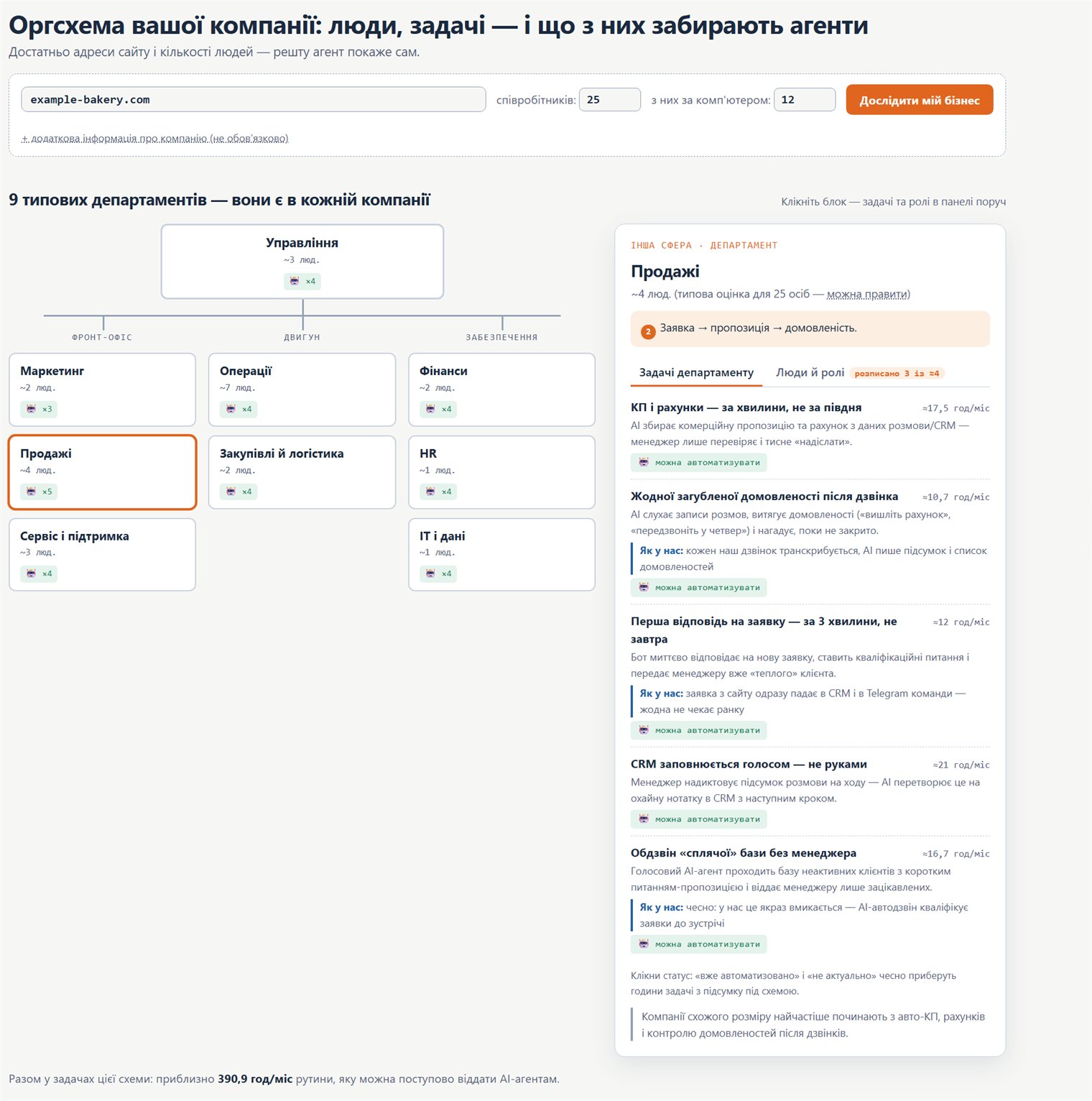
Org chart: how to move your company onto AI
A practical map: which company roles and processes AI agents can take over, where to start, and in what order to roll it out.