Devstral
At a glance
- Price per 1M tokens (input)
- $0.40
- Price per 1M tokens (output)
- $2.00
- Context
- 256,000 tokens
- Free access
- yes (see below)
Refreshed daily; data verified September 29, 2026. Published August 12, 2026, last price change September 18, 2026.
Devstral is a compact, tool-calling-focused model from Mistral AI, designed for developers building agents that need to invoke external APIs, databases, or software tools as part of a conversation. It excels at structured tasks like automating workflows, retrieving live data, and orchestrating multi-step operations where the model must decide which function to call and with what arguments. The vendor's approach emphasizes efficiency and reliability in production, pairing a smaller footprint with rigorous training on real-world function-calling scenarios, so it performs well in latency-sensitive environments without sacrificing accuracy. This model suits teams that want a lightweight, task-oriented alternative to general-purpose assistants, especially when integrating AI into existing software pipelines.
Specifications & pricing
| Input (per 1M tokens) | $0.40 |
|---|---|
| Output (per 1M tokens) | $2.00 |
| Cache read (per 1M tokens) | $0.04 |
| Context window | 256,000 tokens |
| Max output | 256,000 tokens |
| Capabilities | tool calling |
LiteLLM community dataset (MIT), verified September 29, 2026. Official Mistral AI pricing.
What Devstral would cost on your workload — run it through the cost calculator →
Price history
| Date | Input / 1M | Output / 1M |
|---|---|---|
| August 9, 2026 (first record) | $0.40 | $2.00 |
| September 18, 2026 | $0.40 | $2.00 |
Where to try Devstral for free
- Mistral AI offers a free chat — Le Chat (free plan). A vendor's free chat may run a different model from the same family — the exact model is not guaranteed.
Frequently asked questions
What is tool calling, and why does Devstral specialize in it?+
Tool calling (also called function calling) is the ability for a model to output a structured request to use an external tool, like a search engine, a calculator, or a company's internal API. Devstral is trained specifically to make these requests accurately and efficiently, so it can handle tasks like fetching customer records, updating a spreadsheet, or querying a database as part of a chat. This makes it ideal for building AI assistants that act on data or perform actions, rather than just generating text.
How do I get started with Devstral?+
You can access Devstral through Mistral AI's platform, either via the API or through a cloud provider that hosts the model. The simplest way is to use the Mistral SDK or a standard HTTP request, passing your conversation history and a list of available tools in the request. Mistral provides documentation and code examples for common languages like Python and JavaScript, so you can integrate it into your existing application in a few hours. No special hardware is needed if you use the hosted API.
How does Devstral differ from other Mistral models like Mistral Small or Large?+
Devstral is purpose-built for tool calling, whereas Mistral's general-purpose models are optimized for broad conversational and reasoning tasks. That means Devstral may have a narrower skill set—for example, it might be less creative in open-ended writing—but it will be more reliable and faster when you need to trigger a function call. It also has a smaller footprint, which can lower infrastructure costs if you self-host, but the trade-off is that it is not designed for tasks like long-form content generation or complex multilingual dialogue.
What are the practical limitations of Devstral?+
Devstral is not a general assistant; it works best when you provide a clear set of tools and a structured task. If you ask it to write a poem or summarize a lengthy document, it may underperform compared to a larger model. It also requires you to define your tools precisely—poorly documented function schemas can lead to incorrect calls. Finally, like all language models, it can occasionally misinterpret a request and call the wrong tool, so you should implement validation logic on your side to catch errors.
Compare with others
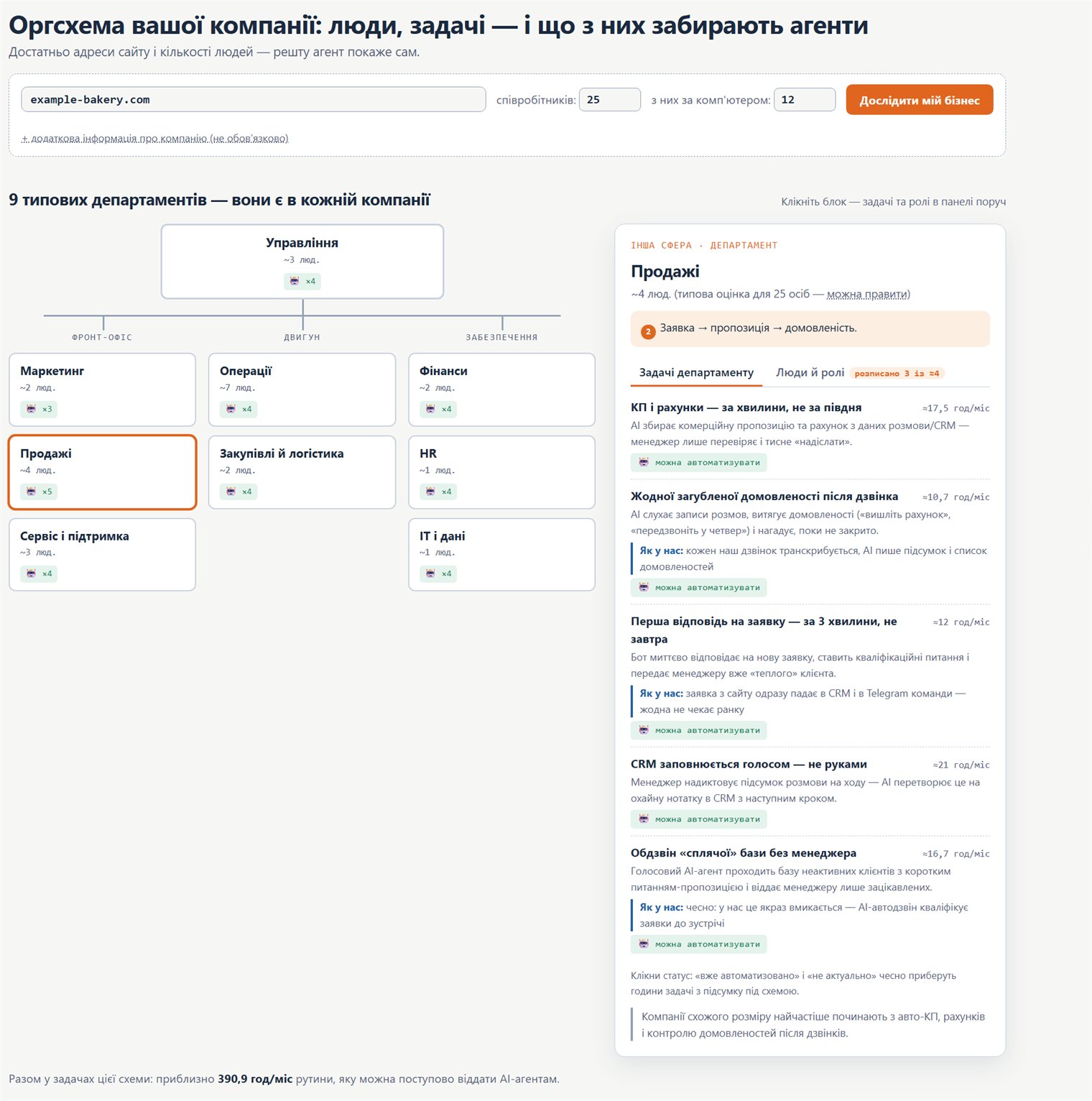
Org chart: how to move your company onto AI
A practical map: which company roles and processes AI agents can take over, where to start, and in what order to roll it out.