GPT-3.5 Turbo 1106
At a glance
- Price per 1M tokens (input)
- $1.00
- Price per 1M tokens (output)
- $2.00
- Context
- 16,385 tokens
- Free access
- yes (see below)
Refreshed daily; data verified September 30, 2026. Published August 12, 2026.
GPT-3.5 Turbo 1106 is a versatile language model from OpenAI designed for developers and businesses that need reliable text generation with structured function calling. It suits tasks such as drafting emails, summarizing documents, building chatbots, and automating workflows that require the model to interact with external tools or APIs. The vendor's approach emphasizes safety, alignment, and practical utility, offering a model that balances performance with ease of integration. Its key distinction is the improved tool calling capability, which allows the model to request specific functions and parse their outputs more accurately, reducing errors in multi-step tasks.
Specifications & pricing
| Input (per 1M tokens) | $1.00 |
|---|---|
| Output (per 1M tokens) | $2.00 |
| Context window | 16,385 tokens |
| Max output | 4,096 tokens |
| Capabilities | tool calling |
LiteLLM community dataset (MIT), verified September 30, 2026. Official OpenAI pricing.
What GPT-3.5 Turbo 1106 would cost on your workload — run it through the cost calculator →
Where to try GPT-3.5 Turbo 1106 for free
- OpenAI offers a free chat — ChatGPT (free plan). A vendor's free chat may run a different model from the same family — the exact model is not guaranteed.
Frequently asked questions
What is this model best used for?+
This model is ideal for applications that need to generate text and also take actions, like booking appointments, querying databases, or updating records. The tool calling feature lets the model output structured commands that your system can execute, making it a strong fit for customer support bots, internal knowledge assistants, and workflow automation.
How do I get started with using it?+
You can access it through the OpenAI API. Start by setting up an account, obtaining an API key, and then making a request with the model name. For tool calling, you define functions in your request, and the model will return a structured response indicating which function to call and with what arguments. OpenAI's documentation provides code examples for common languages.
How does it differ from other GPT-3.5 Turbo versions?+
The main difference is the enhanced tool calling capability, which is more robust and easier to implement than in earlier versions. It also has improved instruction following and output formatting, making it more reliable for tasks that require precise JSON or structured data. Other versions may focus on different trade-offs, such as speed or cost, but this version prioritizes function calling accuracy.
What are its limitations?+
Like all language models, it can produce incorrect or biased information, so you should validate critical outputs. It does not have memory of previous conversations unless you manage that in your application. Also, while tool calling is powerful, it requires careful design of your functions to avoid ambiguity, and the model may occasionally misinterpret complex instructions. It is not a replacement for a full decision-making system.
Compare with others
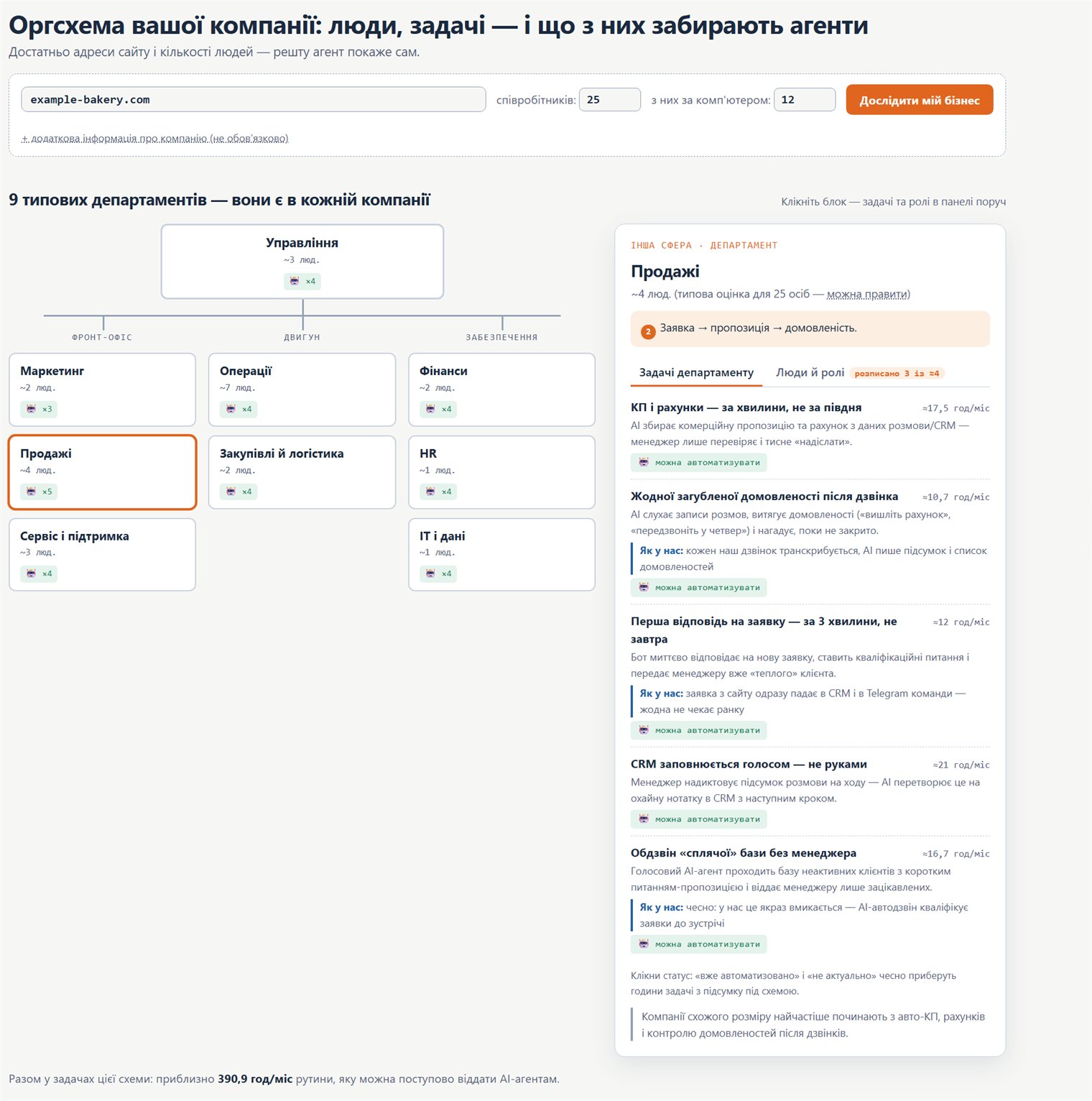
Org chart: how to move your company onto AI
A practical map: which company roles and processes AI agents can take over, where to start, and in what order to roll it out.