GPT-4 Turbo
At a glance
- Price per 1M tokens (input)
- $10.00
- Price per 1M tokens (output)
- $30.00
- Context
- 128,000 tokens
- Free access
- yes (see below)
Refreshed daily; data verified September 29, 2026. Published August 12, 2026.
GPT-4 Turbo is a multimodal model from OpenAI that accepts image inputs alongside text, enabling tasks like visual reasoning, document analysis, and chart interpretation. It also supports tool calling, which lets the model invoke external functions or APIs to fetch live data, perform calculations, or trigger workflows. This makes it a strong fit for developers and businesses building AI-powered assistants, automation pipelines, or applications that need to combine visual and textual understanding. OpenAI’s approach emphasizes reliability and alignment, with built-in safety measures and a straightforward API that integrates into existing software stacks.
Specifications & pricing
| Input (per 1M tokens) | $10.00 |
|---|---|
| Output (per 1M tokens) | $30.00 |
| Context window | 128,000 tokens |
| Max output | 4,096 tokens |
| Capabilities | images, tool calling |
LiteLLM community dataset (MIT), verified September 29, 2026. Official OpenAI pricing.
What GPT-4 Turbo would cost on your workload — run it through the cost calculator →
Where to try GPT-4 Turbo for free
- OpenAI offers a free chat — ChatGPT (free plan). A vendor's free chat may run a different model from the same family — the exact model is not guaranteed.
Frequently asked questions
What is GPT-4 Turbo best used for in a business context?+
It excels at tasks that require both visual and textual reasoning, such as extracting data from receipts or slides, summarizing documents with embedded images, and building conversational agents that can act on user requests. Its tool calling capability also makes it suitable for automating workflows, like fetching records from a database or sending updates to a CRM, directly from a chat interface.
How do I get started with GPT-4 Turbo?+
You access it through OpenAI’s API, where you can send requests with text and image inputs. The API documentation provides examples for enabling tool calling and handling responses. For quick experimentation, you can use OpenAI’s playground environment, then move to a development environment with your own API keys.
How does GPT-4 Turbo differ from other OpenAI models like GPT-4o or GPT-4 mini?+
GPT-4 Turbo is an earlier iteration that balances strong reasoning with image understanding, while GPT-4o is a newer model with faster response times and enhanced multimodal capabilities. GPT-4 mini is a smaller, more efficient variant designed for simpler tasks at lower latency. GPT-4 Turbo remains a solid choice for applications that need robust performance without the latest optimizations.
What are the limitations of GPT-4 Turbo?+
It can struggle with highly complex spatial reasoning in images, such as counting objects or reading dense fine print. Its knowledge is not real-time, so it may not know recent events unless you provide context. Tool calling requires careful setup to avoid errors, and the model may occasionally produce plausible-sounding but incorrect outputs, so validation is recommended for critical decisions.
Compare with others
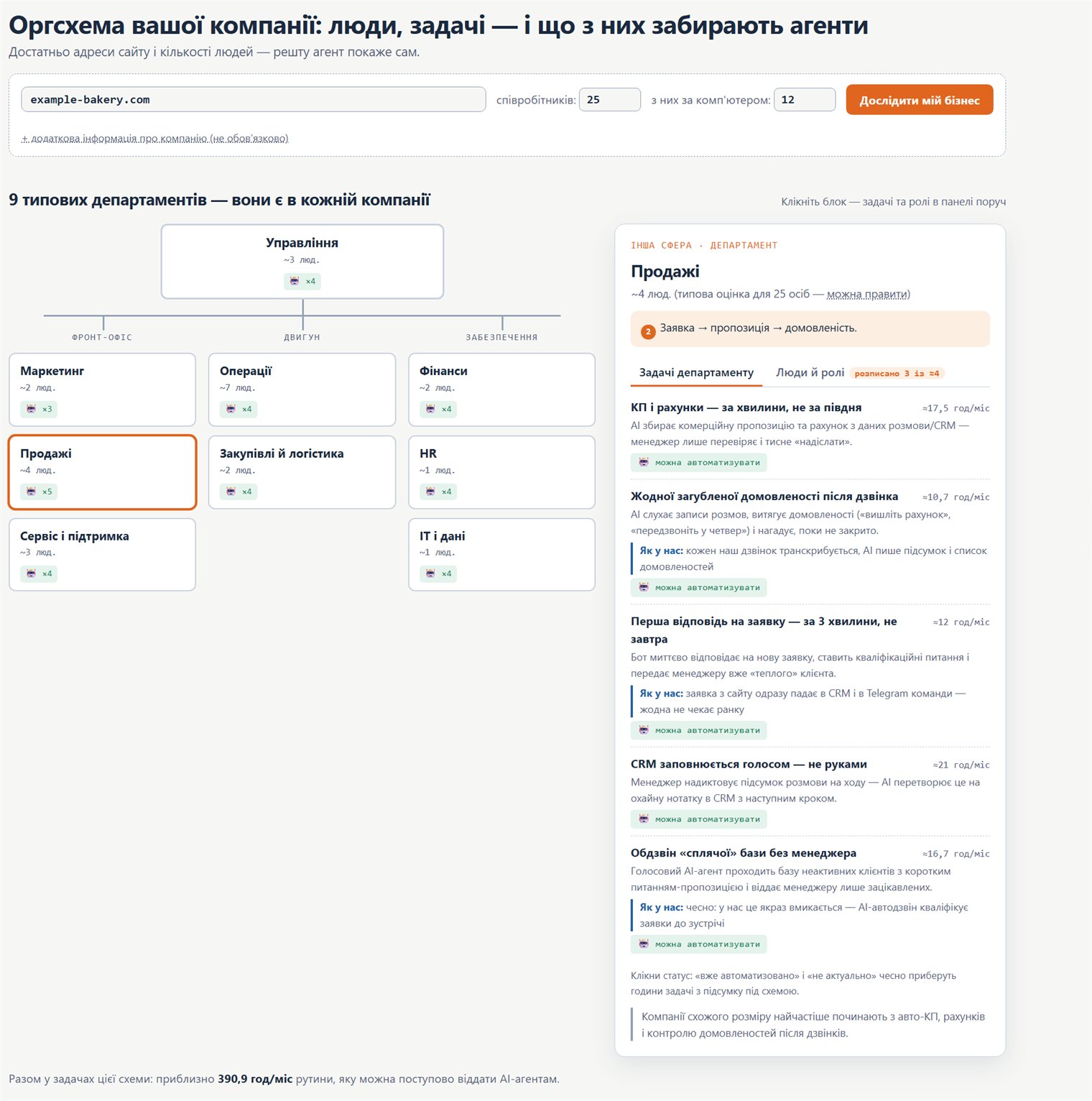
Org chart: how to move your company onto AI
A practical map: which company roles and processes AI agents can take over, where to start, and in what order to roll it out.