Grok 4.20 Beta
At a glance
- Price per 1M tokens (input)
- $1.25
- Price per 1M tokens (output)
- $2.50
- Context
- 1,000,000 tokens
- Free access
- yes (see below)
Refreshed daily; data verified September 25, 2026. Published September 25, 2026.
Grok 4.20 Beta by xAI is designed for developers and technical teams building applications that require multimodal input processing and autonomous task execution. It supports image understanding to interpret visual data alongside text, tool calling to interact with external APIs or functions, and step-by-step reasoning to break down complex problems into logical sequences. The model distinguishes itself through xAI’s emphasis on alignment with real-world utility, prioritizing verifiable outputs and reduced hallucination in structured workflows. It is best suited for use cases where accuracy, traceability, and integration with external systems are more important than raw generative fluency.
Specifications & pricing
| Input (per 1M tokens) | $1.25 |
|---|---|
| Output (per 1M tokens) | $2.50 |
| Cache read (per 1M tokens) | $0.20 |
| Context window | 1,000,000 tokens |
| Max output | 1,000,000 tokens |
| Capabilities | images, tool calling, reasoning |
LiteLLM community dataset (MIT), verified September 25, 2026. Official xAI pricing.
What Grok 4.20 Beta would cost on your workload — run it through the cost calculator →
Where to try Grok 4.20 Beta for free
- xAI offers a free chat — Grok (limited free access). A vendor's free chat may run a different model from the same family — the exact model is not guaranteed.
Frequently asked questions
What types of tasks is Grok 4.20 Beta particularly effective for?+
It excels in scenarios requiring analysis of visual inputs combined with textual reasoning, such as interpreting diagrams, screenshots, or product images to generate reports or trigger actions. Its tool calling ability enables automation of multi-step processes like data retrieval, form submission, or API orchestration. Step-by-step reasoning improves reliability in mathematical, coding, or diagnostic tasks where intermediate logic must be auditable.
How does a developer begin using Grok 4.20 Beta in an application?+
Access is provided through xAI’s API platform, where the model is available as a selectable endpoint. Developers send prompts containing text and optionally image data, and can define function schemas for tool calling to enable the model to invoke external code. Responses include both generated text and structured tool invocation requests, which the application must execute and return results for to continue the reasoning chain.
How does Grok 4.20 Beta differ from earlier versions in the Grok series?+
This version advances multimodal coherence, allowing tighter integration between image understanding and reasoning steps compared to prior text-only or weakly vision-capable releases. Tool calling is more robust, with improved schema adherence and error handling. The step-by-step reasoning module has been refined to reduce premature conclusions and increase consistency in multi-hop logic tasks.
What are current limitations users should be aware of when deploying this model?+
Image understanding performance may vary with low-resolution, abstract, or heavily occluded visuals. Tool calling depends on correct function definitions and reliable external services — failures in those systems propagate to the model’s output. While reasoning is more structured, it does not guarantee correctness in open-ended domains and benefits from validation layers in critical applications.
Compare with others
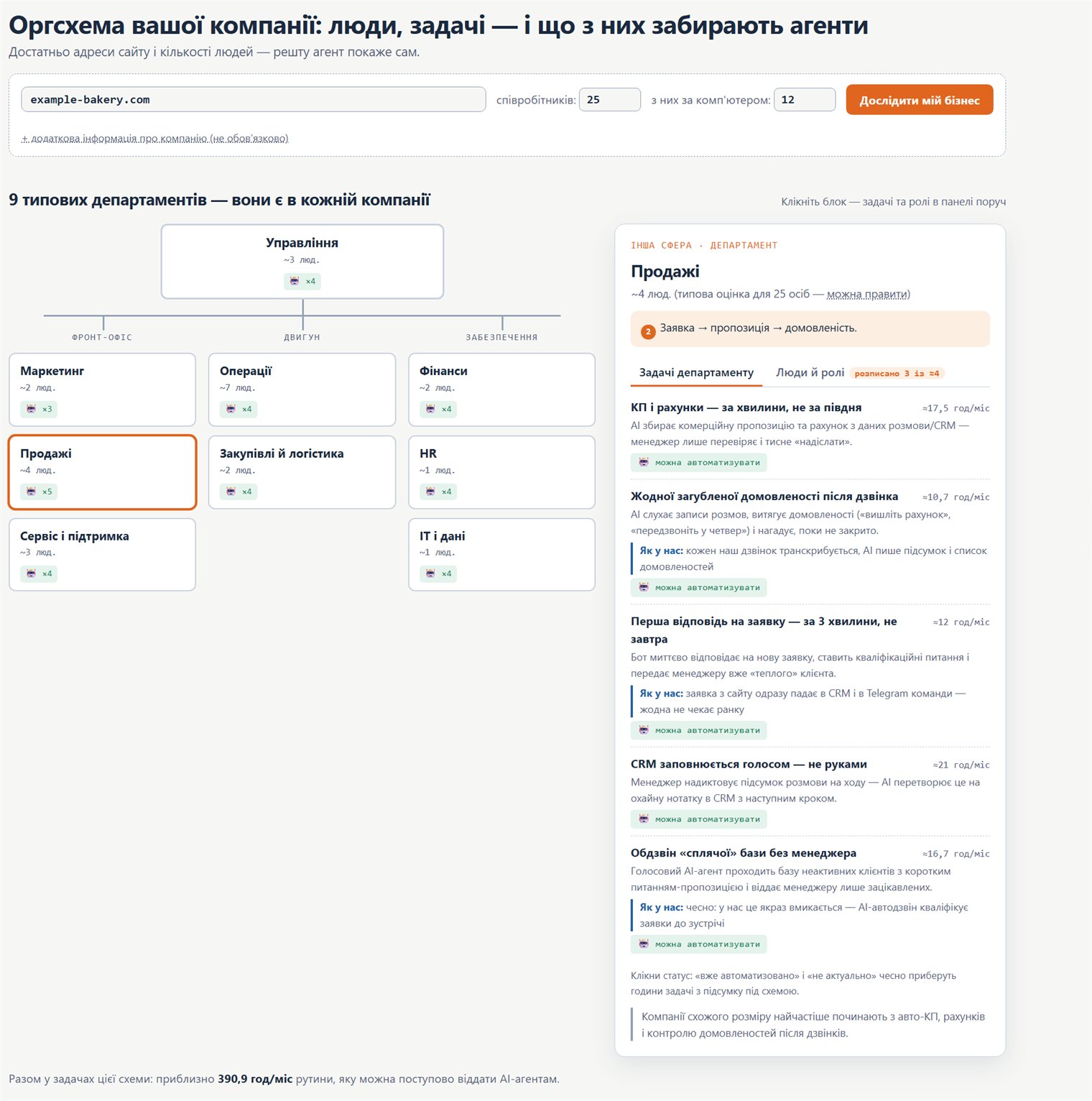
Org chart: how to move your company onto AI
A practical map: which company roles and processes AI agents can take over, where to start, and in what order to roll it out.