Grok 4.20 Reasoning
At a glance
- Price per 1M tokens (input)
- $1.25
- Price per 1M tokens (output)
- $2.50
- Context
- 1,000,000 tokens
- Free access
- yes (see below)
Refreshed daily; data verified October 17, 2026. Published September 2, 2026.
Grok 4.20 Reasoning is built for technical teams and power users who need a model that can see images, call external tools, and show its work through explicit step-by-step reasoning. It suits tasks like visual data extraction, multi-step problem solving, and automated workflows where the model must interact with APIs or databases. The vendor's approach emphasizes transparency: the reasoning chain is exposed, so you can audit how the model arrives at a conclusion, and tool calling is treated as a first-class capability rather than an afterthought. This makes it a practical choice for debugging complex pipelines and for applications where traceability matters as much as accuracy.
Specifications & pricing
| Input (per 1M tokens) | $1.25 |
|---|---|
| Output (per 1M tokens) | $2.50 |
| Cache read (per 1M tokens) | $0.20 |
| Context window | 1,000,000 tokens |
| Max output | 1,000,000 tokens |
| Capabilities | images, tool calling, reasoning |
LiteLLM community dataset (MIT), verified October 17, 2026. Official xAI pricing.
What Grok 4.20 Reasoning would cost on your workload — run it through the cost calculator →
Where to try Grok 4.20 Reasoning for free
- xAI offers a free chat — Grok (limited free access). A vendor's free chat may run a different model from the same family — the exact model is not guaranteed.
Frequently asked questions
What is this model best used for?+
It excels at tasks that combine visual understanding with logical inference, such as reading charts, diagrams, or screenshots and then answering questions or triggering actions. It also handles multi-step workflows where the model must call external functions, like querying a database or sending a request to a web service, while maintaining a clear chain of reasoning.
How do I get started with Grok 4.20 Reasoning?+
You can access it through the xAI platform or via an API. For tool calling, you define the functions the model can invoke, then provide a natural language prompt that describes the task. The model will output a structured call when it needs a tool, and you execute that call and feed the result back. For image understanding, simply attach an image to your request. The API documentation includes examples for both scenarios.
How does this model differ from other Grok models?+
Compared to standard Grok models, this version adds a dedicated reasoning mode that produces a visible step-by-step analysis before the final answer. It also has enhanced tool calling support, meaning it can more reliably decide when and how to use external functions. Sibling models without the 'Reasoning' label are optimized for faster responses and simpler tasks, while this model prioritizes depth and correctness over speed.
What are the limitations or things I should watch out for?+
The reasoning process can be verbose, so responses may take longer and consume more compute. The model may occasionally over-explain simple queries or struggle with ambiguous images. Tool calling requires careful setup: you must define function schemas precisely, and the model can make errors if the schema is too complex. Also, like all language models, it can hallucinate, especially when interpreting low-quality images or when reasoning about unfamiliar domains. Always validate critical outputs.
Compare with others
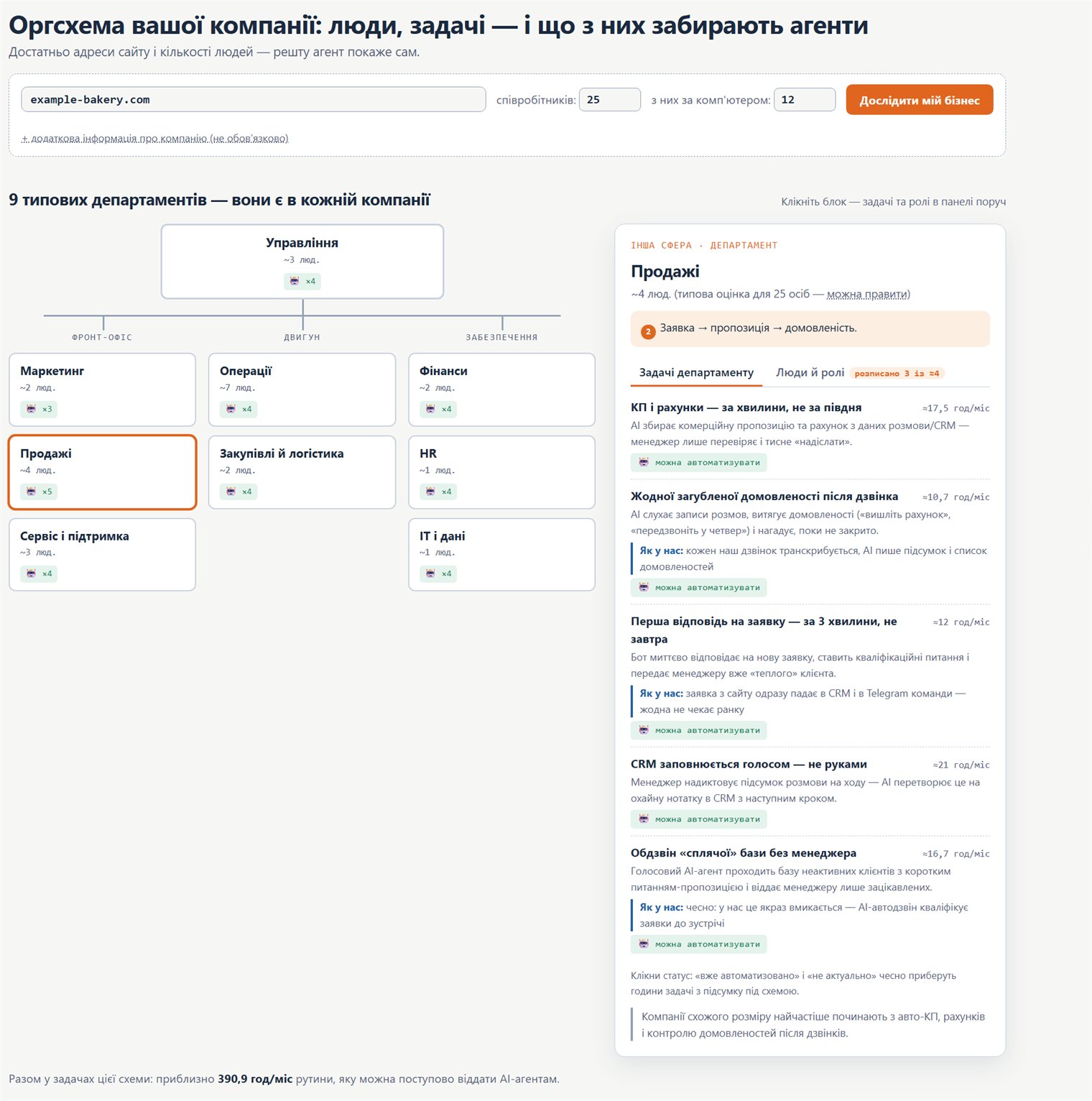
Org chart: how to move your company onto AI
A practical map: which company roles and processes AI agents can take over, where to start, and in what order to roll it out.