Grok Build
At a glance
- Price per 1M tokens (input)
- $2.00
- Price per 1M tokens (output)
- $6.00
- Context
- 500,000 tokens
- Free access
- yes (see below)
Refreshed daily; data verified October 22, 2026. Published September 7, 2026.
Grok Build is designed for developers and technical teams who need a model that can interpret visual inputs, invoke external functions, and work through multi-step problems in a transparent, traceable way. It suits tasks such as document analysis with screenshots, automated workflows that require calling APIs or databases, and complex reasoning challenges where the intermediate steps matter for debugging or audit. The vendor's approach emphasizes openness about the model's reasoning process, allowing users to follow how a conclusion is reached, and it integrates tool calling as a first-class capability rather than an afterthought. This makes it a practical choice for production environments where reliability, explainability, and integration with existing software systems are priorities.
Specifications & pricing
| Input (per 1M tokens) | $2.00 |
|---|---|
| Output (per 1M tokens) | $6.00 |
| Cache read (per 1M tokens) | $0.30 |
| Context window | 500,000 tokens |
| Max output | 500,000 tokens |
| Capabilities | images, tool calling, reasoning |
LiteLLM community dataset (MIT), verified October 22, 2026. Official xAI pricing.
What Grok Build would cost on your workload — run it through the cost calculator →
Where to try Grok Build for free
- xAI offers a free chat — Grok (limited free access). A vendor's free chat may run a different model from the same family — the exact model is not guaranteed.
Frequently asked questions
What is Grok Build best used for in a business context?+
Grok Build excels in three areas: extracting structured information from images or diagrams, automating workflows that require calling external tools like search engines or internal APIs, and solving problems that need step-by-step logical deduction—such as verifying claims or planning multi-stage operations. It is particularly useful when you need to audit the model's reasoning, because it can show its work, making it suitable for regulated industries or quality-sensitive processes.
How do I get started with Grok Build?+
You can access Grok Build through the xAI platform or via an API. The simplest path is to use the provided SDKs and documentation, which include examples for image input, tool definitions, and reasoning traces. For tool calling, you define the functions the model can invoke, and it will request calls in a structured format that your application can execute. No special hardware is needed—everything runs on the vendor's infrastructure.
How does Grok Build differ from other models in the Grok line?+
Grok Build is oriented toward engineering and automation, whereas other Grok variants may prioritize conversational fluency or creative generation. The key distinction is that Build includes robust tool calling and explicit step-by-step reasoning, which makes it more suitable for tasks that require deterministic outcomes and integration with external systems. It also has stronger image understanding compared to text-only siblings, but it is not a multimodal generation model—it reads images, not creates them.
What are the limitations of Grok Build I should be aware of?+
While Grok Build can interpret images, its visual understanding is not as deep as specialized vision models, so it may miss fine details in complex diagrams. Its step-by-step reasoning increases transparency but can be slower than a direct-answer model, and the reasoning trace may not always be fully accurate—it is a guide, not a proof. Tool calling requires that you define functions carefully; poorly specified tools can lead to errors. Finally, it is not designed for open-ended creative writing or long-form content generation.
Compare with others
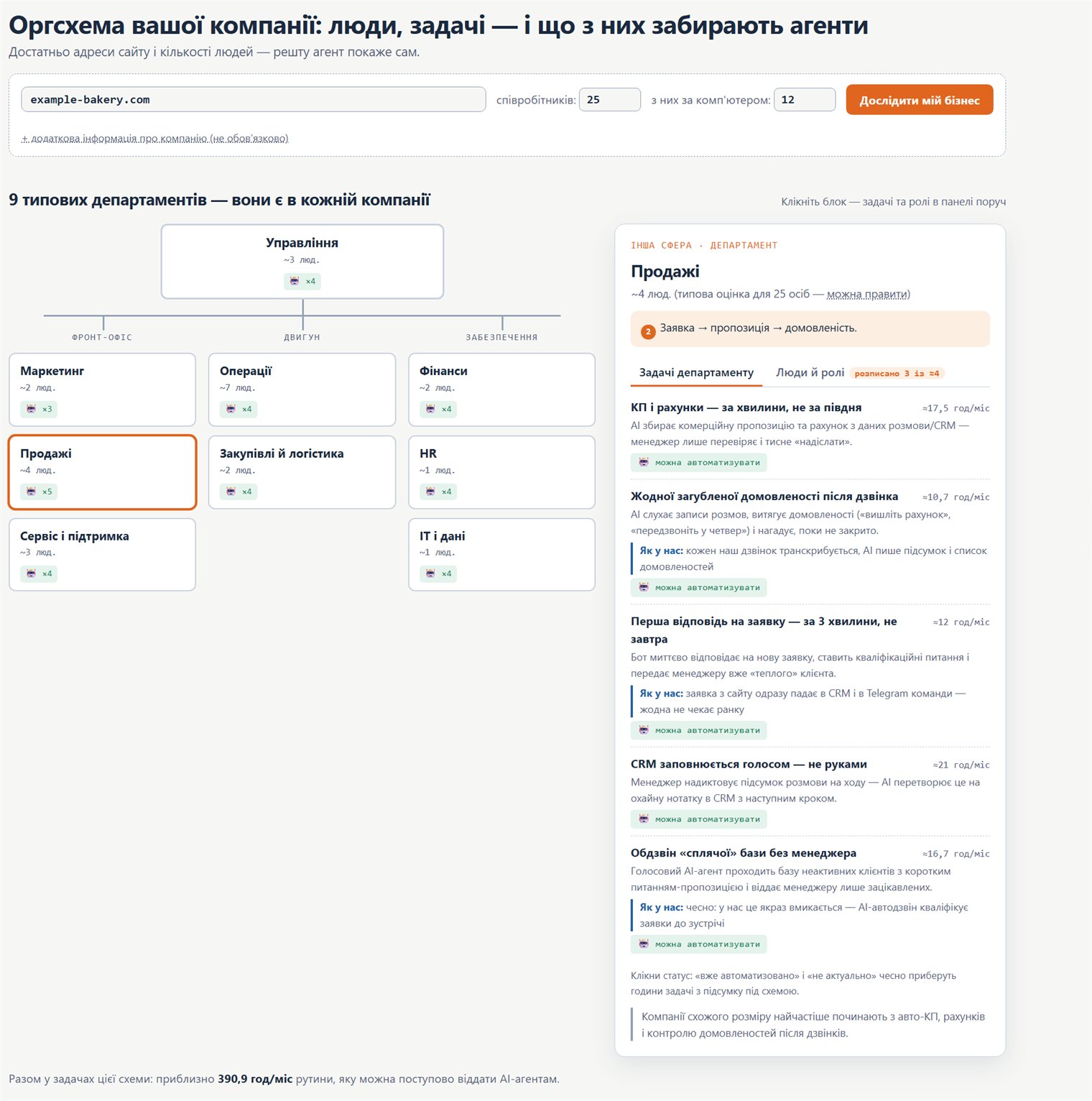
Org chart: how to move your company onto AI
A practical map: which company roles and processes AI agents can take over, where to start, and in what order to roll it out.