Grok Code Fast
At a glance
- Price per 1M tokens (input)
- $1.00
- Price per 1M tokens (output)
- $2.00
- Context
- 256,000 tokens
- Free access
- yes (see below)
Refreshed daily; data verified September 29, 2026. Published August 9, 2026, last price change August 12, 2026.
Grok Code Fast is built for developers and technical teams who need a model that can see and reason about images while also taking direct action through tools. It suits tasks like debugging visual layouts, interpreting diagrams, and automating multi-step workflows where the model must call external functions or APIs. The vendor's approach emphasizes transparent step-by-step reasoning, so the model shows its work rather than presenting a black-box answer, which helps engineers verify and trust the output. This makes it a practical choice for production environments where explainability and reliable tool orchestration matter more than raw creative flair.
Specifications & pricing
| Input (per 1M tokens) | $1.00 |
|---|---|
| Output (per 1M tokens) | $2.00 |
| Cache read (per 1M tokens) | $0.20 |
| Context window | 256,000 tokens |
| Max output | 256,000 tokens |
| Capabilities | images, tool calling, reasoning |
LiteLLM community dataset (MIT), verified September 29, 2026. Official xAI pricing.
What Grok Code Fast would cost on your workload — run it through the cost calculator →
Price history
| Date | Input / 1M | Output / 1M |
|---|---|---|
| August 9, 2026 (first record) | $0.20 | $1.50 |
| August 12, 2026 | $1.00 | $2.00 |
Where to try Grok Code Fast for free
- xAI offers a free chat — Grok (limited free access). A vendor's free chat may run a different model from the same family — the exact model is not guaranteed.
Frequently asked questions
What is this model best used for in a business context?+
It is well suited for tasks that combine visual input with programmatic action, such as analyzing screenshots or charts and then triggering a follow-up function call to update a record or send a notification. It also handles multi-step problem solving where you need a clear audit trail of the reasoning steps, like debugging a data pipeline or validating a user flow.
How do I get started with integrating it into my application?+
You access it through the vendor's API, where you can send text and image inputs and define the available functions or tools the model may invoke. The model returns structured tool calls that your backend executes, plus a reasoning trace you can log or display. Start with a small proof-of-concept that exercises one or two tools, then expand to more complex workflows once you verify the output quality.
How does it differ from other models in the same product line?+
Compared to sibling models that focus purely on text generation or on faster but shallower responses, this variant adds joint image understanding and explicit tool calling as first-class features. It also produces a visible chain-of-thought by default, whereas other versions may hide reasoning or skip it entirely. That makes it a middle ground: more capable than the lightweight tier, but more structured and auditable than the general-purpose flagship.
What are its main limitations I should plan around?+
The model's step-by-step reasoning can be slower than a direct-answer model, so it is not ideal for latency-critical chat interfaces. It may occasionally misread a complex image or choose the wrong tool when the available functions overlap in purpose, so you should design your tool descriptions clearly and add validation on the calling side. It also requires careful prompt engineering to keep the reasoning focused, otherwise it can over-explain simple tasks.
Compare with others
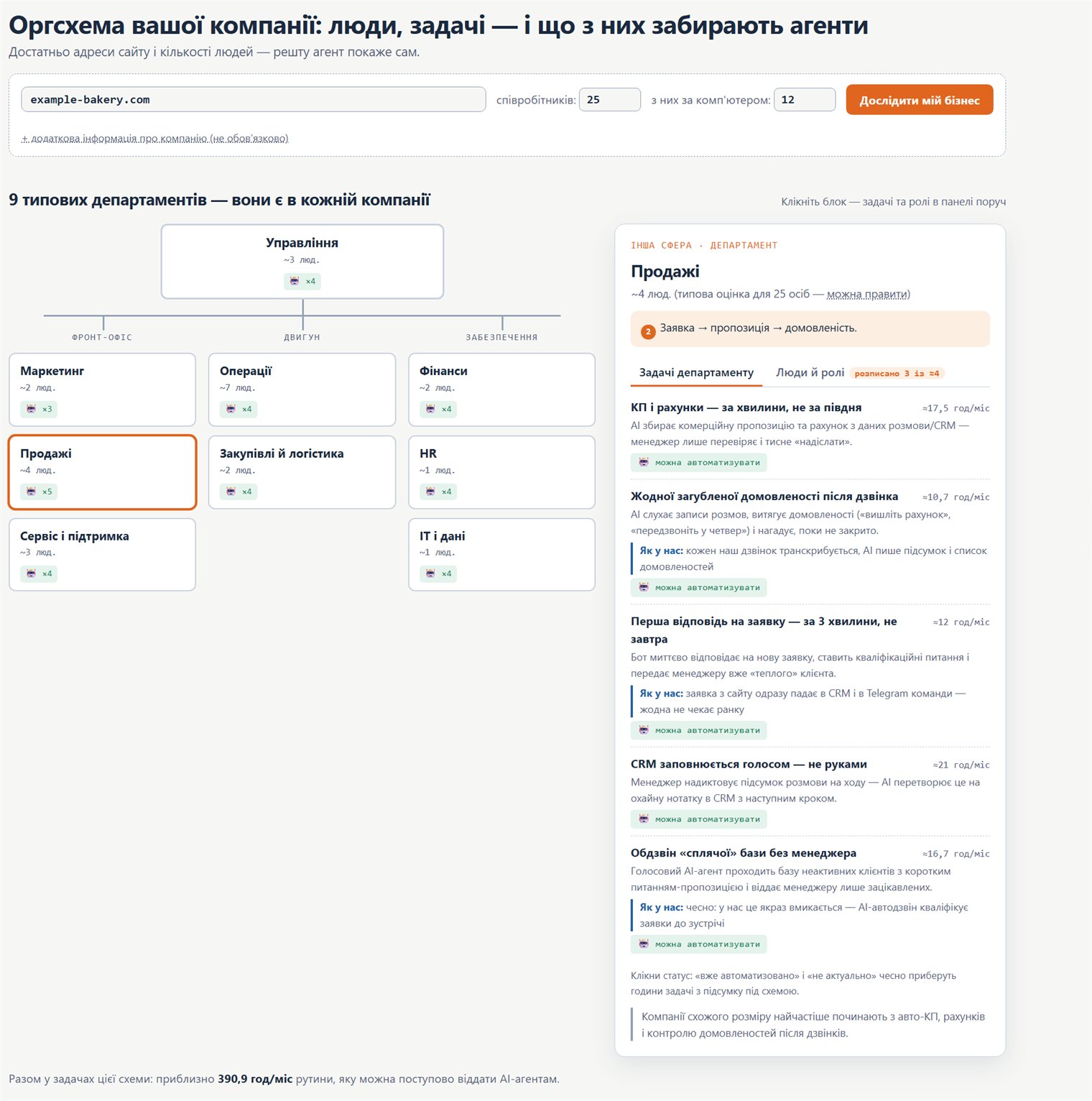
Org chart: how to move your company onto AI
A practical map: which company roles and processes AI agents can take over, where to start, and in what order to roll it out.