Lyria 3.5
At a glance
- Price per 1M tokens (input)
- free
- Price per 1M tokens (output)
- free
- Context
- 131,072 tokens
- Free access
- yes (see below)
Refreshed daily; data verified October 27, 2026. Published September 12, 2026.
Lyria 3.5 by Google is designed for developers and product teams building applications that require coherent, context-aware text generation. It supports tasks such as drafting documents, summarizing content, generating conversational responses, and assisting with code-related writing. What distinguishes Google's approach is the model's integration with the Gemini family's multimodal foundation, enabling consistent behavior across text-only and multimodal workflows while maintaining strong alignment with safety and usability principles.
Specifications & pricing
| Input (per 1M tokens) | free |
|---|---|
| Output (per 1M tokens) | free |
| Context window | 131,072 tokens |
| Max output | 65,536 tokens |
| Capabilities | text |
LiteLLM community dataset (MIT), verified October 27, 2026. Official Google (Gemini) pricing.
What Lyria 3.5 would cost on your workload — run it through the cost calculator →
Where to try Lyria 3.5 for free
- Google (Gemini) offers a free chat — Gemini (free plan). A vendor's free chat may run a different model from the same family — the exact model is not guaranteed.
- 🎁 On our promo-codes page: Gemini for free: access and discounts.
Frequently asked questions
What types of text generation tasks is Lyria 3.5 best suited for?+
Lyria 3.5 performs well in generating clear, structured text for business communication, content drafting, and summarization. It is also effective for creating responses in chat-based interfaces and supporting writing workflows where tone and coherence matter.
How do I begin using Lyria 3.5 in my application?+
Access to Lyria 3.5 is available through Google's AI platform via standard API calls. Users can integrate it using familiar SDKs or REST endpoints, with authentication handled through Google Cloud credentials.
How does Lyria 3.5 differ from other models in the Gemini line?+
Lyria 3.5 is optimized specifically for text generation tasks, offering a balance of quality and efficiency for language-focused use cases. Unlike broader multimodal variants, it focuses on linguistic performance without processing image or audio inputs.
What are the known limitations of Lyria 3.5?+
The model may occasionally produce inaccurate information when dealing with niche or rapidly changing topics. It does not perform real-time data lookup and relies solely on patterns learned during training, so outputs should be reviewed for factual correctness in critical applications.
Compare with others
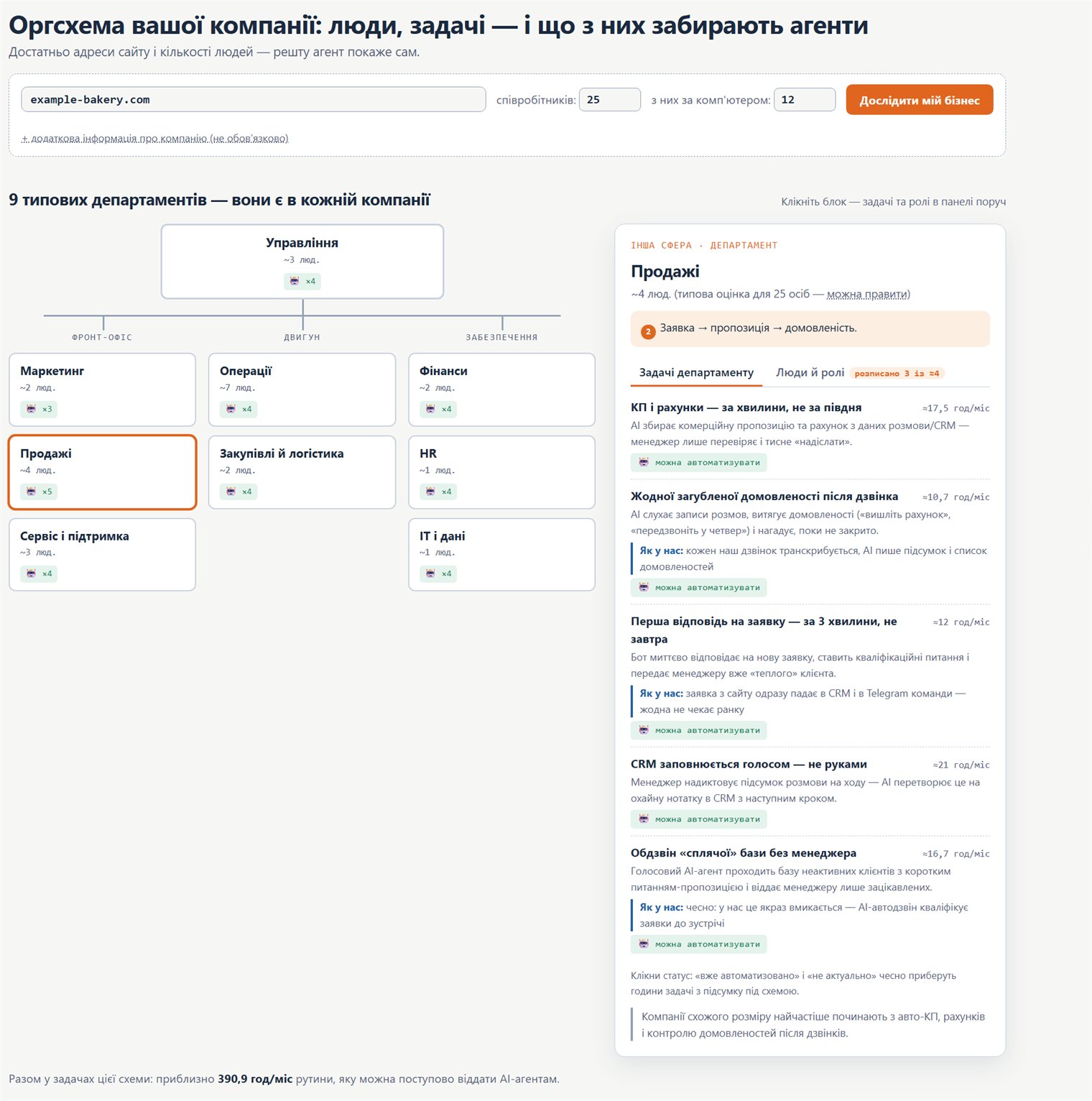
Org chart: how to move your company onto AI
A practical map: which company roles and processes AI agents can take over, where to start, and in what order to roll it out.