Magistral Small
At a glance
- Price per 1M tokens (input)
- $0.15
- Price per 1M tokens (output)
- $0.60
- Context
- 262,144 tokens
- Free access
- yes (see below)
Refreshed daily; data verified September 29, 2026. Published August 12, 2026, last price change September 4, 2026.
Magistral Small is a compact multimodal model from Mistral AI designed for developers and enterprises that need to process images alongside text while maintaining structured decision-making. It suits tasks such as visual document analysis, automated support triage, and workflow automation where the model must both interpret visual input and trigger external actions. The vendor's approach emphasizes efficiency and controllability, pairing a small footprint with explicit reasoning steps and native tool calling, which lets the model invoke APIs or functions without a separate orchestration layer. This makes it a practical choice for teams that want a single model to handle perception, logic, and action in production pipelines, without the overhead of larger systems.
Specifications & pricing
| Input (per 1M tokens) | $0.15 |
|---|---|
| Output (per 1M tokens) | $0.60 |
| Cache read (per 1M tokens) | $0.015 |
| Context window | 262,144 tokens |
| Max output | 262,144 tokens |
| Capabilities | images, tool calling, reasoning |
LiteLLM community dataset (MIT), verified September 29, 2026. Official Mistral AI pricing.
What Magistral Small would cost on your workload — run it through the cost calculator →
Price history
| Date | Input / 1M | Output / 1M |
|---|---|---|
| August 9, 2026 (first record) | $0.50 | $1.50 |
| September 4, 2026 | $0.15 | $0.60 |
Where to try Magistral Small for free
- Mistral AI offers a free chat — Le Chat (free plan). A vendor's free chat may run a different model from the same family — the exact model is not guaranteed.
Frequently asked questions
What is Magistral Small best used for in a business context?+
It is best for tasks that combine visual understanding with structured output, such as extracting data from scanned forms, analyzing screenshots to generate summaries, or routing customer requests based on both image content and text. Its tool calling capability also allows it to trigger downstream systems, like updating a database or sending a notification, directly from the model's output.
How do I get started with Magistral Small?+
You can access it through Mistral's API or via the platform's model catalog. Begin by sending a prompt that includes an image and a text instruction, then test its tool calling by defining a function schema in your request. The model will respond with a structured call if it determines a tool is needed. Review the documentation for examples of image input formatting and function definitions.
How does Magistral Small differ from other models in the Mistral line?+
Compared to larger sibling models, Magistral Small is optimized for lower latency and resource usage while retaining core capabilities like image understanding and step-by-step reasoning. It trades some depth of world knowledge for speed and cost efficiency, making it suitable for high-volume or real-time applications. Unlike text-only models in the line, it natively accepts images, and unlike models without tool calling, it can directly produce function invocations.
What are the main limitations of Magistral Small?+
Its compact size means it may struggle with highly complex reasoning or nuanced visual details that require a larger model's capacity. It is not ideal for tasks needing broad factual knowledge or creative generation. Also, while it supports tool calling, the function definitions must be explicit and well-structured; it may not handle ambiguous or multi-step tool sequences as reliably as more powerful models. For best results, keep prompts and function schemas concise.
Compare with others
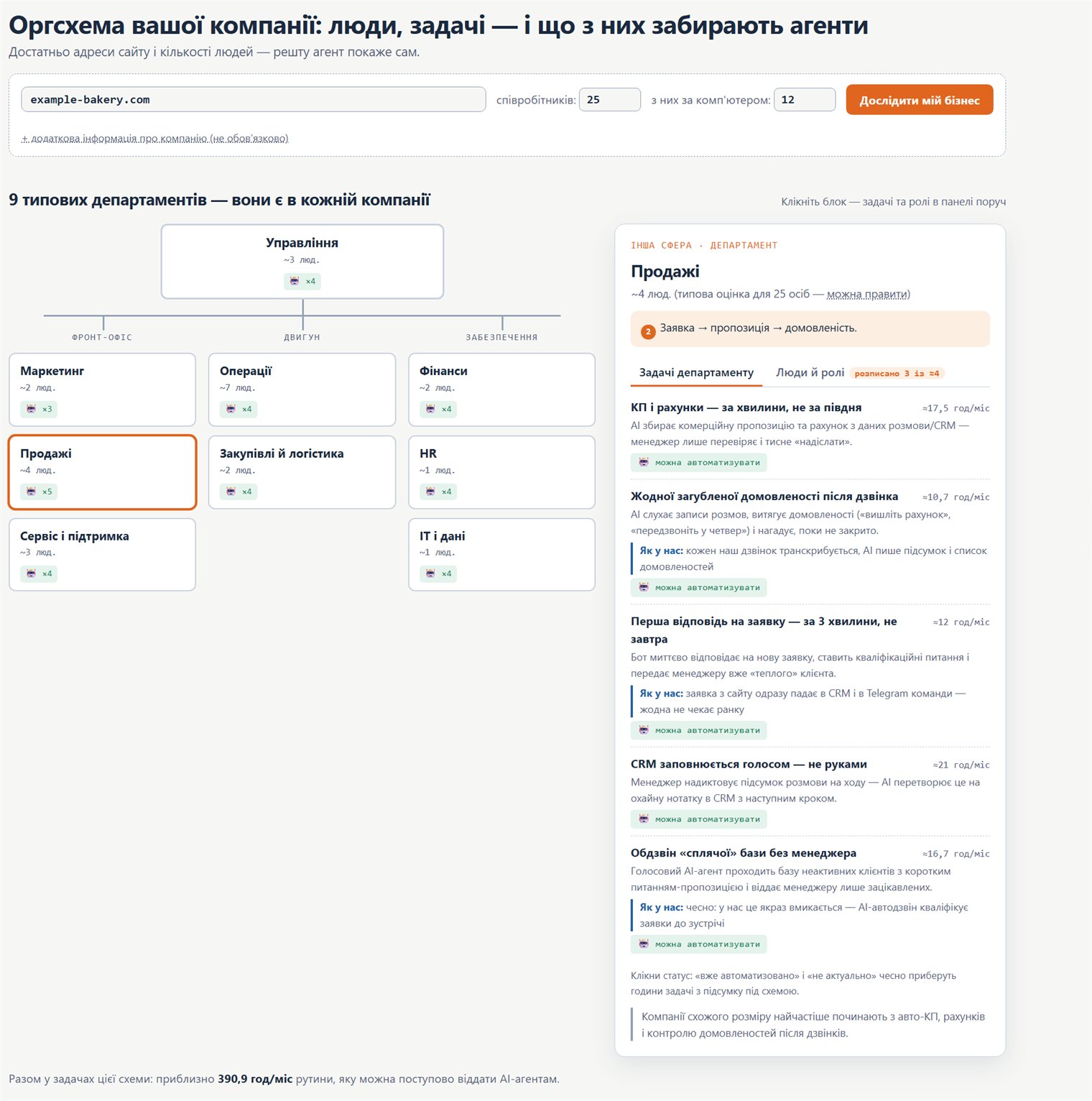
Org chart: how to move your company onto AI
A practical map: which company roles and processes AI agents can take over, where to start, and in what order to roll it out.