Mistral Code Fim
At a glance
- Price per 1M tokens (input)
- $0.30
- Price per 1M tokens (output)
- $0.90
- Context
- 128,000 tokens
- Free access
- yes (see below)
Refreshed daily; data verified October 17, 2026. Published September 2, 2026.
Mistral Code Fim is designed for developers and engineering teams who need to integrate code generation or completion directly into their workflows, with a focus on function-level assistance. It suits tasks like autocompleting boilerplate, generating test stubs, or suggesting implementations within an IDE or CI pipeline. What distinguishes Mistral AI's approach is its emphasis on efficient, lightweight models that prioritize low-latency inference and seamless tool calling, allowing the model to invoke external functions or APIs as part of its output. This makes it a practical choice for building agentic coding assistants where the model must interact with a codebase or development environment rather than just produce static text.
Specifications & pricing
| Input (per 1M tokens) | $0.30 |
|---|---|
| Output (per 1M tokens) | $0.90 |
| Cache read (per 1M tokens) | $0.03 |
| Context window | 128,000 tokens |
| Max output | 128,000 tokens |
| Capabilities | tool calling |
LiteLLM community dataset (MIT), verified October 17, 2026. Official Mistral AI pricing.
What Mistral Code Fim would cost on your workload — run it through the cost calculator →
Where to try Mistral Code Fim for free
- Mistral AI offers a free chat — Le Chat (free plan). A vendor's free chat may run a different model from the same family — the exact model is not guaranteed.
Frequently asked questions
What is this model best used for in a business context?+
It excels at accelerating code authoring and reducing repetitive typing for software teams. You can embed it in internal tools to suggest function implementations, complete partially written code, or generate documentation snippets, all while keeping the model's responses grounded in your existing code structure.
How do I get started with integrating it into my existing stack?+
You can access the model through Mistral AI's API or self-host it using their deployment tools. The key is to set up your environment to pass code context and define the functions you want the model to call. The official documentation provides examples for Python and JavaScript, and you can prototype quickly using their playground before wiring it into your build pipeline.
How does Mistral Code Fim differ from other models in the Mistral line?+
Unlike general-purpose chat models, this variant is specialized for fill-in-the-middle (FIM) tasks—meaning it predicts code between a prefix and suffix—and is optimized for tool calling, so it can output structured calls to external functions. It is not intended for open-ended conversation or broad reasoning; it trades that versatility for higher precision and speed in code-centric workflows.
What are the main limitations I should be aware of?+
The model works best with well-defined, idiomatic code patterns and may struggle with ambiguous or highly domain-specific logic. It does not maintain long-term memory across requests, so you need to provide sufficient context each time. Also, while it supports tool calling, you must define the function schemas clearly, and the model may occasionally produce syntactically valid but logically incorrect calls, so human review is recommended for critical paths.
Compare with others
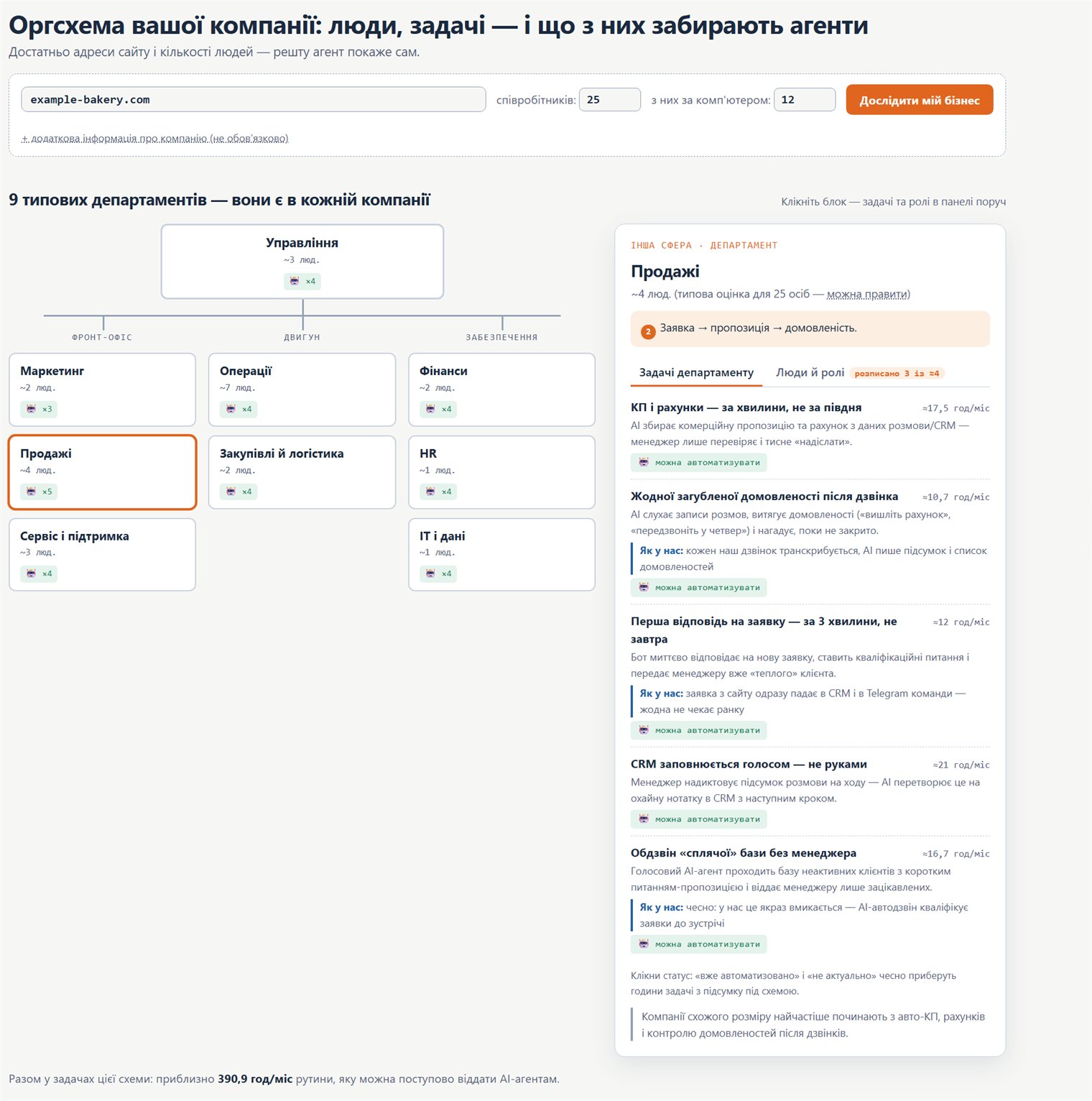
Org chart: how to move your company onto AI
A practical map: which company roles and processes AI agents can take over, where to start, and in what order to roll it out.