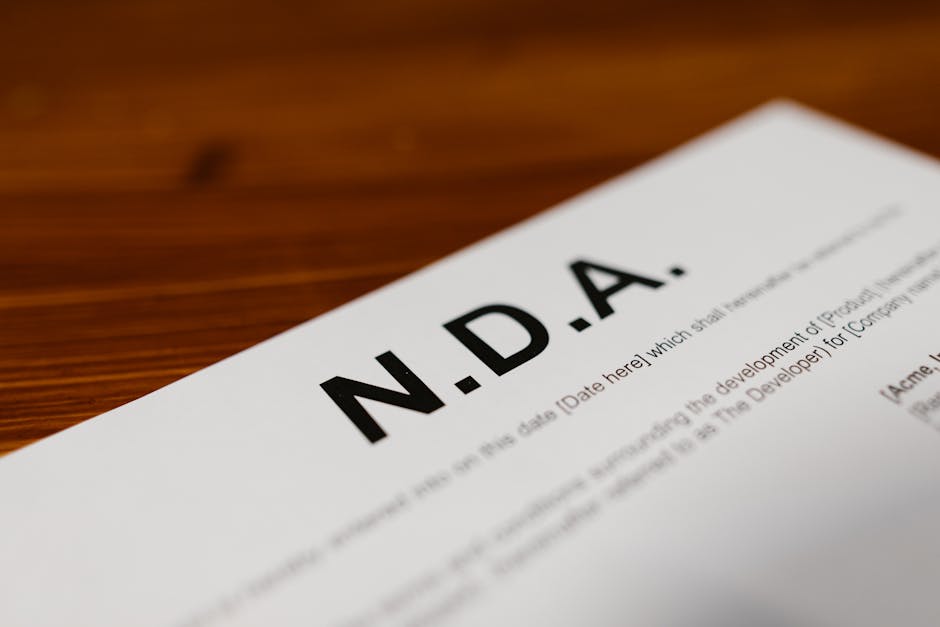
NDA with AI Contractors: Key Clauses for Founders
TL;DR
- •When sharing data with an AI contractor, clearly define the purpose of its use and specific limitations.
- •Explicitly state ownership of developed automations and their underlying code in the agreement to avoid vendor lock-in.
- •Remember that AI contractors may leverage both your data and publicly available models, introducing additional risks.
Integrating AI into your business often means collaborating with external vendors, contractors, or consultants. A critical question arises: how do you protect your data, processes, and intellectual property when handing them over for development? A Non-Disclosure Agreement (NDA) is not merely a formality but a vital safeguard. This article will guide you through the essential clauses to include in such an agreement, ensuring your peace of mind.
Why an NDA is Crucial with an AI Contractor
An NDA (Non-Disclosure Agreement) is designed to protect your company's trade secrets, confidential information, and intellectual property when engaging with third-party vendors. Without one, any information you share with a contractor could be used or disclosed without your consent, potentially causing significant business damage. With AI contractors, this concern is amplified, as they will directly handle your data, which is the 'fuel' for any AI system.
Essential Clauses for Your AI Contractor NDA
A standard NDA is a good starting point, but working with AI technologies requires specific additions. Here are the key aspects to consider.
1. Clear Definition of Confidential Information
Beyond just "information not publicly available," an AI-specific NDA should cover:
- Training Data: This may include client files, sales figures, internal processes, or financial reports. Clearly define what types of data are confidential and what the contractor is permitted to do with them.
- Business Processes and Algorithms: Descriptions of your unique business operations that you intend to automate are also valuable.
- Projects and Ideas: Concepts for new products, services, or strategies you're developing with AI assistance.
- Methodology and Prompts: Even the phrasing of prompts used to interact with AI can hold commercial value.
2. Purpose of Use and Access Limitations
The NDA must clearly state the precise reason for granting the contractor access to confidential information, typically "solely for the performance of services under this agreement." For AI, it's crucial to add:
- Prohibition on Use for Other Clients: Ensure your data will not be used to train models that subsequently serve competitors. This is particularly important if the contractor develops industry-specific solutions.
- Internal Access Restrictions: Specify that only contractor employees directly involved in your project and who have signed similar non-disclosure agreements with their employer may access your data.
3. Ownership of Work Product
This is one of the most critical clauses. Who owns the developed automations, scripts, and trained models?
- Code and Algorithms: Transfer of intellectual property rights for created code (even if AI generated via prompts) is standard practice. You should own everything developed on your behalf.
- Trained Models: If the work results in the creation or fine-tuning of an AI model, you must acquire full rights to it. This protects you from vendor dependence and allows you to transition the solution to another vendor or maintain it with your internal team if needed.
- Source Data: Your data always remains your property. The contractor should only have limited rights to use it, with an obligation to delete it after project completion (see next point).
Definition: An AI model is a computer program or algorithm trained on large datasets to perform specific tasks, such as pattern recognition, natural language processing, or content generation.
4. Term and Return/Destruction of Information
- NDA Term: Typically, an NDA remains in effect during collaboration and for a specified period after its conclusion (e.g., 3-5 years). For highly sensitive data, consider perpetual non-disclosure obligations.
- Data Destruction: Clearly stipulate the contractor's obligation to destroy all copies of your confidential data and provide confirmation (e.g., a certificate of destruction) upon project completion or agreement termination. This includes not only files but also any intermediate copies used for testing or model training.
5. Liability for Breach
- Penalties: Specify concrete penalty amounts for the disclosure of confidential information. This serves as an additional deterrent.
- Damages: In addition to penalties, include the possibility of claiming actual damages if they exceed the penalty amount.
6. Use of Third-Party AI Services and Models
This clause is unique to AI projects. Many contractors use publicly available Large Language Models (LLMs) like ChatGPT, Claude, or services from Google, Microsoft. It's crucial to understand how this impacts your data.
- Prohibition on Using Confidential Data in Public LLMs: If you're sharing sensitive data, ensure the contractor does not 'feed' it into public versions of AI models. This could result in your data becoming part of these models' training and potentially accessible to other users. For example, OpenAI explicitly states that data entered into ChatGPT without using specific API interfaces or enterprise plans may be used for model fine-tuning.
- Requirements for API and Enterprise Versions: If using third-party AI services is necessary, demand that the contractor only uses versions that guarantee data confidentiality and do not use your data for training (e.g., corporate API interfaces with separate data agreements).
- Consent for Third-Party Services: If you permit the use of certain third-party AI services, clearly state this in the NDA and ensure their terms of use align with your confidentiality requirements. For more on data protection in cloud services, you can read "Company Data and Cloud AI Services: What You Can and Cannot Share" (available at:
/uk/blog/dani-kompanii-ai-servisy-shcho-peredavaty).
Definition: An LLM (Large Language Model) is a type of AI trained on vast amounts of text data to understand, generate, and process human language.
Checklist: NDA Clauses for AI Contractors
Here's a concise checklist of what your NDA should include when working with AI contractors:
✅ Clear definition of confidential information: including training data, business processes, prompts. ✅ Purpose of information use: exclusively for project execution, prohibition on use for other clients. ✅ Access limitations: who within the contractor's team has access, and their signing of similar obligations. ✅ Ownership of results: all developed automations, code, and trained models are your property. ✅ NDA term: during collaboration and after its completion (preferably 3-5 years or perpetually). ✅ Data return/destruction terms: a clear mechanism and confirmation of destruction after project completion. ✅ Liability for breach: penalties and compensation for actual damages. ✅ Restrictions on third-party AI service use: prohibition on public LLM use for sensitive data, API version requirements. ✅ Defined roles and responsibilities: who on your side controls access, who on the contractor's side ensures compliance. ✅ Audit mechanism: the ability to verify the contractor's compliance with confidentiality terms.
What if the Contractor Refuses to Sign a Detailed NDA?
If an AI contractor balks at key clauses or proposes an overly generic NDA, it's a red flag. A reputable company that values its reputation and client data security understands the importance of such agreements. In such cases, you should either find another vendor or reconsider the scope of data you are willing to provide. It might be more prudent to train your internal team first rather than outsource sensitive data.
How this works on our side: We understand that data is a company's most valuable asset. That's why our corporate program ensures that all automations are built using your tools, and both the code and solutions remain your company's property. For sensitive processes, training sessions utilize test or anonymized data. We are also prepared to sign an NDA upon request. Learn more on our page: https://course.aiadvisoryboard.me/corporate?utm_source=blog&utm_medium=article_body&utm_campaign=corporate
FAQ
Can a standard NDA be used for AI contractors?
Yes, but it's risky. A standard NDA may not account for the specifics of using data for AI model training or intellectual property rights for AI-generated solutions. It's best to augment it with the clauses mentioned above.
What constitutes intellectual property in the context of AI solutions?
In AI, this can include AI-generated code, unique prompts, custom AI models (e.g., fine-tuned on your data), and the commercial value of the data used for training itself.
How can I verify that the contractor has indeed deleted my data?
While 100% verification is challenging, you can demand written confirmation (a certificate of destruction). If risks are high, consider including a clause in the agreement granting you the right to audit the contractor's infrastructure. This adds a layer of accountability.
Do I need an NDA if I only use public AI tools?
If you use public AI tools (e.g., ChatGPT without an enterprise plan) for internal data, an NDA with a contractor won't protect you from the privacy policies of the service itself. In this case, it's more crucial to have an internal company policy on AI use that restricts entering sensitive information into such services.
Conclusion
An NDA for working with AI contractors is not just paperwork; it's a vital tool for protecting your business. Pay close attention to ownership of results, data usage limitations, and mechanisms for data destruction. If you're just considering AI adoption, start with a free 30-minute diagnostic consultation where we can analyze a real-world task for your company.
Read with AI
Open this article in your assistant — it will summarize it and help apply it to your company.
Show the prompt
Read the article https://aiadvisoryboard.me/blog/nda-ai-pidryadniki-shcho-propyasaty-dogovor.md and summarize the key points. Then ask me about my company (industry, team size, what takes the most time) and explain which ideas from the article apply to us and where to start.
The AI board discusses this article
This is a product demo by AI Advisory Board. AI-generated, not professional advice.
This week, draft a one-page NDA checklist based on the article: include items like defining confidential data (training data, prompts, processes), purpose limitation, ownership of code and models, data destruction terms, and third-party LLM restrictions. Share it with your legal or ops lead to review and adapt for your next AI vendor discussion.
Start by updating your NDA template to include explicit clauses: define confidential information as training data, business processes, and prompts; restrict contractor use to your project only; mandate ownership of all code, scripts, and trained models; require data destruction with certification upon completion; and prohibit use of public LLMs for your sensitive data—insist on enterprise/API versions with data confidentiality guarantees.

Implements AI agents in companies and teaches founders and their teams to work with them — through courses and corporate programs.
This article was prepared with AI assistance, based on Yaroslav Maxymovych's methodology and materials. Spotted an inaccuracy — let us know via the form below.
Your company's first 3 AI automations — in 2 weeks
A corporate AI-transition program: 4 live sessions with your team plus a video course for every employee. Up to 20 people for one fixed price. If it doesn't work — money back.
New case studies on AI adoption — in your inbox
Once a week: practical breakdowns of what companies automate with AI and what actually comes out of it.
No spam. Unsubscribe anytime.
Related Articles

Signs Your AI Adoption Is Going Off Track: Early Diagnosis for Founders
Spot when your AI project is veering off course and what to do early. Practical tips and a checklist for fast diagnosis.
Read more
Signs of a Corporate AI Program That Leaves Real Results Behind
How to know if AI training will leave lasting results in your company? Signs that a program leaves working automations inside the company: employee ownership, real-data execution, IP retention, and…
Read more
The True Cost of AI Subscriptions Per Employee: Hidden Expenses and Real Value
Many founders assume AI adoption simply means buying subscriptions. However, the real cost of integrating AI tools like ChatGPT or Copilot extends far beyond direct licensing fees. Hidden expenses…
Read more