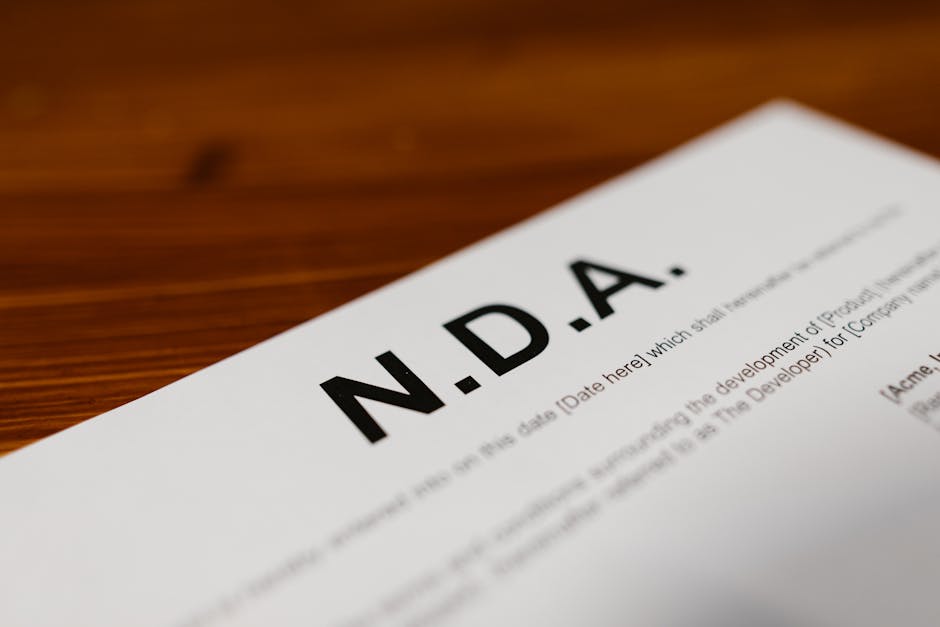
NDA with AI Contractors: What to Include in the Agreement Before Work Starts
TL;DR
- •Ensure the NDA clearly defines what information is considered confidential and how the AI contractor may handle it.
- •Explicitly state ownership of data and intellectual property created during collaboration and any resulting intellectual property.
- •Establish liability for breaches and the process for resolving disputes.
Implementing AI solutions in your company often requires bringing in external specialists. These could be consultants, developers, or providers of ready-made tools. This raises a pressing question: how do you protect trade secrets, confidential information, and avoid risks tied to data transfer or ownership of created automations? A properly drafted non-disclosure agreement (NDA) is your first and most important step.
Why a Standard NDA May Not Be Enough for AI Projects
A standard NDA used for other contractors may overlook nuances specific to artificial intelligence. AI tools, especially generative models, process large volumes of data, learn from them, and may potentially reproduce your confidential information in other projects or leak it to third parties. If the agreement lacks special provisions, this creates gaps in your business protection.
Definition: NDA (Non-Disclosure Agreement) — a legal contract in which parties agree not to disclose certain information received during collaboration to third parties.
What Risks Arise When Working with AI Contractors?
The primary risk is the leakage or unauthorized use of your data. If the AI contractor uses publicly available AI models to work with your information, there is a chance that this data becomes part of the model's training and could later be used in responses to other users. There is also a risk of losing control over intellectual property created with AI if the contract terms are unclear.
What Must an NDA with an AI Contractor Include?
An NDA with an AI contractor needs to be significantly more detailed than a standard agreement. Here are the key points to focus on:
1. Clear Definition of Confidential Information
Simply stating "all data transferred to the contractor" is insufficient. It's crucial to detail exactly what counts as confidential: trade secrets, client personal data, financial metrics, technological developments, business processes, algorithms, input data for AI training, and AI model outputs. Also specify data formats (text, images, code, databases, etc.).
2. Usage Restrictions on Confidential Information
Specify that the contractor may use your data solely to perform tasks outlined in the technical specification or agreement. Prohibit using the data to train their own AI models, for other projects, or sharing it with third parties unless separately agreed. Especially important: clarify whether using the data to improve general-purpose AI services (e.g., OpenAI, Anthropic, Google) is permitted.
3. Data Access and Storage Rules
- Who has access: Limit the circle of contractor personnel who may access confidential information. Require these individuals to also sign the NDA or be bound by its terms.
- Where data is stored: Define which servers or cloud storage will hold your data. Mandatorily specify the geographic location of these storage systems and the security requirements they must meet.
- Security measures: State minimum data security requirements: encryption, two-factor authentication, regular security audits.
4. Ownership of Created Intellectual Property
This is one of the most critical points when working with AI contractors. Clearly define who owns the intellectual property created using AI tools: the AI code itself, automations, or new algorithms developed based on your data. In most cases, the business owner should seek full ownership of all work results to avoid dependency on the contractor. Learn more in our article «Contractor Code Ownership: How to Protect Your Automation».
5. Procedure for Data Return and Destruction
After collaboration ends or the agreement is terminated, the contractor must be obligated to return all confidential data received from you or securely destroy it. Document the destruction verification procedure (e.g., a written certificate). This applies not only to original data but also to all copies, backups, and derivative materials.
6. Liability for Breach
The NDA must contain clear provisions on liability for violating confidentiality. These may include financial penalties, compensation for damages, or the possibility of legal prosecution. Penalty amounts should be sufficient to incentivize contractor compliance.
7. Termination of Cooperation and NDA Duration
Define the conditions and procedure for terminating cooperation. Also specify the NDA's term. Often it is made perpetual or limited to 3–5 years after the main agreement ends, especially for highly sensitive information.
Checklist: Before Signing an NDA with an AI Contractor
Verify that your agreement accounts for the following:
- ✅ Clear definition of confidential information, including data for AI and AI work results.
- ✅ Data usage restricted exclusively to project purposes, without training third-party AI models.
- ✅ Access, storage, and security rules for your data (encryption, server location).
- ✅ Full ownership of created AI code, automations, and other intellectual property.
- ✅ Procedure for returning and verifying data destruction after collaboration ends.
- ✅ Clear financial penalties and liability for confidentiality breaches.
- ✅ NDA term covering long-term risks.
How This Works on Our Side: We understand that for a company owner, the top priority is retaining control over data and intellectual property. In our corporate program, each participant receives a recorded video course and technical assignment templates. The code and created automations belong to the company, run on its tools, with no dependency on the contractor. Before launch, we can sign an NDA for sensitive processes. Learn more at https://course.aiadvisoryboard.me/corporate?utm_source=blog&utm_medium=article_body&utm_campaign=corporate
FAQ
Do I Need to Sign an NDA Separately with Each AI Specialist?
If you're working with a contractor company, signing one NDA with the legal entity is sufficient. However, it's important that the agreement requires the contractor to bind its employees to the same terms. If you hire a freelancer, you should sign an NDA directly with them.
How Can I Verify That an AI Contractor Is Complying with the NDA?
This is a complex question. Reputable providers and contractors have transparent data usage policies and security audits. You can build in the right to conduct audits or require reports on data usage and destruction. However, full guarantees are difficult to give, so choosing a reliable partner is critically important.
Can I Use My Own NDA Templates?
Yes, you can use your own NDA templates, but you must consult a lawyer specializing in intellectual property and data to adapt the document to AI-specific work. This helps account for risks tied to new technologies and protects your interests.
Conclusion
Protecting your data and intellectual property when working with AI contractors is not a formality — it's a business necessity. A thoroughly crafted NDA becomes a reliable shield against potential risks. Start by auditing your needs and be sure to involve lawyers to adapt the agreement to the unique demands of AI projects. The first step toward safe AI implementation is a free 30-minute consultation-diagnostic where you can discuss your specific case.
Read with AI
Open this article in your assistant — it will summarize it and help apply it to your company.
Show the prompt
Read the article https://aiadvisoryboard.me/blog/nda-with-ai-contractors-what-to-include-in.md and summarize the key points. Then ask me about my company (industry, team size, what takes the most time) and explain which ideas from the article apply to us and where to start.

Implements AI agents in companies and teaches founders and their teams to work with them — through courses and corporate programs.
This article was prepared with AI assistance, based on Yaroslav Maxymovych's methodology and materials. Spotted an inaccuracy — let us know via the form below.
Your company's first 3 AI automations — in 2 weeks
A corporate AI-transition program: 4 live sessions with your team plus a video course for every employee. Up to 20 people for one fixed price. If it doesn't work — money back.
AI adoption resources — one email
Leave your email to receive a welcome email with blog resources. There is no regular newsletter at present
No spam. Unsubscribe anytime.
Related Articles

Signs of a corporate AI program that actually leaves results in your company
How to recognize a corporate AI program that leaves real results in your company: an owner’s checklist, selection criteria, and automation examples.
Read more
AI experiment didn't work: why it happened and how to fix it
An analysis of why a company AI experiment produced no results, and step-by-step: what a business owner should do next to avoid wasting budget.
Read more
AI in Marketing for a Three-Person Team: First Steps and What to Delegate
How a marketing team of three can start using AI without technical skills: first automations, what to delegate, how to measure impact, and avoid wasting budget.
Read more