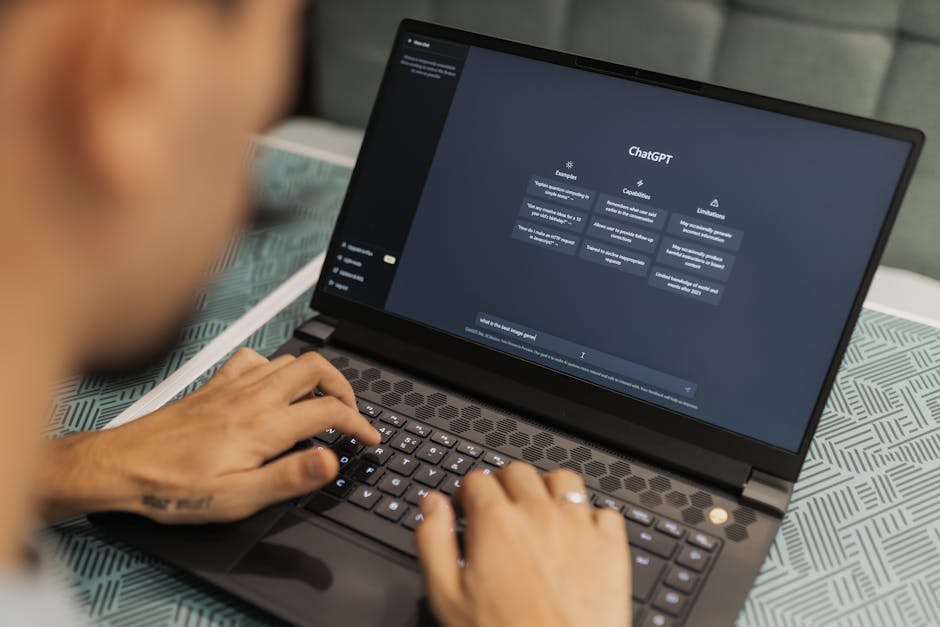
Company Data Security with ChatGPT: Protect Your Sensitive Information
TL;DR
- •Risks are Real:** Accidental data leaks can cost your company its reputation and money, so clear rules aren't bureaucracy, but a necessity.
- •Educate, Don't Forbid:** A complete ban on AI tools is ineffective; it's better to train your team on safe usage and establish transparent policies.
- •Start with Policy:** Develop clear guidelines on what can and cannot be uploaded to AI, how to do it correctly, and then train everyone.
Integrating Artificial Intelligence (AI) into daily operations opens new opportunities but also introduces risks, especially concerning data confidentiality. A business owner's biggest fear is the accidental leak of critical information by employees using ChatGPT or other public AI tools. How can you set up your team to maximize AI benefits while minimizing risks?
Why Data Might Leak and Who is Responsible?
The responsibility for data always rests with the business owner. Even if an employee accidentally "leaks" information, the penalties and reputational damage fall on the company. Data leaks can occur for several reasons:
- Lack of Awareness: Employees may simply not realize that certain information is confidential or that it shouldn't be uploaded to public AI.
- Carelessness: Sometimes, due to haste or inattention, an individual might copy an entire document into ChatGPT without removing sensitive data.
- Lack of Clear Instructions: If the company doesn't have a clear policy on AI usage, everyone acts on their own discretion.
- Use of "Shadow" AI: Employees might use unauthorized AI tools not controlled by the company and without proper non-disclosure agreements.
Definition: ChatGPT is a large language model (LLM) developed by OpenAI. It can generate text, answer questions, translate languages, and perform many other tasks related to natural language processing.
What Data Should Not Be Trusted to Public AI Services?
This forms the foundation of your security policy. Include everything that could harm your company, its clients, or partners:
- Personal Data: Names, addresses, phone numbers, email addresses, passport data of clients, employees, partners. It's especially crucial to protect financial and medical data.
- Trade Secrets: Information about new products, technologies, business plans, marketing strategies, price lists, product costs, negotiation details.
- Financial Information: Data on income, expenses, bank accounts, financial reports of the company or its clients.
- Intellectual Property: Code, technical drawings, unique developments, patents, trademarks that are not yet registered or are a competitive advantage.
- Legal Documents: Draft contracts, lawsuits, internal legal opinions, NDAs (non-disclosure agreements) containing confidential terms.
- Security Data: Information about internal networks, security systems, passwords, access keys, vulnerabilities.
Technical Solutions and Organizational Measures
Rules alone are not enough; tools and continuous monitoring are necessary.
1. AI Usage Policy
This is your core document. It must be clear, understandable, and mandatory for everyone. Here's what to include:
- Allowed and Forbidden: Create a list of data types that are strictly prohibited from being uploaded to external AI, and supplement it with examples. Clearly define which tasks can be solved using ChatGPT and which cannot.
- Anonymization: Require employees to anonymize data before uploading it. This means removing any information that could identify an individual or company (names, company names, account numbers, unique identifiers).
- Use of Corporate Accounts: Encourage, or better yet, require the use of corporate accounts for accessing paid AI services. This allows you to control subscriptions and access.
- Accountability: Clearly outline the consequences of policy violations – from warnings to termination, depending on the severity of the leak.
- Regular Review: The policy is not static. AI technologies evolve rapidly, so review and update the document at least once a year.
2. Training and Awareness
The best protection is a well-informed employee. Train continuously, not just once a year:
- Mandatory Training: All employees working with AI must undergo data security training. Conduct refresher training every six months.
- Case Studies and Examples: Provide real-world examples of data leaks (without revealing company names) and their consequences. This helps better understand the risks.
- Memos and Reminders: Place short memos at workstations, on the corporate network, in email signatures. A link to the full policy should always be readily available.
- Knowledge Testing: Periodically test employee knowledge using quizzes or mini-case studies.
3. Technical Control Measures
Technology can help you implement and enforce your security policy:
- Data Loss Prevention (DLP) Systems: This software monitors outbound traffic and blocks the transfer of confidential data outside the corporate network. For example, DLP can block copying documents with keywords like "confidential" or "contract" into a web form.
- Access Control: Restrict access to certain AI services or features for employees who don't need them for their work.
- Corporate AI Solutions: Consider using enterprise versions of AI services (e.g., ChatGPT Enterprise, Microsoft Copilot), which offer enhanced security, non-disclosure guarantees, and the ability to work with data within your infrastructure (if stated by the provider).
- On-premise AI Models: For highly sensitive tasks, consider deploying your own AI models on local servers or in a private cloud environment. This is more expensive and complex but provides complete control over data.
- Usage Audit: Maintain logs of AI tool usage, if technically permissible and not violating legislation. This helps identify potential problems.
Definition: Data Loss Prevention (DLP) is a set of tools and processes designed to prevent the leakage or loss of confidential data. DLP systems detect, monitor, and block the transfer of sensitive information outside the organization.
Checklist: How to Implement an AI Security Policy
Here's a step-by-step plan to help you protect your company's data:
- Step 1: Risk Assessment (Week 1)
- Identify which data is critically important to your company.
- Analyze which departments and employees have access to this data.
- Understand which AI tools are already in use (both officially and "shadow"). ✅
- Step 2: AI Policy Development (Week 2)
- Create a working group (IT, legal, management). ✅
- Develop a draft AI usage policy with clear rules, permissions, and prohibitions. ✅
- Include clauses on data anonymization and accountability. ✅
- Step 3: Legal Review and Approval (Week 3)
- Conduct a legal review of the policy. ✅
- Approve the policy at the company management level. ✅
- Step 4: Team Training (Week 4-5)
- Conduct mandatory training for all employees. ✅
- Distribute memos and short instructions. ✅
- Ensure employees sign off on acknowledging the policy. ✅
- Step 5: Technical Implementation (Within a month)
- Install and configure DLP systems (if appropriate for your business). ✅
- Restrict access to unauthorized AI services or monitor their use. ✅
- Consider transitioning to corporate versions of AI tools. ✅
- Step 6: Monitoring and Updates (Ongoing)
- Regularly review and update the policy (at least once a year). ✅
- Conduct periodic audits of AI tool usage. ✅
- Gather feedback from the team to improve the policy. ✅
How this works on our side: We understand the importance of data protection. In our programs, sensitive tasks use test or anonymized data, and NDAs can be signed upon request. The code and automations created are the property of the company and run on its tools, minimizing vendor lock-in risks. Start with a free consultation to discuss secure AI implementation in your company: https://course.aiadvisoryboard.me/corporate?utm_source=blog&utm_medium=article_body&utm_campaign=corporate
FAQ
Can I completely ban ChatGPT usage in my company?
Outright banning ChatGPT and other AI tools rarely works effectively. Employees will still find ways to use them, but "in the shadows," creating even greater data security risks. It's better to train your team on safe and responsible usage.
What is data anonymization and how is it done?
Anonymization is the process of removing or modifying data in such a way that it can no longer be linked to a specific individual or company. This can include replacing names with pseudonyms, removing addresses, phone numbers, and unique identifiers. For example, instead of "John Doe, client #123 from Kyiv," you would write "Client A, user B from region C."
Does an NDA protect against leaks via AI?
An NDA (Non-Disclosure Agreement) protects you from intentional disclosure of information, but not from an accidental "leak" of data by an employee into a public AI. While an NDA is an important legal tool, it does not replace internal security policies and team training.
Are paid versions of ChatGPT more secure?
Paid versions, such as ChatGPT Enterprise, typically offer better terms regarding data confidentiality. OpenAI states that Enterprise customer data is not used to train their models by default. However, this doesn't mean you can upload absolutely any information – always adhere to your company's internal policy and reasonable precautions.
What are the risks if a company doesn't implement an AI usage policy?
Without a policy, a company faces high risks of confidential information leaks, loss of intellectual property, non-compliance with legal requirements (e.g., GDPR or personal data protection laws), as well as reputational and financial damages. The absence of clear rules leads to chaos and unpredictable consequences.
Conclusion
Protecting data when using AI tools is not a one-time task but an ongoing process. It requires a combination of clear policies, continuous team training, and the smart use of technical safeguards. Start by developing clear rules, educate your employees, and you'll be able to leverage all the benefits of AI while minimizing risks. Your first step could be a free 30-minute consultation-diagnostic where we'll analyze one of your real-world tasks and assess risks, so you understand where to begin.
Read with AI
Open this article in your assistant — it will summarize it and help apply it to your company.
Show the prompt
Read the article https://aiadvisoryboard.me/blog/zahyst-danyh-chatgpt-pravyla-komandy.md and summarize the key points. Then ask me about my company (industry, team size, what takes the most time) and explain which ideas from the article apply to us and where to start.
The AI board discusses this article
This is a product demo by AI Advisory Board. AI-generated, not professional advice.
Start by running a one-week audit of current AI tool usage across departments to identify shadow usage and high-risk data types. Document findings to prioritize policy scope and training focus. This baseline enables targeted policy creation and measures reduction in risky uploads after implementation.
This week, step 1: Identify all critical company data. Then, map which departments and employees access it. Simultaneously, list all AI tools currently in use, both official and unofficial ('shadow AI'). This forms our baseline for policy development next week.
To ensure our team adopts these AI practices successfully, we'll establish a dedicated working group, including IT and management, to draft our AI usage policy within two weeks. This group will define specific data types that are strictly prohibited from public AI, alongside clear examples of safe anonymization techniques.
The pillar guide for "Ризики і заперечення (засновник)" linking every article in this cluster.

Implements AI agents in companies and teaches founders and their teams to work with them — through courses and corporate programs.
This article was prepared with AI assistance, based on Yaroslav Maxymovych's methodology and materials. Spotted an inaccuracy — let us know via the form below.
Your company's first 3 AI automations — in 2 weeks
A corporate AI-transition program: 4 live sessions with your team plus a video course for every employee. Up to 20 people for one fixed price. If it doesn't work — money back.
New case studies on AI adoption — in your inbox
Once a week: practical breakdowns of what companies automate with AI and what actually comes out of it.
No spam. Unsubscribe anytime.
Related Articles

AI in Marketing for a Three-Person Team: First Steps and What to Delegate
How a marketing team of three can start using AI without technical skills: first automations, what to delegate, how to measure impact, and avoid wasting budget.
Read more
10 Questions to Ask an AI Training Provider Before Paying
Avoid wasting money on training that delivers no results. Specific questions about guarantee, code ownership, priorities, and support to evaluate the offer as a founder.
Read more
Signs Your Company’s AI Implementation Is Going Off Track: Early Diagnosis
How to tell if your company’s AI rollout is off course: 5 early warning signs founders see and what to do about each one.
Read more