Claude Fable 5.2
At a glance
- Price per 1M tokens (input)
- $8.00
- Price per 1M tokens (output)
- $40.00
- Context
- 1,000,000 tokens
- Free access
- yes (see below)
Refreshed daily; data verified November 16, 2026. Published November 11, 2026.
Claude Fable 5.2 by Anthropic is a large language model built for teams that need reliable language processing combined with visual input and structured actions. It suits document review, visual analysis, workflow automation, and multi-step problem solving. The model can interpret images, use tool calling to connect with external functions, and apply step-by-step reasoning to break down complex tasks. Anthropic's approach centers on safety research and alignment techniques designed to make model behavior more predictable and steerable.
Specifications & pricing
| Input (per 1M tokens) | $8.00 |
|---|---|
| Output (per 1M tokens) | $40.00 |
| Cache read (per 1M tokens) | $0.20 |
| Cache write (per 1M tokens) | $10.00 |
| Context window | 1,000,000 tokens |
| Max output | 128,000 tokens |
| Capabilities | images, tool calling, reasoning |
LiteLLM community dataset (MIT), verified November 16, 2026. Official Anthropic pricing.
What Claude Fable 5.2 would cost on your workload — run it through the cost calculator →
Where to try Claude Fable 5.2 for free
- Anthropic offers a free chat — Claude (free plan). A vendor's free chat may run a different model from the same family — the exact model is not guaranteed.
- 🎁 On our promo-codes page: Claude Code Guest Pass — a community invite.
Frequently asked questions
What is this model good for?+
It is suited for reading and summarizing documents, interpreting charts and photographs, connecting to business software through tool calling, and working through multi-step reasoning tasks such as policy review or troubleshooting guides.
How do I get started?+
Access the model through Anthropic's platform or supported partners, then send text and image inputs through the API. For tool calling, define the functions your application can perform and pass them with the request so the model can select the right one.
How does it differ from sibling models in the line?+
This version adds image understanding alongside text processing, while sibling models may focus on text-only tasks or different trade-offs between speed and depth. The exact balance depends on the specific model in the family.
What are its limitations?+
It cannot take actions in the physical world, its knowledge reflects its training data rather than live information unless tools are provided, and image interpretation can miss fine details or context. Tool calling also requires your own infrastructure to execute the functions it requests.
Compare with others
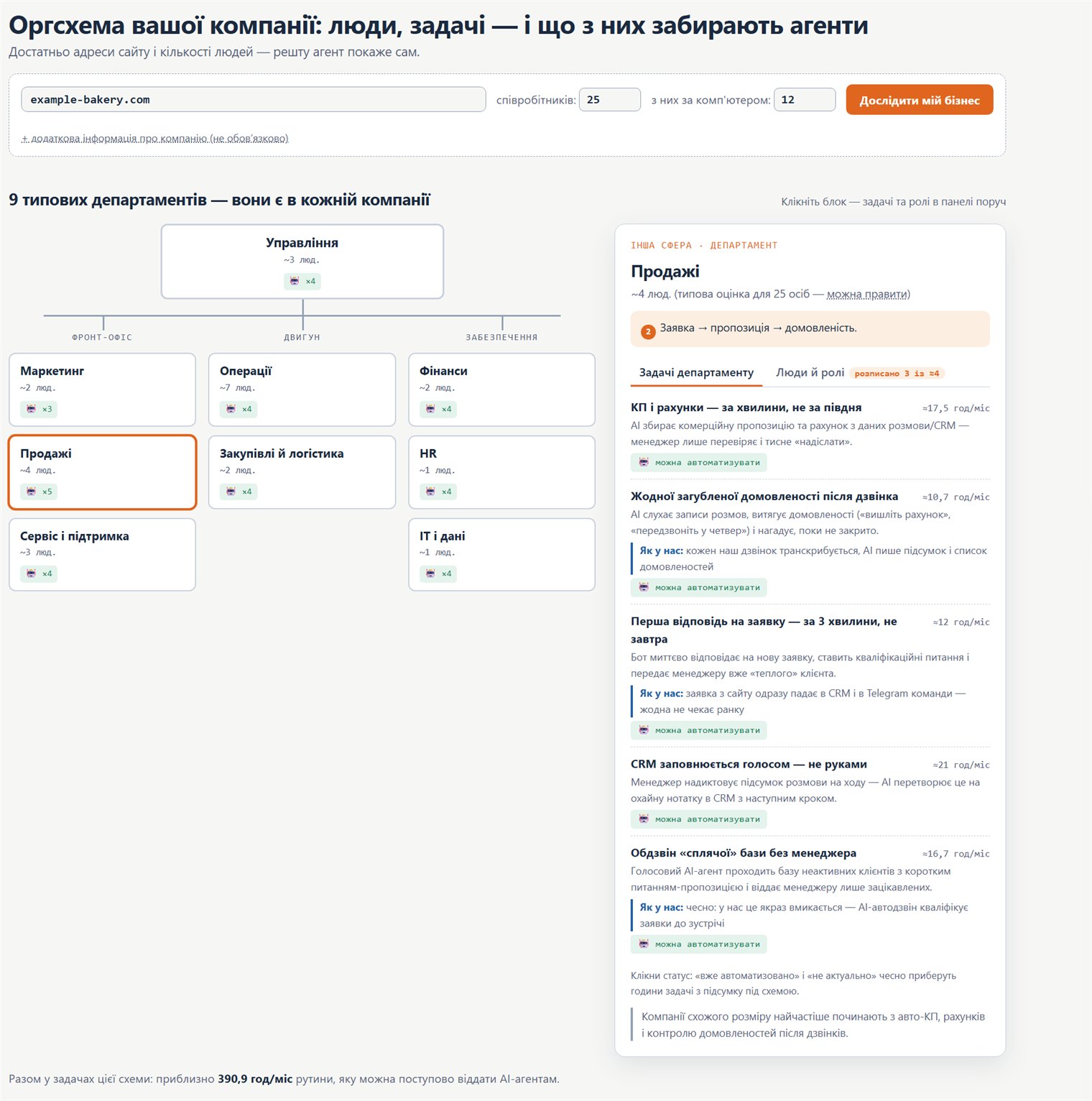
Org chart: how to move your company onto AI
A practical map: which company roles and processes AI agents can take over, where to start, and in what order to roll it out.