Claude Sonnet 5.5
At a glance
- Price per 1M tokens (input)
- $2.00
- Price per 1M tokens (output)
- $10.00
- Context
- 1,000,000 tokens
- Free access
- yes (see below)
Refreshed daily; data verified September 30, 2026. Published September 30, 2026.
Claude Sonnet 5.5 by Anthropic is designed for professionals who need a model that can interpret visual inputs, execute external functions through tool calling, and perform multi-step logical reasoning. It suits tasks such as analyzing diagrams or screenshots to extract structured data, automating workflows by invoking APIs or scripts based on context, and solving complex problems that require breaking down objectives into sequential steps. Anthropic’s approach emphasizes alignment and safety through constitutional AI techniques, aiming to produce reliable outputs that adhere to specified constraints without requiring extensive prompt engineering.
Specifications & pricing
| Input (per 1M tokens) | $2.00 |
|---|---|
| Output (per 1M tokens) | $10.00 |
| Cache read (per 1M tokens) | $0.20 |
| Cache write (per 1M tokens) | $2.50 |
| Context window | 1,000,000 tokens |
| Max output | 128,000 tokens |
| Capabilities | images, tool calling, reasoning |
LiteLLM community dataset (MIT), verified September 30, 2026. Official Anthropic pricing.
What Claude Sonnet 5.5 would cost on your workload — run it through the cost calculator →
Where to try Claude Sonnet 5.5 for free
- Anthropic offers a free chat — Claude (free plan). A vendor's free chat may run a different model from the same family — the exact model is not guaranteed.
- 🎁 On our promo-codes page: Claude Code Guest Pass — a community invite.
Frequently asked questions
What types of tasks benefit most from the image understanding capability in Claude Sonnet 5.5?+
Tasks that involve interpreting visual information such as reading text from images, understanding chart data, identifying objects in diagrams, or extracting meaning from screenshots benefit from this capability. It allows the model to process inputs where visual context is essential for accurate response generation.
How does tool calling work in this model, and when should it be used?+
Tool calling enables the model to invoke external functions or APIs when needed to perform actions beyond text generation, such as querying a database or triggering a workflow. It is useful when the task requires real-time data access or interaction with software systems, allowing the model to act as an agent in a broader process.
How does Claude Sonnet 5.5 differ from other models in the Claude series?+
Compared to other variants in the Claude lineup, Sonnet 5.5 balances reasoning depth with responsiveness, offering stronger performance on multi-step tasks and tool use than lighter models while avoiding the higher computational load of the most advanced tiers. It is positioned for applications requiring both precision and efficiency.
What are the current limitations users should be aware of when deploying this model?+
The model may occasionally misinterpret ambiguous visual inputs or fail to select the correct tool in complex routing scenarios. It also depends on the clarity of the prompt and the availability of well-defined tools for function calling. Users should validate outputs in high-stakes applications and provide clear instructions for tool use.
Compare with others
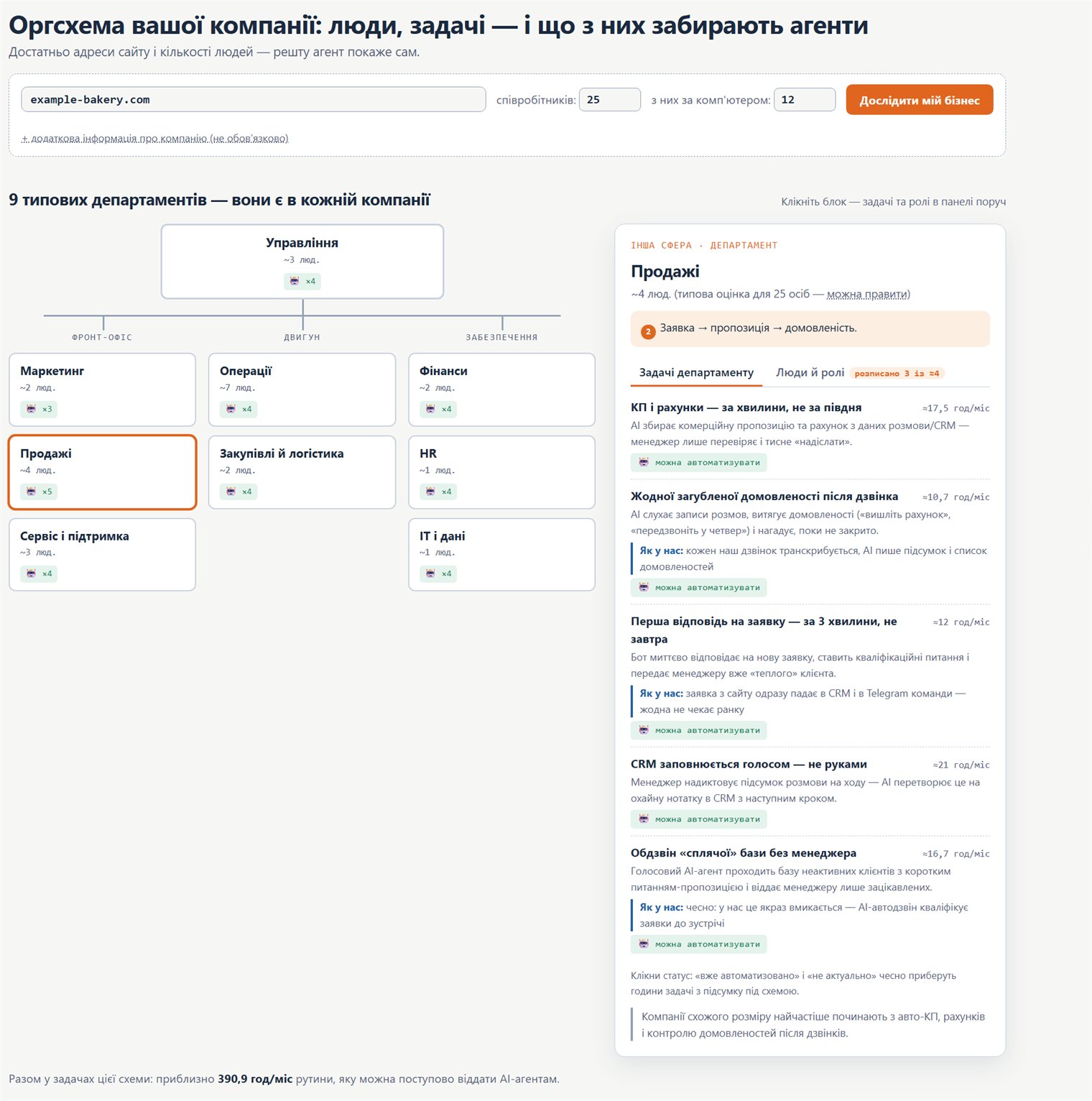
Org chart: how to move your company onto AI
A practical map: which company roles and processes AI agents can take over, where to start, and in what order to roll it out.