Claude Mythos 5.1
At a glance
- Price per 1M tokens (input)
- $10.00
- Price per 1M tokens (output)
- $50.00
- Context
- 1,000,000 tokens
- Free access
- yes (see below)
Refreshed daily; data verified October 22, 2026. Published September 7, 2026.
Claude Mythos 5.1 is designed for enterprise teams needing reliable multimodal reasoning in production environments. It excels at tasks that require interpreting visual inputs alongside textual analysis, such as document understanding, workflow automation with external systems, and complex decision chains where intermediate reasoning steps must be verifiable. Anthropic’s approach emphasizes constitutional AI principles to improve alignment and reduce harmful outputs without sacrificing performance on structured reasoning tasks. This makes the model suitable for regulated industries where traceability and safety are as important as capability.
Specifications & pricing
| Input (per 1M tokens) | $10.00 |
|---|---|
| Output (per 1M tokens) | $50.00 |
| Cache read (per 1M tokens) | $0.25 |
| Cache write (per 1M tokens) | $12.50 |
| Context window | 1,000,000 tokens |
| Max output | 128,000 tokens |
| Capabilities | images, tool calling, reasoning |
LiteLLM community dataset (MIT), verified October 22, 2026. Official Anthropic pricing.
What Claude Mythos 5.1 would cost on your workload — run it through the cost calculator →
Where to try Claude Mythos 5.1 for free
- Anthropic offers a free chat — Claude (free plan). A vendor's free chat may run a different model from the same family — the exact model is not guaranteed.
- 🎁 On our promo-codes page: Claude Code Guest Pass — a community invite.
Frequently asked questions
What types of tasks is Claude Mythos 5.1 best suited for?+
It is well suited for applications involving image understanding combined with logical reasoning, such as analyzing scanned forms, interpreting diagrams for technical support, or guiding robotic process automation through visual cues. Its tool calling ability allows it to interact with APIs, databases, or software interfaces to retrieve data or execute actions as part of a reasoned workflow. This makes it effective for multi-step business processes where both perception and action are required.
How does one get started with using Claude Mythos 5.1 in a business setting?+
Access is typically provided through Anthropic’s API platform, where users can integrate the model into existing applications using standard REST or SDK interfaces. Developers begin by defining the tools the model can call — such as a CRM lookup or image processor — and specifying the desired behavior through prompts that encourage step-by-step reasoning. Testing with real-world inputs helps validate performance before scaling to production use.
How does Claude Mythos 5.1 differ from other models in the Claude series?+
While sharing the core architecture and safety training of its siblings, Mythos 5.1 places stronger emphasis on multimodal integration and reliable tool use in complex sequences. It is optimized not just for understanding images but for reasoning about them in context — for example, using visual data to inform a decision that triggers an external action. Other models may prioritize speed or pure language fluency, whereas this variant balances perception, reasoning, and execution.
What are the current limitations of Claude Mythos 5.1 that users should be aware of?+
The model may occasionally misinterpret ambiguous or low-quality images, particularly when fine details are critical to the reasoning outcome. Tool calling depends on the correct formatting and availability of external systems; failures in those systems can interrupt the reasoning chain. Additionally, while designed to avoid harmful outputs, it is not infallible, and oversight is recommended in high-stakes applications where errors could lead to operational or compliance risks.
Compare with others
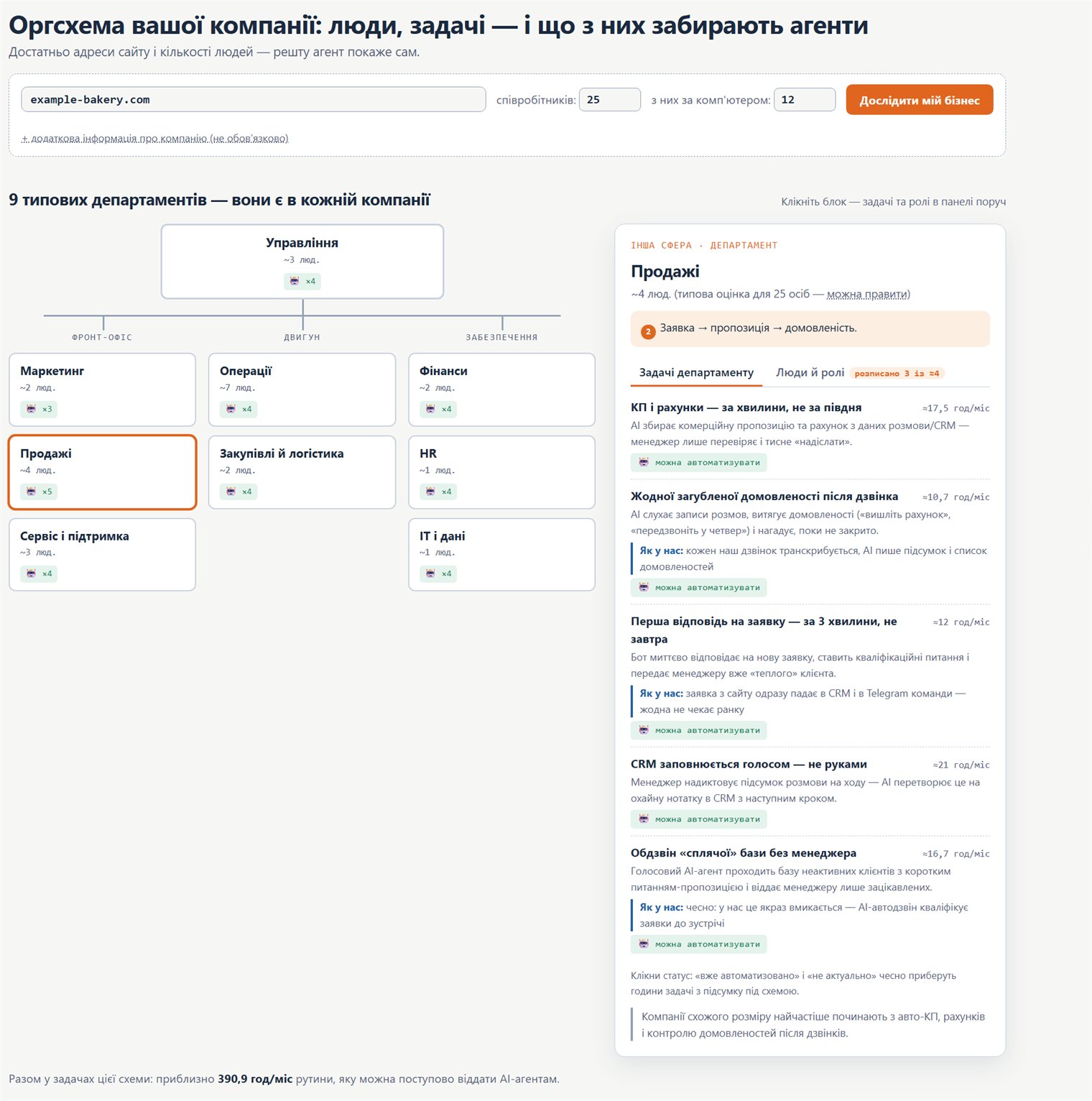
Org chart: how to move your company onto AI
A practical map: which company roles and processes AI agents can take over, where to start, and in what order to roll it out.