Claude Opus 4.1
At a glance
- Price per 1M tokens (input)
- $15.00
- Price per 1M tokens (output)
- $75.00
- Context
- 200,000 tokens
- Free access
- yes (see below)
Refreshed daily; data verified September 29, 2026. Published August 12, 2026.
Claude Opus 4.1 is aimed at enterprises and developers who need reliable multimodal assistance across text and visual inputs. It excels at tasks such as document analysis with embedded images, complex workflow automation through tool calling (function calling), and transparent reasoning that can be broken down step by step. Anthropic’s approach centers on safety‑first training and interpretable response generation, which distinguishes it from other large language models that prioritize raw scale. The model’s ability to invoke external functions enables seamless integration with existing business systems while maintaining a consistent conversational experience.
Specifications & pricing
| Input (per 1M tokens) | $15.00 |
|---|---|
| Output (per 1M tokens) | $75.00 |
| Cache read (per 1M tokens) | $1.50 |
| Cache write (per 1M tokens) | $18.75 |
| Context window | 200,000 tokens |
| Max output | 32,000 tokens |
| Capabilities | images, tool calling, reasoning |
LiteLLM community dataset (MIT), verified September 22, 2026. Official Anthropic pricing.
What Claude Opus 4.1 would cost on your workload — run it through the cost calculator →
Where to try Claude Opus 4.1 for free
- Anthropic offers a free chat — Claude (free plan). A vendor's free chat may run a different model from the same family — the exact model is not guaranteed.
- 🎁 On our promo-codes page: Claude Code Guest Pass — a community invite.
Frequently asked questions
What kinds of business problems is Claude Opus 4.1 best suited for?+
It is well suited for scenarios that combine visual data with textual analysis, such as processing scanned contracts, reviewing product photos, and orchestrating automated actions by calling external services.
How do I start using the model in my applications?+
Begin by accessing the provider’s API, supplying a prompt that may include image data, and optionally specifying the functions you want the model to invoke; the response will include a structured call that you can execute.
How does Claude Opus 4.1 differ from the other Claude models in the same family?+
Compared with the smaller sibling, it offers multimodal perception and more sophisticated tool calling, while the larger sibling focuses on maximum language depth without visual input; the trade‑off is in response latency and resource usage.
What limitations should I be aware of?+
The model may produce plausible‑sounding answers that require verification, it cannot access real‑time external data beyond the functions you expose, and its visual understanding is limited to image formats supported by the API.
Comparisons
Compare with others
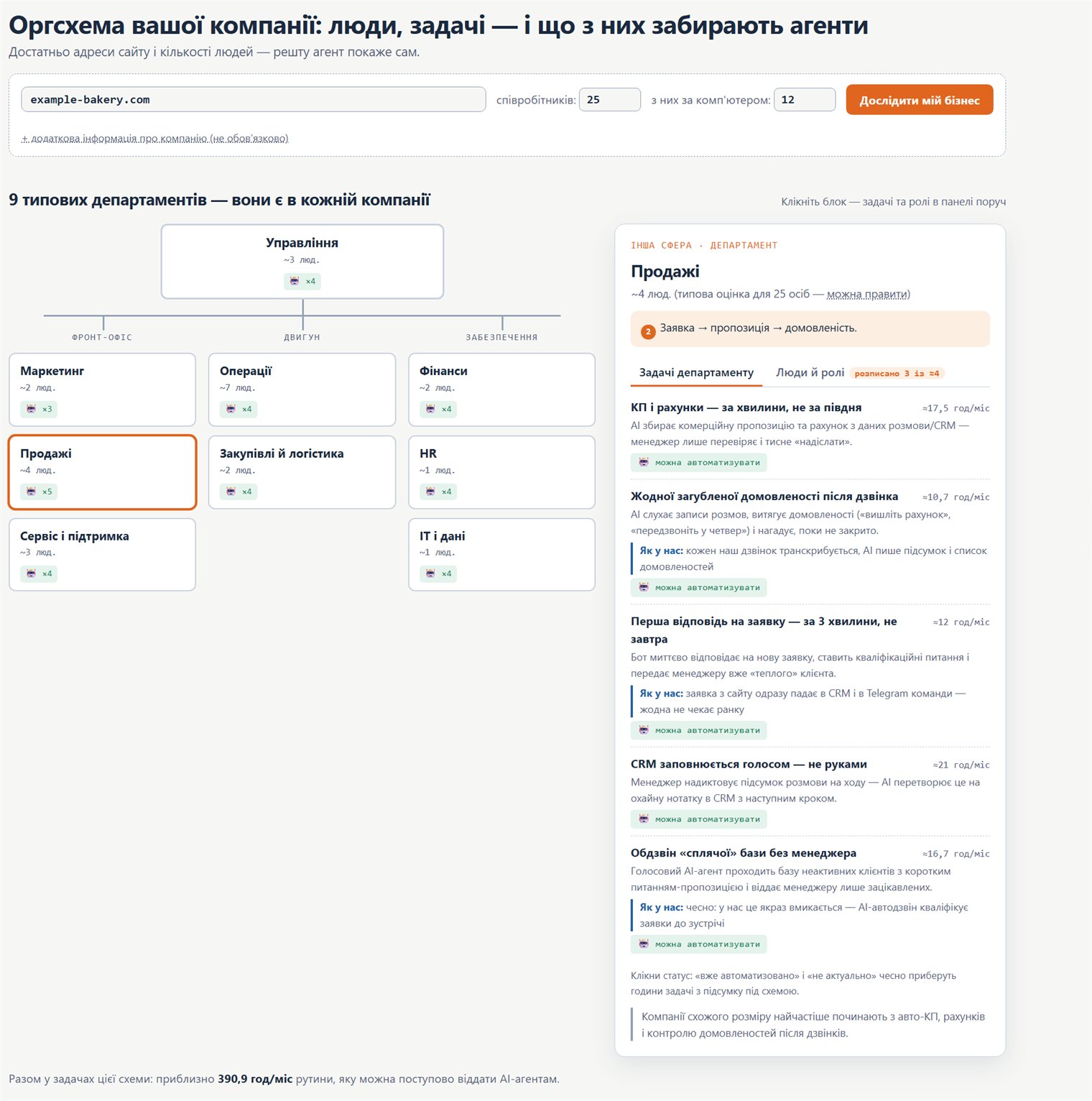
Org chart: how to move your company onto AI
A practical map: which company roles and processes AI agents can take over, where to start, and in what order to roll it out.