GPT-4.1 Mini
At a glance
- Price per 1M tokens (input)
- $0.40
- Price per 1M tokens (output)
- $1.60
- Context
- 1,047,576 tokens
- Free access
- yes (see below)
Refreshed daily; data verified September 30, 2026. Published August 12, 2026.
GPT-4.1 Mini by OpenAI is a compact multimodal model designed for developers and businesses that need reliable image understanding and tool calling—the ability to let the model invoke external functions or APIs—without the overhead of a larger system. It suits production workflows like document analysis, visual data extraction, and automated agent pipelines where speed and cost-efficiency matter more than exhaustive reasoning depth. OpenAI's approach here emphasizes practical utility: the model balances competence with operational simplicity, making it a sensible default for teams that want to integrate AI into existing software with minimal friction. Its strengths are most visible in structured tasks where the model can act as a coordinator between user input, visual content, and backend services.
Specifications & pricing
| Input (per 1M tokens) | $0.40 |
|---|---|
| Output (per 1M tokens) | $1.60 |
| Cache read (per 1M tokens) | $0.10 |
| Context window | 1,047,576 tokens |
| Max output | 32,768 tokens |
| Capabilities | images, tool calling |
LiteLLM community dataset (MIT), verified September 30, 2026. Official OpenAI pricing.
What GPT-4.1 Mini would cost on your workload — run it through the cost calculator →
Where to try GPT-4.1 Mini for free
- OpenAI offers a free chat — ChatGPT (free plan). A vendor's free chat may run a different model from the same family — the exact model is not guaranteed.
Frequently asked questions
What is this model best used for in a business context?+
It is best for tasks that combine visual input with structured actions, such as extracting information from screenshots or scanned documents, classifying images, or powering chatbots that need to look up data from a database or trigger a workflow via tool calling. It is a strong fit for high-volume, repetitive operations where you want consistent output and low latency.
How do I get started with integrating it into my application?+
You access it through OpenAI's API, using the same authentication and request format as their other models. You can send text and image inputs in a single request, and for tool calling you define functions in your code that the model can choose to invoke. Start with a small pilot project, test its output quality on your specific data, then scale up gradually.
How does it differ from the larger models in the GPT-4.1 family?+
The Mini variant is designed to be leaner and faster, making it more suitable for real-time or high-throughput applications where response speed and computational efficiency are priorities. It trades some depth of reasoning and creative nuance for that efficiency, so it may struggle with very complex multi-step logic or ambiguous prompts. The larger siblings offer more headroom for sophisticated analysis but come with higher operational demands.
What are its main limitations I should plan for?+
It can misinterpret low-quality images or images with dense, overlapping text, so you should preprocess visual inputs when possible. Its tool calling works best when you provide clear, well-scoped function definitions; vague instructions lead to unreliable calls. It also has a shorter effective working memory for long conversations, so you may need to summarize or restructure context in extended sessions.
Compare with others
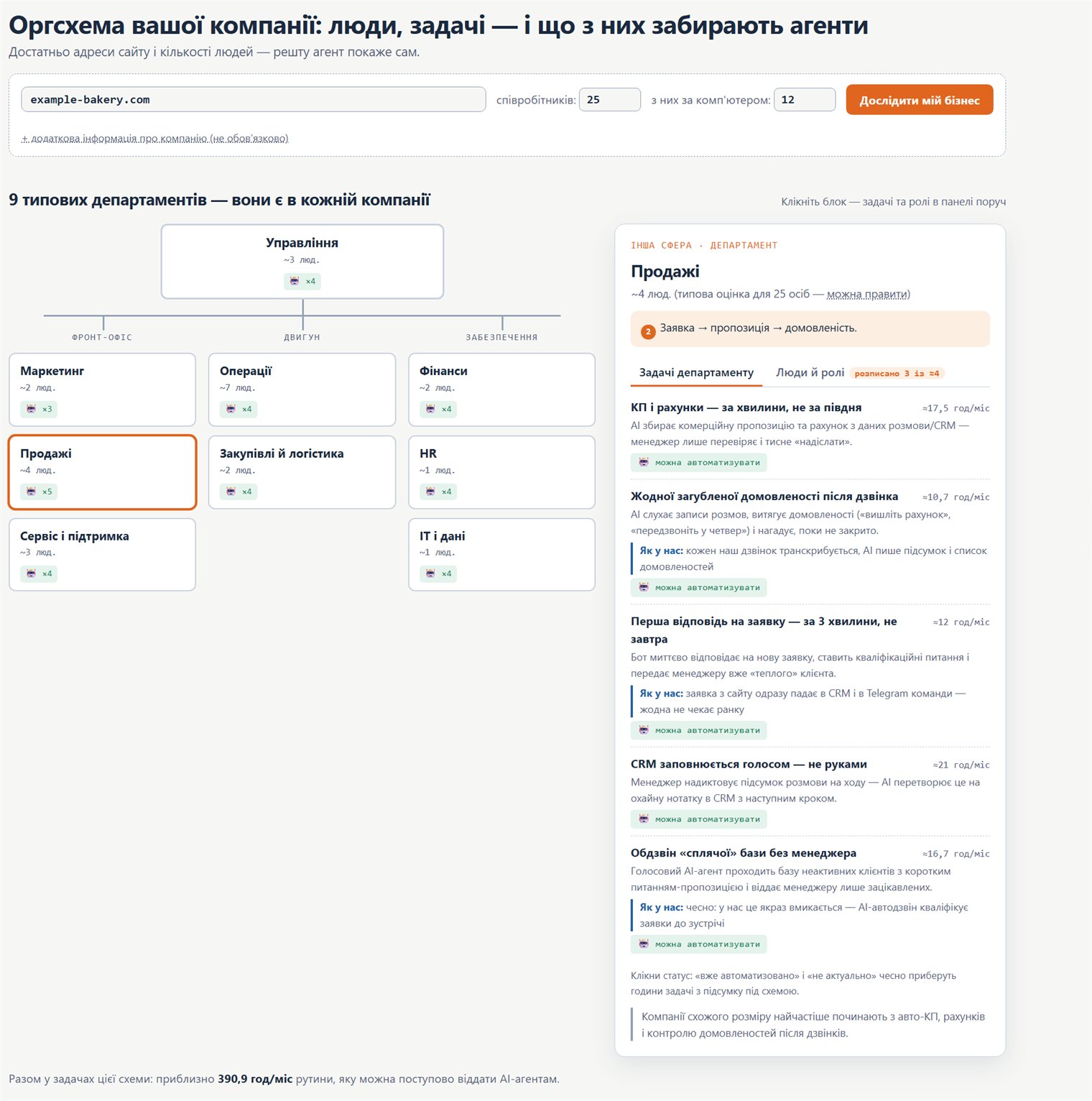
Org chart: how to move your company onto AI
A practical map: which company roles and processes AI agents can take over, where to start, and in what order to roll it out.