GPT-4.1 Nano
At a glance
- Price per 1M tokens (input)
- $0.10
- Price per 1M tokens (output)
- $0.40
- Context
- 1,047,576 tokens
- Free access
- yes (see below)
Refreshed daily; data verified September 30, 2026. Published August 12, 2026.
GPT-4.1 Nano is a lightweight, cost-efficient model from OpenAI designed for developers and businesses that need fast, reliable language processing without the overhead of larger systems. It suits high-volume tasks such as classification, extraction, summarization, and routing, where speed and simplicity matter more than deep reasoning. The model supports image understanding and tool calling, which lets it read visual inputs and invoke external functions or APIs in a structured way. What distinguishes OpenAI's approach here is the emphasis on a compact architecture that maintains strong instruction-following and reliability while reducing latency and operational complexity. This makes it a practical choice for production pipelines and edge-adjacent applications that require consistent, low-friction inference.
Specifications & pricing
| Input (per 1M tokens) | $0.10 |
|---|---|
| Output (per 1M tokens) | $0.40 |
| Cache read (per 1M tokens) | $0.025 |
| Context window | 1,047,576 tokens |
| Max output | 32,768 tokens |
| Capabilities | images, tool calling |
LiteLLM community dataset (MIT), verified September 30, 2026. Official OpenAI pricing.
What GPT-4.1 Nano would cost on your workload — run it through the cost calculator →
Where to try GPT-4.1 Nano for free
- OpenAI offers a free chat — ChatGPT (free plan). A vendor's free chat may run a different model from the same family — the exact model is not guaranteed.
Frequently asked questions
What is this model best used for?+
It is best for high-frequency, narrow-scope tasks like tagging, categorizing text, extracting structured data from documents or images, and building simple conversational flows. Its speed and efficiency make it a strong fit for real-time or batch systems where you need dependable output without the computational overhead of larger models.
How do I get started with it?+
You can access it through OpenAI's API by selecting the model identifier in your existing integration. If you are new, start by testing a few sample prompts that match your use case, then gradually increase complexity. The API supports standard chat completions, and you can enable tool calling by defining functions in your request schema, which the model will invoke when appropriate.
How does it differ from the other models in the GPT-4.1 line?+
The line is designed to cover a spectrum of performance and resource needs. The larger siblings offer deeper reasoning and broader knowledge, which helps with complex analytical tasks and long-form generation. This Nano variant trades some of that depth for greater speed and lower operational cost, so it is better suited to straightforward, repetitive jobs where consistency and quick turnaround are priorities.
What are its main limitations?+
It has a smaller capacity for nuanced reasoning, so it may struggle with multi-step logic, creative writing, or tasks requiring extensive background knowledge. While it can understand images, its visual interpretation is less detailed than that of larger models. Also, because it is optimized for efficiency, it can be sensitive to prompt phrasing, so you may need to iterate on instructions to get reliable results for edge cases.
Compare with others
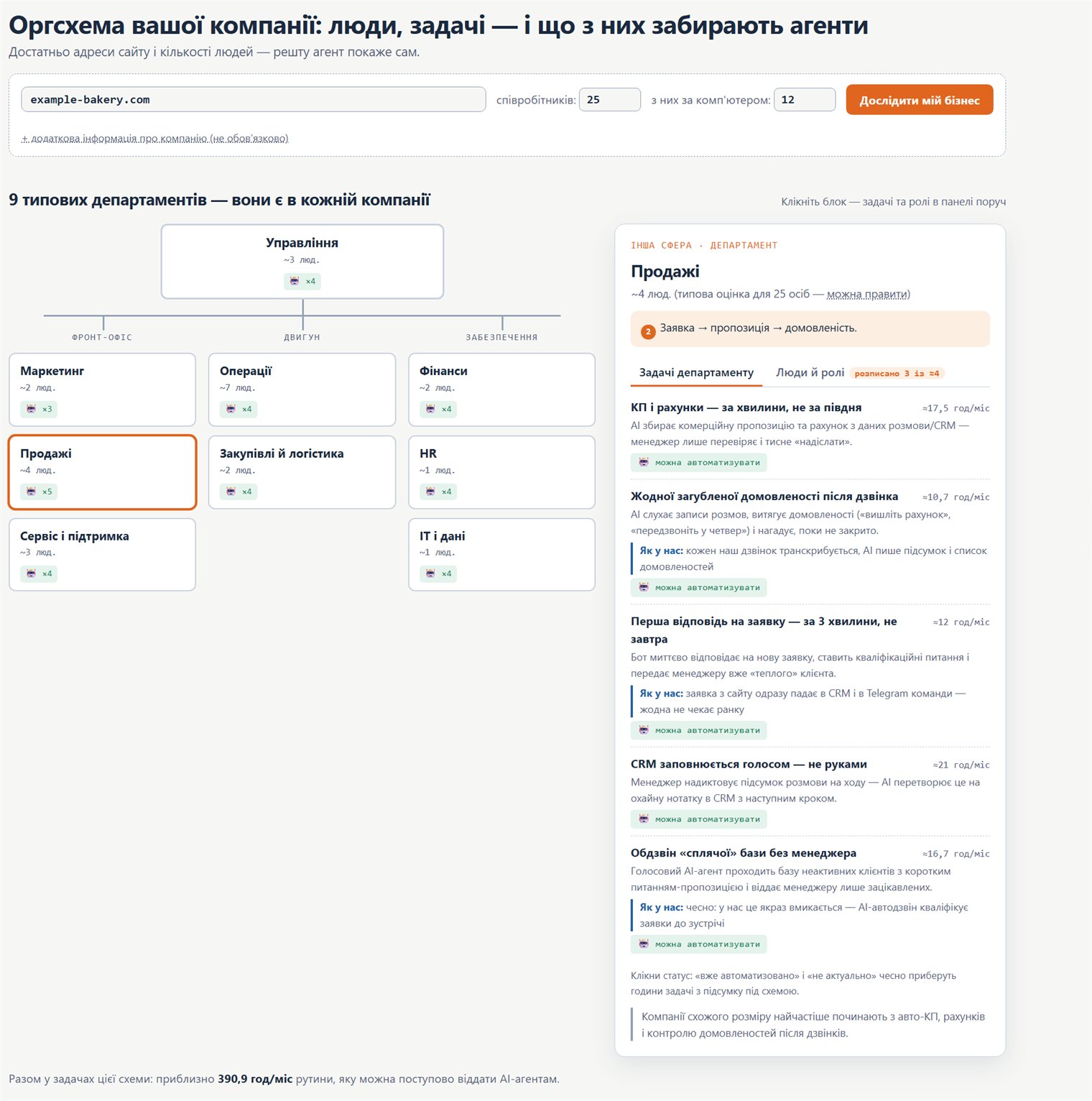
Org chart: how to move your company onto AI
A practical map: which company roles and processes AI agents can take over, where to start, and in what order to roll it out.