Grok 4.20 Multi Agent 0309
At a glance
- Price per 1M tokens (input)
- $1.25
- Price per 1M tokens (output)
- $2.50
- Context
- 1,000,000 tokens
- Free access
- yes (see below)
Refreshed daily; data verified September 29, 2026. Published August 12, 2026.
Grok 4.20 Multi Agent 0309 is built for enterprise teams that need a model capable of parsing complex visual inputs, orchestrating external software actions, and explaining its reasoning step by step. It suits tasks like document analysis with embedded charts, automated workflow execution via tool calling, and audit-friendly decision support where transparency matters. xAI's approach emphasizes a multi-agent architecture, meaning the model internally decomposes a request into subtasks handled by specialized components, which improves reliability on multi-step problems. This makes it a practical choice for operations, research, and engineering teams that require both perception and action in a single pipeline.
Specifications & pricing
| Input (per 1M tokens) | $1.25 |
|---|---|
| Output (per 1M tokens) | $2.50 |
| Cache read (per 1M tokens) | $0.20 |
| Context window | 1,000,000 tokens |
| Max output | 1,000,000 tokens |
| Capabilities | images, tool calling, reasoning |
LiteLLM community dataset (MIT), verified August 27, 2026. Official xAI pricing.
What Grok 4.20 Multi Agent 0309 would cost on your workload — run it through the cost calculator →
Where to try Grok 4.20 Multi Agent 0309 for free
- xAI offers a free chat — Grok (limited free access). A vendor's free chat may run a different model from the same family — the exact model is not guaranteed.
Frequently asked questions
What is this model best used for in a business context?+
It is ideal for tasks that combine visual data with executable steps, such as reviewing scanned contracts, extracting figures from diagrams, and then triggering follow-up actions in your CRM or database. It also handles complex reasoning chains, like debugging a supply chain bottleneck by analyzing shipment photos and querying inventory systems. For teams that need a single model to see, think, and act, this reduces the need to stitch together separate vision and automation tools.
How do I get started with integrating this model into my existing stack?+
You access it via the standard API endpoint, where you can send image inputs alongside text prompts and define custom functions for the model to call. Start by testing with a small set of representative images and a few tool definitions, then iterate on your prompts to align with your workflow. The model supports both synchronous and streaming responses, so you can integrate it into real-time dashboards or batch processing pipelines without changing your infrastructure.
How does this model differ from other Grok models in the same family?+
The key difference is the multi-agent reasoning layer, which is not present in the simpler single-pass models. While sibling models may handle text or vision alone, this version explicitly decomposes complex requests into sub-tasks, verifies intermediate results, and then composes a final answer with tool outputs. That makes it slower per request but far more accurate for multi-step problems, whereas lighter models are better for low-latency, single-shot queries.
What are the practical limitations I should plan for?+
The main limitation is that it requires well-defined tool schemas; if your external functions are vague or poorly documented, the model may call them incorrectly. It also has a higher computational cost per request due to the multi-agent loop, so it is not suited for high-volume, trivial classification tasks. Finally, while it understands images, it does not generate images, and its reasoning is transparent but not guaranteed to be error-free, so you should still validate critical outputs.
Compare with others
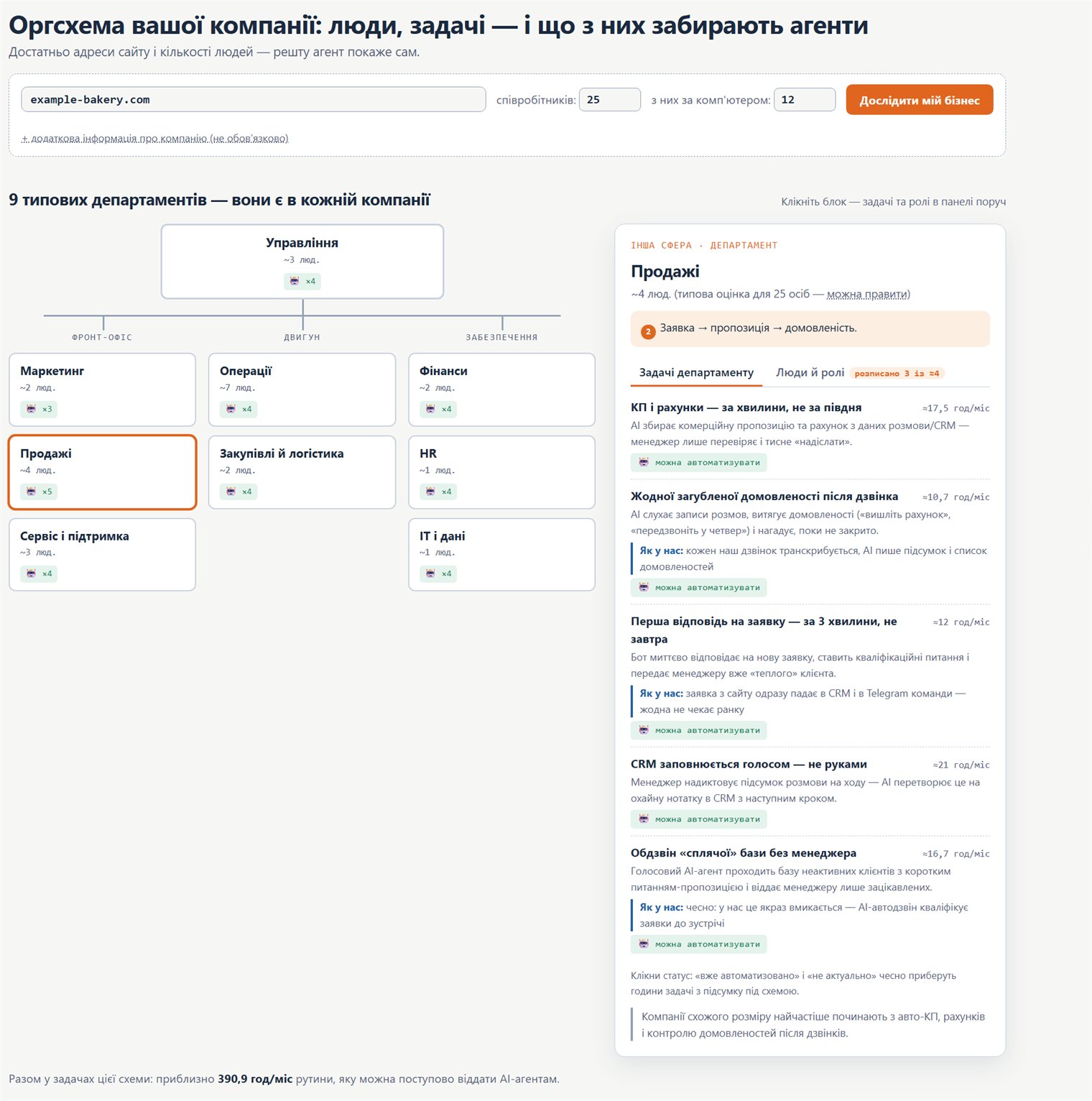
Org chart: how to move your company onto AI
A practical map: which company roles and processes AI agents can take over, where to start, and in what order to roll it out.