Magistral Medium 1.2.2509
At a glance
- Price per 1M tokens (input)
- $2.00
- Price per 1M tokens (output)
- $5.00
- Context
- 40,000 tokens
- Free access
- yes (see below)
Refreshed daily; data verified September 30, 2026. Published August 12, 2026.
Magistral Medium 1.2.2509 is a mid-tier language model from Mistral AI designed for businesses that need reliable automation and structured decision-making. It excels at tool calling, which lets the model invoke external APIs or software functions to complete tasks like database queries or form submissions, and at step-by-step reasoning, which breaks complex problems into verifiable stages. This model suits operations teams, developers, and analysts who want to integrate AI into existing workflows without overhauling their infrastructure. What distinguishes Mistral's approach is a focus on efficiency and control—prioritizing predictable outputs and transparent logic over raw conversational flair, making it a practical choice for production environments.
Specifications & pricing
| Input (per 1M tokens) | $2.00 |
|---|---|
| Output (per 1M tokens) | $5.00 |
| Context window | 40,000 tokens |
| Max output | 40,000 tokens |
| Capabilities | tool calling, reasoning |
LiteLLM community dataset (MIT), verified September 22, 2026. Official Mistral AI pricing.
What Magistral Medium 1.2.2509 would cost on your workload — run it through the cost calculator →
Where to try Magistral Medium 1.2.2509 for free
- Mistral AI offers a free chat — Le Chat (free plan). A vendor's free chat may run a different model from the same family — the exact model is not guaranteed.
Frequently asked questions
What is this model best used for in a business context?+
It is ideal for automating multi-step processes that require external data or actions, such as updating customer records, generating structured reports, or orchestrating workflows across different software tools. Its reasoning capability also helps with tasks like summarizing complex documents, diagnosing issues, or planning project steps. If your use case involves connecting to databases, APIs, or internal systems, this model can handle those calls reliably.
How do I get started with integrating it into my existing stack?+
You can access the model via Mistral AI's API, which supports standard REST calls. Start by defining the functions or tools you want the model to use—these are described in a JSON schema—and then send a request with your prompt and tool definitions. The model will respond with a structured request to call a function, which your application executes and returns the result for the model to continue. Mistral's documentation includes examples for Python and other common languages.
How does this model differ from other models in the Mistral line?+
Within the Mistral family, this model sits between the smaller, faster models and the largest, most capable ones. Compared to the smaller models, it offers stronger reasoning and more accurate tool calling, making it better for complex tasks. Compared to the largest models, it is lighter and faster to run, which can reduce latency and infrastructure overhead. The trade-off is that it may not handle extremely nuanced creative writing or very long, open-ended conversations as well as the top-tier models.
What are the main limitations I should be aware of?+
Like all language models, it can occasionally produce incorrect or fabricated information, especially when the input is ambiguous or outside its training scope. Its tool calling requires that you define functions clearly; poorly specified tools may lead to invalid calls or unexpected behavior. It also has a finite context window, so very long documents or conversations may need to be truncated or summarized. For high-stakes decisions, always validate the model's output with human oversight.
Compare with others
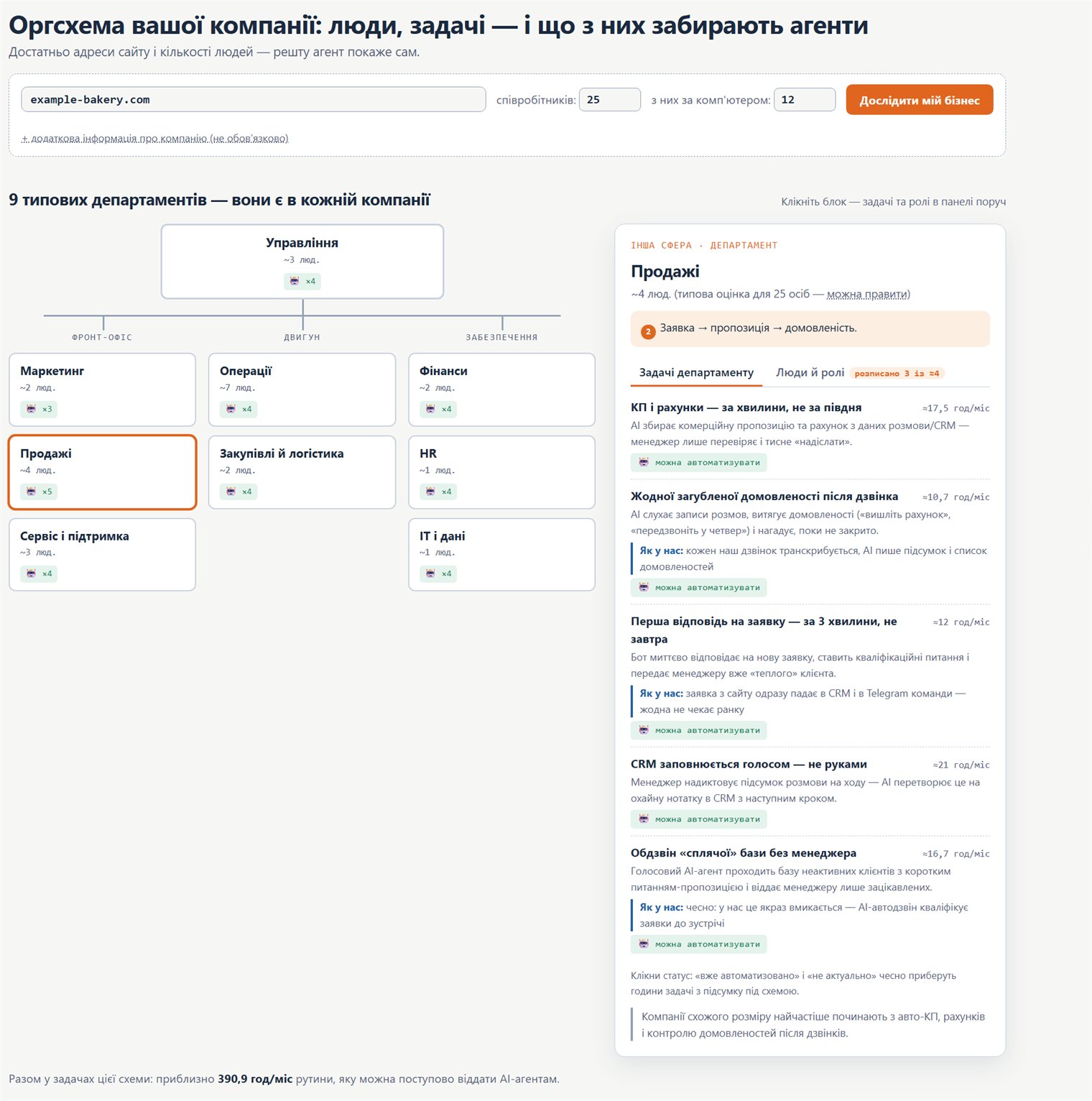
Org chart: how to move your company onto AI
A practical map: which company roles and processes AI agents can take over, where to start, and in what order to roll it out.