Magistral Medium 2509
At a glance
- Price per 1M tokens (input)
- $2.00
- Price per 1M tokens (output)
- $5.00
- Context
- 40,000 tokens
- Free access
- yes (see below)
Refreshed daily; data verified September 29, 2026. Published August 12, 2026.
Magistral Medium 2509 is a Mistral AI model designed for developers and technical teams who need reliable, structured automation in their applications. It excels at tool calling, which lets the model invoke external functions or APIs during a conversation, and at step-by-step reasoning, which makes it suitable for multi-stage tasks like data extraction, workflow orchestration, and complex query resolution. Mistral AI's approach emphasizes efficiency and control, prioritizing predictable behavior over creative output, so the model stays focused on executing instructions precisely. This makes it a practical choice for production environments where consistency and integration with existing systems matter more than conversational flair.
Specifications & pricing
| Input (per 1M tokens) | $2.00 |
|---|---|
| Output (per 1M tokens) | $5.00 |
| Context window | 40,000 tokens |
| Max output | 40,000 tokens |
| Capabilities | tool calling, reasoning |
LiteLLM community dataset (MIT), verified September 22, 2026. Official Mistral AI pricing.
What Magistral Medium 2509 would cost on your workload — run it through the cost calculator →
Where to try Magistral Medium 2509 for free
- Mistral AI offers a free chat — Le Chat (free plan). A vendor's free chat may run a different model from the same family — the exact model is not guaranteed.
Frequently asked questions
What is this model best used for in a business context?+
It is best for automating backend processes that require structured outputs, such as parsing user requests into API calls, routing tickets to the correct department, or chaining multiple logical steps to solve a problem. It suits teams building internal tools, customer support bots, or data pipelines that need deterministic, function-driven behavior rather than open-ended chat.
How do I get started integrating it with my existing stack?+
You start by accessing it through Mistral AI's platform or a compatible inference endpoint, then define your available functions in a JSON schema for tool calling. After that, you send a prompt with the user query and the tool definitions, and the model returns a structured call request that your application executes. The step-by-step reasoning mode can be enabled for tasks that require intermediate calculations or decision trees, which you can inspect for debugging.
How does this model differ from other Mistral models in the same line?+
Compared to lighter or more general-purpose siblings, this model prioritizes deterministic tool use and multi-step logic over broad conversational knowledge. It is less creative and more constrained, meaning it will not improvise when a function call is expected, and it will explicitly show its reasoning steps when asked. That makes it more predictable for engineering teams, but less suited for tasks like summarization or brainstorming where fluid prose is the goal.
What are the main limitations I should plan for?+
The model can struggle with ambiguous instructions that do not map cleanly to a defined tool or reasoning chain, so you need to write precise prompts and schemas. It also does not handle long-form memory or context across sessions natively, so you must manage conversation state externally. Finally, its reasoning is transparent but not always optimal—it may choose a valid but inefficient sequence of steps, so you should validate outputs in a test environment before production use.
Compare with others
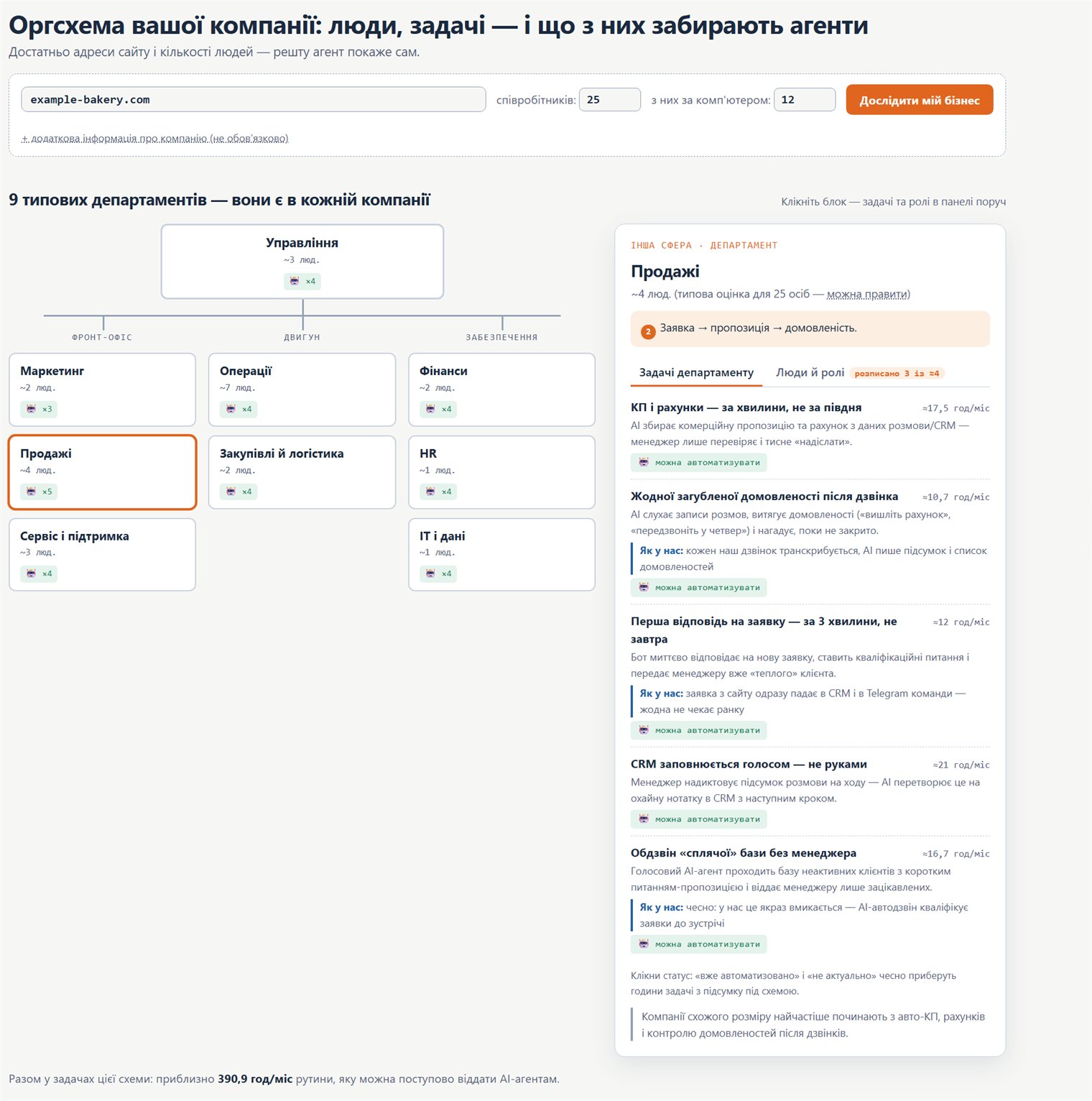
Org chart: how to move your company onto AI
A practical map: which company roles and processes AI agents can take over, where to start, and in what order to roll it out.