Ministral 3b
At a glance
- Price per 1M tokens (input)
- $0.10
- Price per 1M tokens (output)
- $0.10
- Context
- 131,072 tokens
- Free access
- yes (see below)
Refreshed daily; data verified October 14, 2026. Published August 30, 2026, last price change September 6, 2026.
Ministral 3b is a compact multimodal model for developers who need image understanding and tool calling in resource-constrained environments. It suits automation workflows, visual assistants, and edge deployments where efficiency matters more than raw breadth. Mistral AI's approach emphasizes small, focused models that maintain strong reasoning and actionable output, making them practical for production systems. This model bridges visual input and programmatic action without requiring heavy infrastructure.
Specifications & pricing
| Input (per 1M tokens) | $0.10 |
|---|---|
| Output (per 1M tokens) | $0.10 |
| Cache read (per 1M tokens) | $0.01 |
| Context window | 131,072 tokens |
| Max output | 131,072 tokens |
| Capabilities | images, tool calling |
LiteLLM community dataset (MIT), verified October 14, 2026. Official Mistral AI pricing.
What Ministral 3b would cost on your workload — run it through the cost calculator →
Price history
| Date | Input / 1M | Output / 1M |
|---|---|---|
| August 28, 2026 (first record) | $0.10 | $0.10 |
| September 6, 2026 | $0.10 | $0.10 |
Where to try Ministral 3b for free
- Mistral AI offers a free chat — Le Chat (free plan). A vendor's free chat may run a different model from the same family — the exact model is not guaranteed.
Frequently asked questions
What is this model best used for?+
It excels at tasks that combine interpreting images with triggering external functions, such as document processing, visual QA, or smart home automation. Tool calling lets the model invoke APIs or code to complete a user request, so it suits workflows that need a lightweight reasoning layer.
How do I get started with Ministral 3b?+
You can access it through Mistral's platform or download the open-weight version and run it locally. Standard integration paths include using the Mistral API or loading the model into popular inference frameworks. For tool calling, define your functions in a schema and pass them with each request.
How does it differ from other Mistral models?+
Compared to larger siblings, this model trades raw knowledge breadth for speed and lower memory footprint. It is optimized for focused tasks like image understanding and function invocation, whereas bigger models handle broader language understanding and complex reasoning. It also supports vision, which some text-only counterparts lack.
What are its limitations?+
Given its compact size, it may struggle with highly abstract reasoning, long contextual dependencies, or nuanced language generation. Image understanding is strong for common objects and scenes but can be less reliable for fine-grained details or rare categories. For high-stakes or open-ended tasks, consider a larger model.
Compare with others
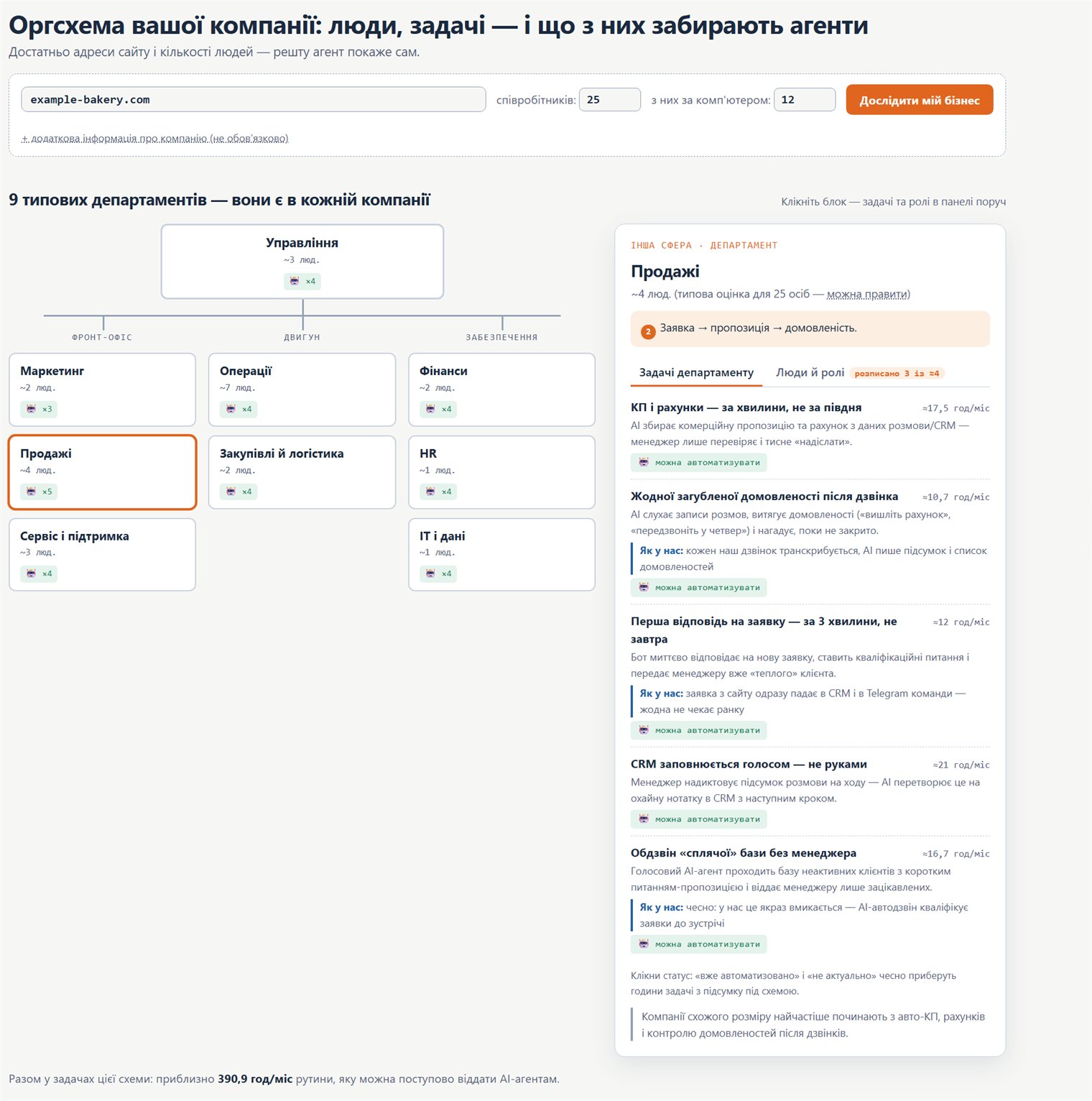
Org chart: how to move your company onto AI
A practical map: which company roles and processes AI agents can take over, where to start, and in what order to roll it out.