Mistral Medium 2505
At a glance
- Price per 1M tokens (input)
- $0.40
- Price per 1M tokens (output)
- $2.00
- Context
- 131,072 tokens
- Free access
- yes (see below)
Refreshed daily; data verified September 29, 2026. Published August 12, 2026.
Mistral Medium 2505 is a mid-tier language model from Mistral AI, designed for teams that need reliable, cost-conscious automation without the overhead of a frontier-scale system. It suits structured tasks like data extraction, routing, and multi-step workflows where the model must call external APIs or tools to complete an action. The vendor’s approach emphasizes efficiency and control: the model is trained to use tool calling (invoking functions or services in code) with minimal hallucinated arguments, and it integrates cleanly into existing enterprise stacks. This makes it a practical choice for developers and operations teams building internal assistants, ticketing systems, or database query tools.
Specifications & pricing
| Input (per 1M tokens) | $0.40 |
|---|---|
| Output (per 1M tokens) | $2.00 |
| Context window | 131,072 tokens |
| Max output | 8,191 tokens |
| Capabilities | tool calling |
LiteLLM community dataset (MIT), verified September 22, 2026. Official Mistral AI pricing.
What Mistral Medium 2505 would cost on your workload — run it through the cost calculator →
Where to try Mistral Medium 2505 for free
- Mistral AI offers a free chat — Le Chat (free plan). A vendor's free chat may run a different model from the same family — the exact model is not guaranteed.
Frequently asked questions
What is this model best used for in a business setting?+
It is best for automating structured, action-oriented workflows: parsing incoming requests, deciding which backend system to call, formatting a response, or updating a record. Examples include customer support triage, invoice data extraction, or a natural-language interface to an internal CRM. It is not ideal for open-ended creative writing or long-form research synthesis, where larger models with broader knowledge are preferable.
How do I get started with tool calling on this model?+
You define a set of functions in JSON schema, describe each function’s purpose and parameters, and pass that schema along with your user prompt to the model. The model returns a structured request to invoke one of those functions, including the arguments. Your application executes the function, then sends the result back to the model for a final answer. Mistral’s API documentation and client libraries include ready examples for this loop.
How does this model differ from other Mistral models, like the small or large tiers?+
The medium tier sits between the lightweight and the flagship models. Compared to the small tier, it handles more complex instructions and longer multi-step tool sequences with fewer errors. Compared to the large tier, it is lighter to deploy and faster per request, but it may miss subtle context or require more explicit prompting in edge cases. Choose it when you need a balance of reliability and operational simplicity.
What are the main limitations I should plan for?+
The model can occasionally mis-format a tool call, especially when the function schema is very large or the instruction is ambiguous, so you should validate its output before executing side effects. It also does not retain memory across conversations, so you must pass relevant context each time. Finally, it may struggle with highly specialized domain jargon unless you provide examples or a glossary in the prompt.
Compare with others
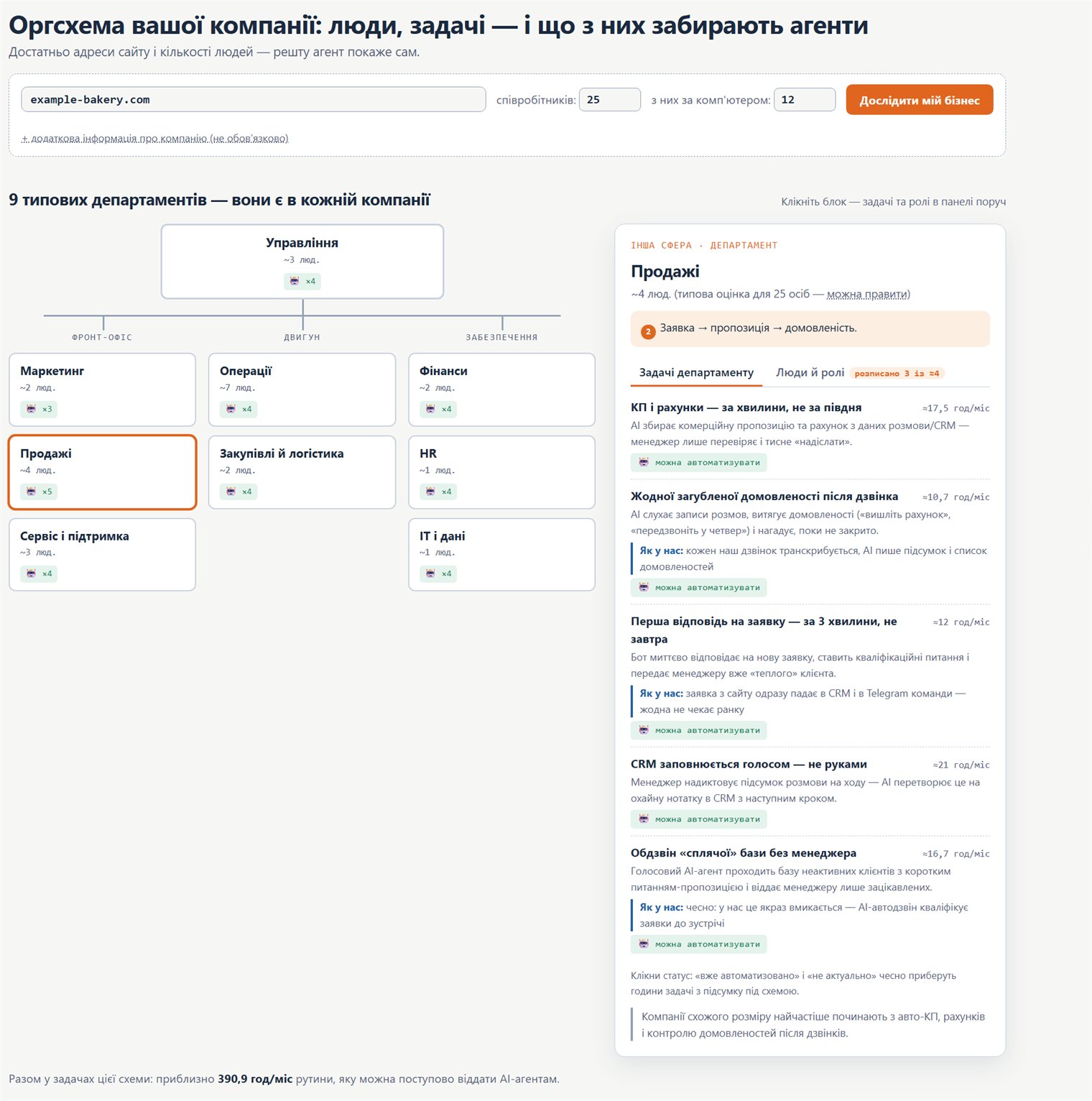
Org chart: how to move your company onto AI
A practical map: which company roles and processes AI agents can take over, where to start, and in what order to roll it out.