O1
At a glance
- Price per 1M tokens (input)
- $15.00
- Price per 1M tokens (output)
- $60.00
- Context
- 200,000 tokens
- Free access
- yes (see below)
Refreshed daily; data verified September 29, 2026. Published August 12, 2026.
OpenAI's O1 model is designed for professionals who need rigorous, multi-step problem solving—such as software engineers, data scientists, and researchers working on complex logic, math, or planning tasks. It combines image understanding with tool calling, meaning it can interpret visual inputs and invoke external functions or APIs to gather data or execute actions. Its standout feature is deliberate step-by-step reasoning, which makes it more transparent and reliable for tasks that require careful deduction rather than quick pattern matching. This model suits use cases where accuracy and explainability matter more than speed, and it is a strong choice for building agentic workflows that need to reason through a problem before acting.
Specifications & pricing
| Input (per 1M tokens) | $15.00 |
|---|---|
| Output (per 1M tokens) | $60.00 |
| Cache read (per 1M tokens) | $7.50 |
| Context window | 200,000 tokens |
| Max output | 100,000 tokens |
| Capabilities | images, tool calling, reasoning |
LiteLLM community dataset (MIT), verified September 29, 2026. Official OpenAI pricing.
What O1 would cost on your workload — run it through the cost calculator →
Where to try O1 for free
- OpenAI offers a free chat — ChatGPT (free plan). A vendor's free chat may run a different model from the same family — the exact model is not guaranteed.
Frequently asked questions
What is the O1 model best used for in a business context?+
O1 excels at tasks that require deep, sequential reasoning—such as debugging complex code, optimizing supply chain routes, analyzing legal contracts, or generating multi-step research summaries. It is also effective for tasks that combine visual data (like charts or diagrams) with logic, and for orchestrating workflows where it must call external tools or databases to reach a conclusion.
How do I get started with O1?+
You can access O1 through the OpenAI API or in supported platforms like Azure OpenAI Service. Start by testing it on a representative problem from your domain—provide a clear prompt with any necessary images or function definitions—and compare its output against your current solution. OpenAI provides documentation and example notebooks for tool calling and reasoning traces to help you integrate it into your existing stack.
How does O1 differ from other models in the OpenAI line, like the GPT series?+
The main difference is that O1 is built to 'think before answering'—it generates internal reasoning steps before producing a final response, which improves accuracy on complex problems but makes it slower and more deliberate. GPT models are optimized for fast, broad conversational responses and may be better for high-volume, straightforward tasks. O1 also supports tool calling and image understanding, but its reasoning focus makes it less suited for casual chat or creative writing where speed and fluidity are key.
What are the practical limitations of O1 that I should know about?+
O1 is not designed for real-time, low-latency interactions—its step-by-step reasoning adds noticeable delay, so it is not ideal for customer-facing chat where instant replies are expected. It may also overthink simple requests, producing verbose responses for trivial queries. Additionally, while it can understand images, it does not generate images, and its tool calling requires you to define and manage external functions securely. Finally, like all large language models, it can still make errors in edge cases, so human review is recommended for high-stakes decisions.
Compare with others
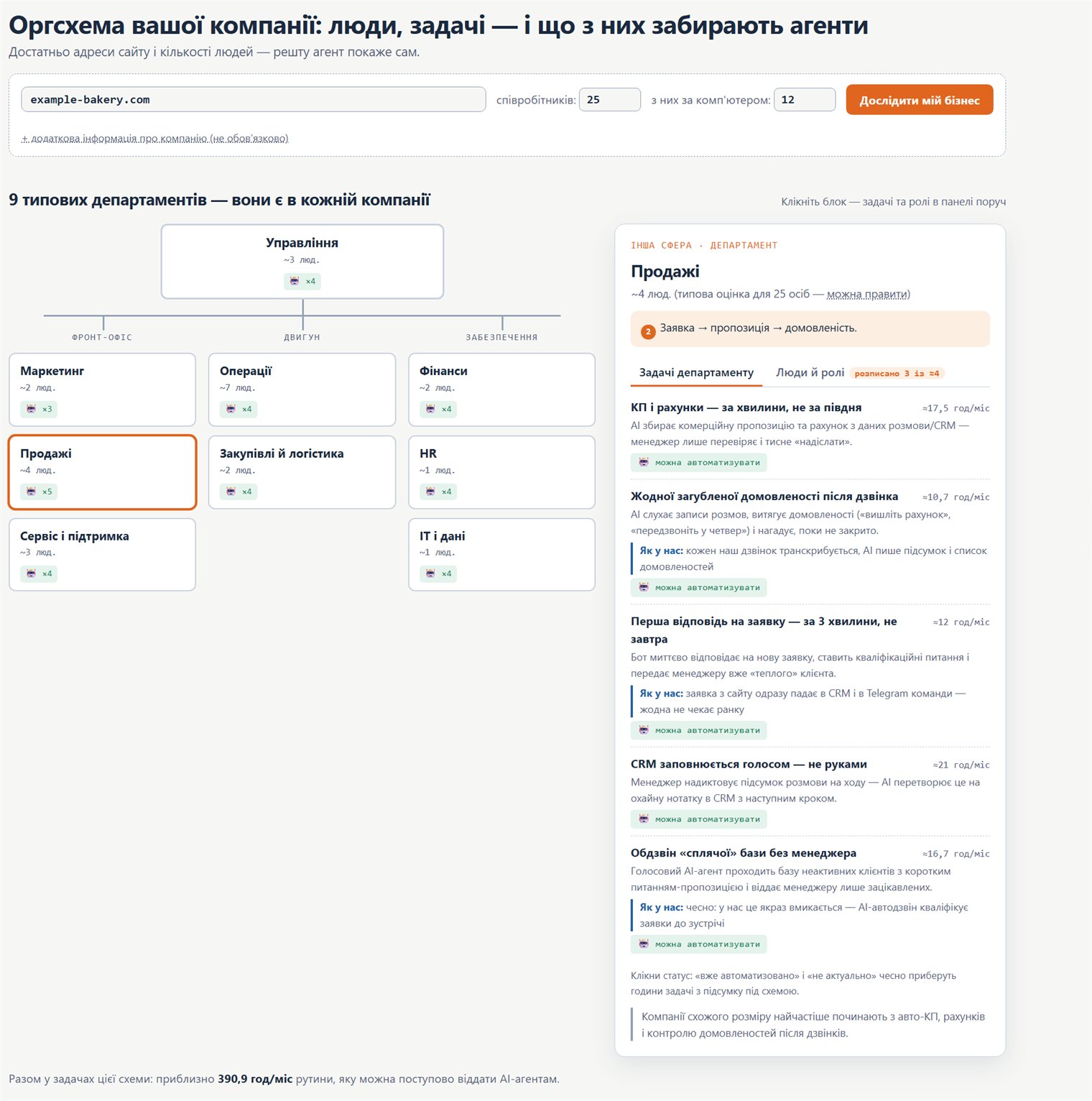
Org chart: how to move your company onto AI
A practical map: which company roles and processes AI agents can take over, where to start, and in what order to roll it out.