O4 Mini
At a glance
- Price per 1M tokens (input)
- $1.10
- Price per 1M tokens (output)
- $4.40
- Context
- 200,000 tokens
- Free access
- yes (see below)
Refreshed daily; data verified September 29, 2026. Published August 12, 2026.
O4 Mini is a compact reasoning model from OpenAI designed for developers and businesses that need reliable, cost-efficient AI for complex tasks. It excels at image understanding, tool calling (the ability to invoke external functions or APIs), and step-by-step reasoning, making it suitable for workflows like document analysis, data extraction, and automated decision support. The vendor's approach emphasizes balancing advanced reasoning with practical deployability, offering a smaller model that still delivers strong performance on structured problems. This model is ideal for teams that want to integrate AI into production systems without the overhead of a larger, more resource-intensive model.
Specifications & pricing
| Input (per 1M tokens) | $1.10 |
|---|---|
| Output (per 1M tokens) | $4.40 |
| Cache read (per 1M tokens) | $0.28 |
| Context window | 200,000 tokens |
| Max output | 100,000 tokens |
| Capabilities | images, tool calling, reasoning |
LiteLLM community dataset (MIT), verified September 29, 2026. Official OpenAI pricing.
What O4 Mini would cost on your workload — run it through the cost calculator →
Where to try O4 Mini for free
- OpenAI offers a free chat — ChatGPT (free plan). A vendor's free chat may run a different model from the same family — the exact model is not guaranteed.
Frequently asked questions
What is this model best used for in a business context?+
It is well-suited for tasks that require visual understanding, such as scanning invoices or diagrams, and for workflows that involve calling external tools or APIs to complete actions, like retrieving data or updating records. Its step-by-step reasoning also makes it effective for multi-step problem solving, such as generating structured reports or debugging code snippets.
How do I get started with integrating this model?+
You can access it through the vendor's API, using standard endpoints for chat or completions. The model supports function calling, so you can define your own tools and pass them in the request. Start with the official documentation and sample code, then test with your own data to fine-tune prompts and tool definitions for your specific use case.
How does this model differ from sibling models in the same line?+
Compared to larger siblings, this model is more efficient and faster, making it a good choice for high-volume or latency-sensitive applications. It retains core capabilities like image understanding and tool calling but may handle more complex reasoning tasks with less depth than a bigger model. It is a middle ground between a standard model and a full reasoning model, offering a balance of speed and capability.
What are the main limitations I should be aware of?+
While it performs well on many tasks, it may not match the accuracy of larger models on highly nuanced or ambiguous reasoning problems. Its image understanding is strong but not perfect, especially with low-quality images or dense text. Also, because it is optimized for efficiency, it might sometimes take shortcuts in reasoning, so for critical decisions, you should validate outputs with additional checks.
Comparisons
Compare with others
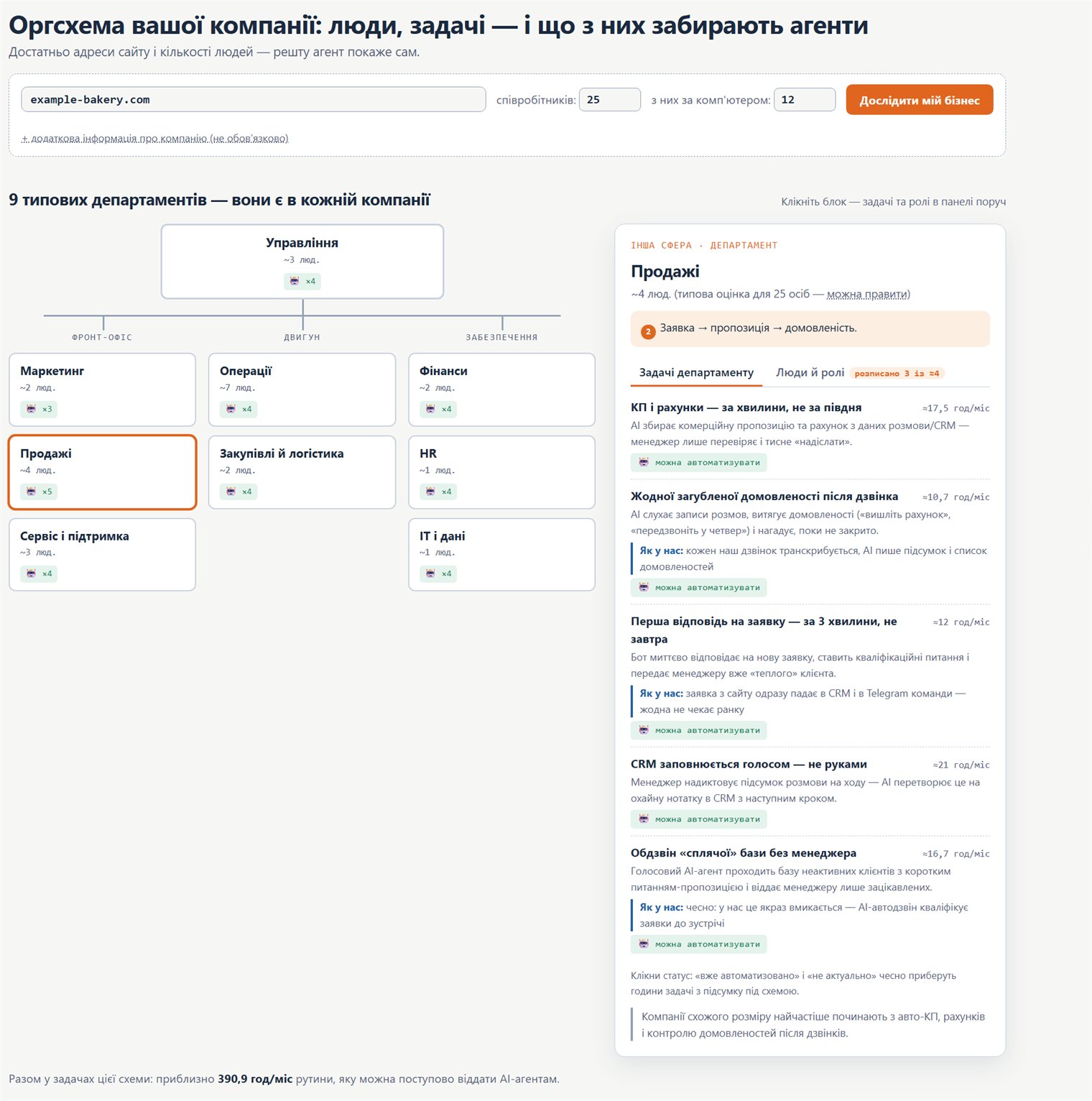
Org chart: how to move your company onto AI
A practical map: which company roles and processes AI agents can take over, where to start, and in what order to roll it out.