Claude Opus 4
At a glance
- Price per 1M tokens (input)
- $15.00
- Price per 1M tokens (output)
- $75.00
- Context
- 200,000 tokens
- Free access
- yes (see below)
Refreshed daily; data verified September 29, 2026. Published August 12, 2026.
Claude Opus 4 is aimed at enterprises that need deep language understanding combined with visual analysis. It excels at tasks such as document summarization that includes images, complex data extraction, and orchestrating external services through tool calling. The model’s step‑by‑step reasoning lets it break down intricate problems into manageable parts, improving reliability for decision‑support workflows. Anthropic’s approach emphasizes safety‑aware prompting and transparent reasoning traces, differentiating it from more opaque large language models.
Specifications & pricing
| Input (per 1M tokens) | $15.00 |
|---|---|
| Output (per 1M tokens) | $75.00 |
| Cache read (per 1M tokens) | $1.50 |
| Cache write (per 1M tokens) | $18.75 |
| Context window | 200,000 tokens |
| Max output | 32,000 tokens |
| Capabilities | images, tool calling, reasoning |
LiteLLM community dataset (MIT), verified September 22, 2026. Official Anthropic pricing.
What Claude Opus 4 would cost on your workload — run it through the cost calculator →
Where to try Claude Opus 4 for free
- Anthropic offers a free chat — Claude (free plan). A vendor's free chat may run a different model from the same family — the exact model is not guaranteed.
- 🎁 On our promo-codes page: Claude Code Guest Pass — a community invite.
Frequently asked questions
What kinds of business problems benefit most from Claude Opus 4?+
Use cases that blend text and image inputs, need structured outputs, or require the model to invoke APIs for actions such as fetching live data, generating reports, or updating records are a good fit.
How do I start using the model in my applications?+
Integrate via the provider’s API, send a request that includes any images as encoded data, and specify the desired tool calls in the prompt; the response will contain both the generated text and any suggested function invocations.
How does Claude Opus 4 differ from the other Claude models?+
Compared with the smaller variants, Opus offers broader multimodal perception and more elaborate reasoning chains, while the lightweight models trade off depth of analysis for faster turnaround.
What limitations should I be aware of?+
The model may still produce plausible‑but‑incorrect statements, especially when visual context is ambiguous, and it relies on clear tool definitions; it also cannot access external resources unless explicitly called through a defined function.
Compare with others
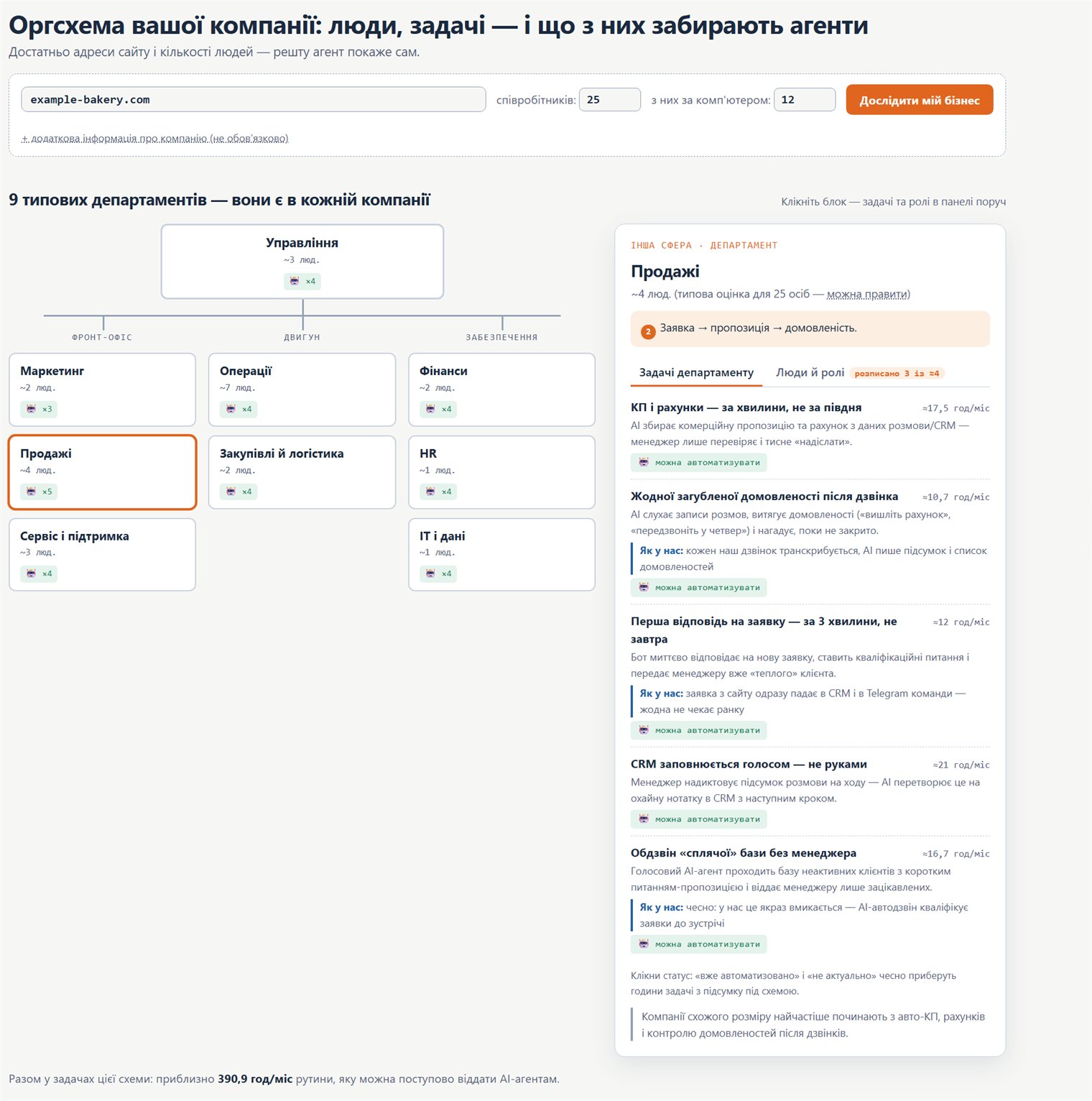
Org chart: how to move your company onto AI
A practical map: which company roles and processes AI agents can take over, where to start, and in what order to roll it out.