GPT-4.0613
At a glance
- Price per 1M tokens (input)
- $30.00
- Price per 1M tokens (output)
- $60.00
- Context
- 8,192 tokens
- Free access
- yes (see below)
Refreshed daily; data verified September 29, 2026. Published August 12, 2026.
GPT-4.0613 is designed for developers and technical teams who need to integrate reliable, instruction-following language capabilities into their own applications. It is particularly well-suited for tasks that require structured data extraction, multi-step reasoning, and automated workflows, thanks to its support for tool calling—a feature that lets the model request and use external functions or APIs during a conversation. OpenAI’s approach here emphasizes practical utility and developer control, offering a model that can be steered with clear system prompts and that returns predictable outputs for production use. This version is a solid choice for teams building assistants, internal knowledge tools, or automation pipelines that need a balance of conversational fluency and deterministic behavior.
Specifications & pricing
| Input (per 1M tokens) | $30.00 |
|---|---|
| Output (per 1M tokens) | $60.00 |
| Context window | 8,192 tokens |
| Max output | 4,096 tokens |
| Capabilities | tool calling |
LiteLLM community dataset (MIT), verified September 29, 2026. Official OpenAI pricing.
What GPT-4.0613 would cost on your workload — run it through the cost calculator →
Where to try GPT-4.0613 for free
- OpenAI offers a free chat — ChatGPT (free plan). A vendor's free chat may run a different model from the same family — the exact model is not guaranteed.
Frequently asked questions
What is this model best used for in a business setting?+
It is best for automating back-office tasks like parsing customer emails, extracting key fields from documents, generating structured summaries, or powering internal chatbots that need to query databases. Because it supports tool calling, you can connect it to your own systems so it can look up records, run calculations, or update tickets as part of a single request.
How do I get started with GPT-4.0613?+
You get started by accessing it through the provider's API platform, where you can send a test prompt and review the response format. For tool calling, you define a set of functions in your code, describe them in the API request, and the model will output a structured call when it needs external data. Most teams begin by prototyping in a sandbox environment, then move to a staging setup before production.
How does this model differ from other models in the same line?+
This version is specifically optimized for reliable function calling and structured output, making it more predictable when you need the model to trigger actions or fill templates. Earlier versions in the same family may be more general-purpose for conversation, while later versions may focus on different trade-offs like speed or creative writing. For business automation where you need the model to interact with your software, this version is the intended choice.
What are the main limitations I should plan for?+
The model can occasionally misinterpret a function call or produce a malformed argument, so you should add validation logic on your side. It also does not have built-in memory between sessions, so you must manage conversation history yourself. Finally, it is not ideal for real-time streaming or very low-latency interactions, as it prioritizes accuracy over speed in complex tasks.
Compare with others
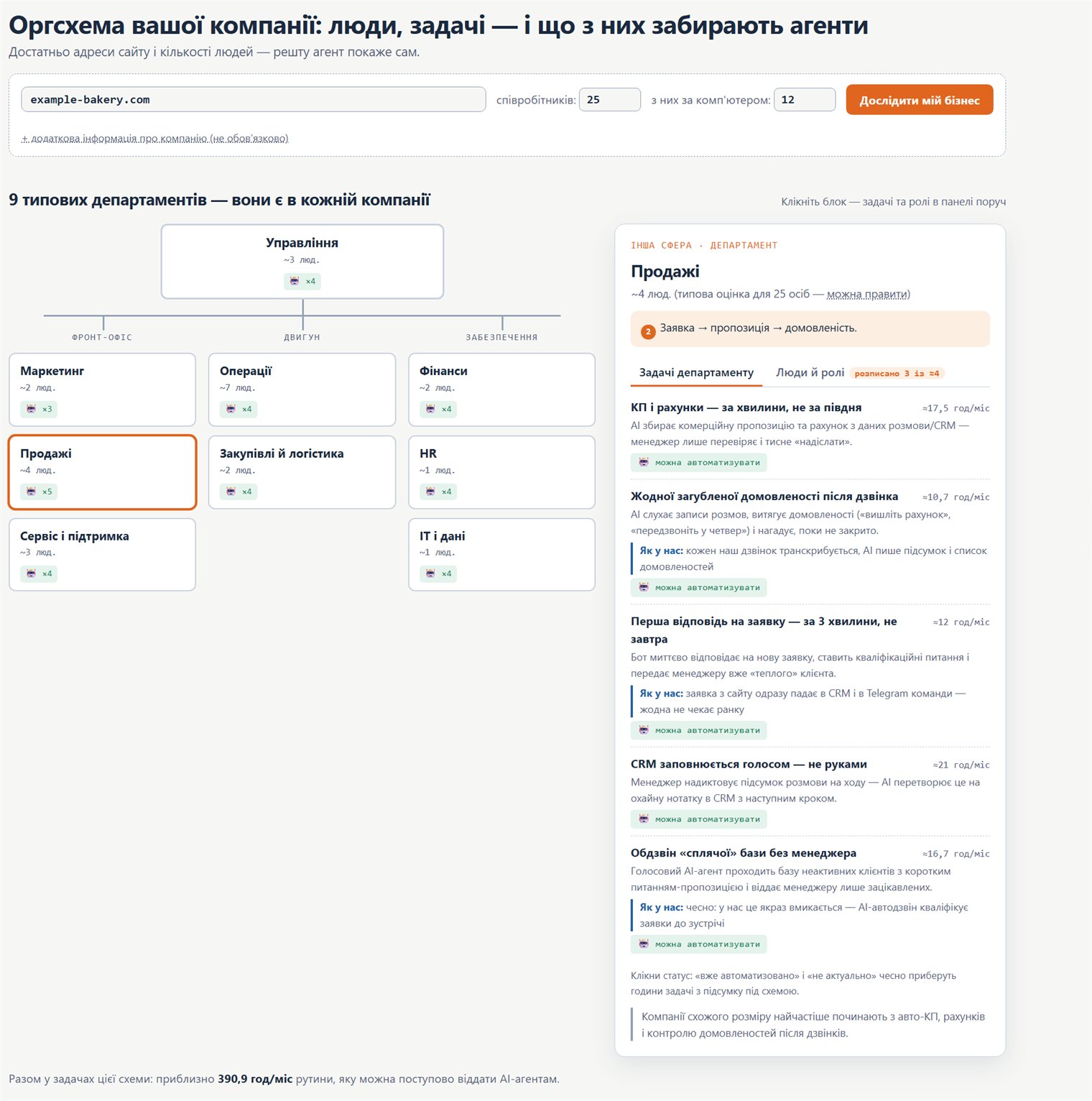
Org chart: how to move your company onto AI
A practical map: which company roles and processes AI agents can take over, where to start, and in what order to roll it out.