GPT-5.6 Terra
At a glance
- Price per 1M tokens (input)
- $2.00
- Price per 1M tokens (output)
- $12.00
- Context
- 922,000 tokens
- Free access
- yes (see below)
Refreshed daily; data verified September 29, 2026. Published August 12, 2026.
GPT-5.6 Terra is designed for businesses that need a single model to handle visual data, structured workflows, and multi-step problem solving. It suits tasks like document analysis, customer support automation, and data extraction from images or charts, where the model must both understand inputs and take actions. The vendor's approach emphasizes reliability through explicit step-by-step reasoning and native tool calling, which lets the model interact with external systems such as databases or APIs in a controlled manner. This makes it a practical choice for teams that want to move from prototype to production without stitching together multiple specialized models.
Specifications & pricing
| Input (per 1M tokens) | $2.00 |
|---|---|
| Output (per 1M tokens) | $12.00 |
| Cache read (per 1M tokens) | $0.20 |
| Cache write (per 1M tokens) | $2.50 |
| Context window | 922,000 tokens |
| Max output | 128,000 tokens |
| Capabilities | images, tool calling, reasoning |
LiteLLM community dataset (MIT), verified September 29, 2026. Official OpenAI pricing.
What GPT-5.6 Terra would cost on your workload — run it through the cost calculator →
Where to try GPT-5.6 Terra for free
- OpenAI offers a free chat — ChatGPT (free plan). A vendor's free chat may run a different model from the same family — the exact model is not guaranteed.
Frequently asked questions
What is this model best used for in a business context?+
It is strongest for tasks that combine visual understanding with follow-up actions, like reading a scanned invoice and then updating a ledger, or analyzing a chart and generating a summary. It also handles multi-step reasoning well, so it suits complex queries that require breaking a problem into parts before answering.
How do I get started with integrating it into my existing systems?+
You can access it through the standard API, and because it supports tool calling, you can define custom functions that the model invokes during a conversation. Start by testing with a small set of your own documents or workflows, then gradually expand the tool definitions to match your backend services.
How does GPT-5.6 Terra differ from other models in the same family?+
Compared to text-only siblings, Terra adds native image understanding, so it can process photos, screenshots, and scanned documents without a separate vision model. Compared to larger general-purpose models, Terra is optimized for operational tasks that require reliable function execution and clear reasoning, rather than open-ended creative writing.
What are the main limitations I should plan for?+
It is not designed for real-time video analysis or high-frequency streaming inputs, as its image understanding works best on static images. Also, while tool calling is robust, you need to define each function explicitly and handle edge cases where the model may request clarification. Finally, its reasoning is transparent but can be slower on very complex multi-step tasks, so you should design timeouts accordingly.
Compare with others
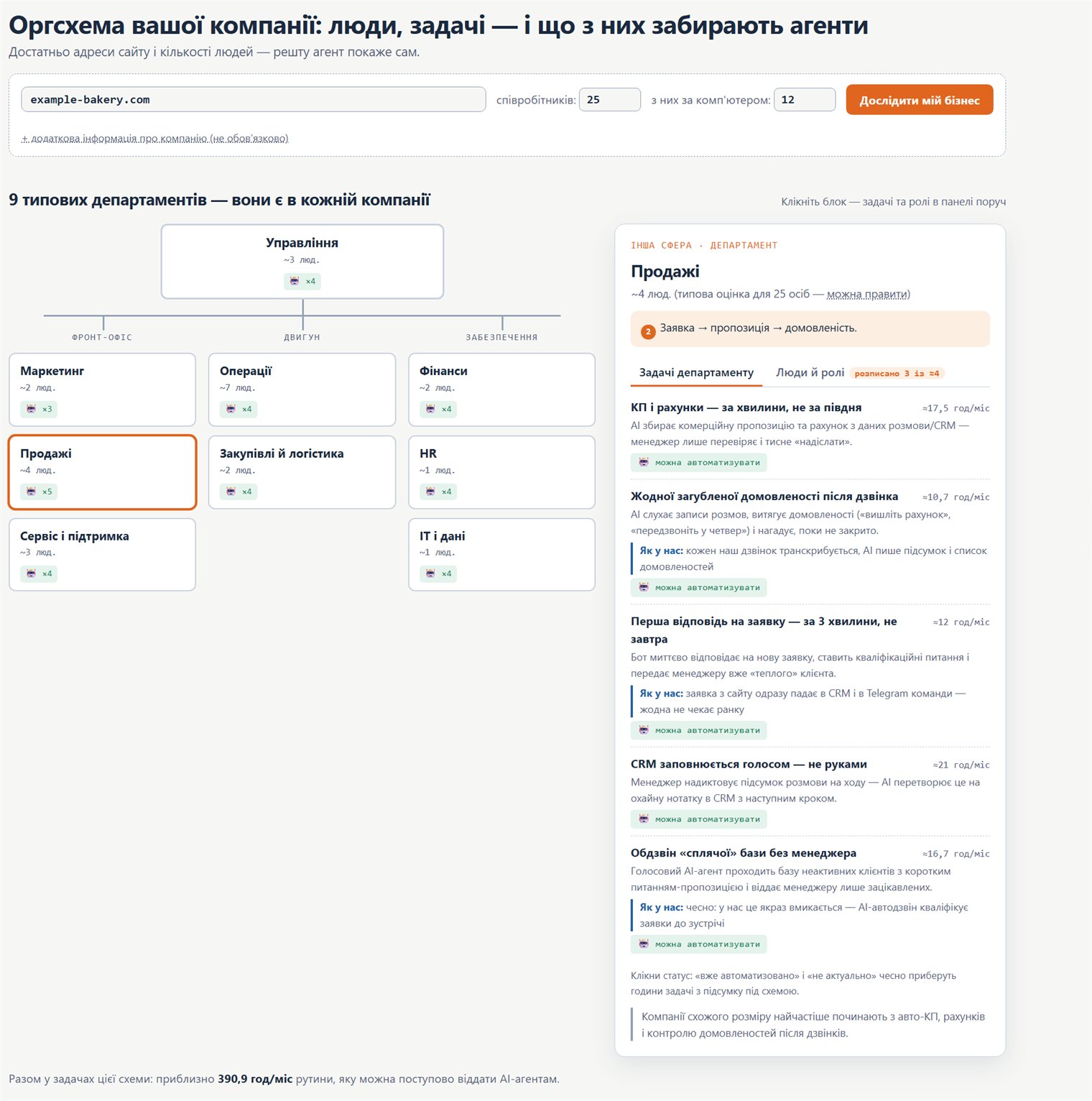
Org chart: how to move your company onto AI
A practical map: which company roles and processes AI agents can take over, where to start, and in what order to roll it out.