GPT-6 Astra
At a glance
- Price per 1M tokens (input)
- $10.00
- Price per 1M tokens (output)
- $50.00
- Context
- 922,000 tokens
- Free access
- yes (see below)
Refreshed daily; data verified October 22, 2026. Published September 7, 2026.
GPT-6 Astra is designed for developers and enterprise teams building applications that require deep visual understanding combined with reasoning and external tool integration. It excels at tasks such as analyzing complex diagrams, interpreting medical imaging, or extracting structured data from scanned documents while coordinating with APIs or databases through function calls. Unlike earlier models that treated vision and language as separate streams, Astra unifies these capabilities in a single reasoning loop, allowing it to adjust its analysis based on tool outputs or intermediate conclusions. This integrated approach reduces the need for complex pipeline orchestration and improves accuracy in multi-step, multimodal workflows.
Specifications & pricing
| Input (per 1M tokens) | $10.00 |
|---|---|
| Output (per 1M tokens) | $50.00 |
| Cache read (per 1M tokens) | $1.00 |
| Cache write (per 1M tokens) | $12.50 |
| Context window | 922,000 tokens |
| Max output | 128,000 tokens |
| Capabilities | images, tool calling, reasoning |
LiteLLM community dataset (MIT), verified October 22, 2026. Official OpenAI pricing.
What GPT-6 Astra would cost on your workload — run it through the cost calculator →
Where to try GPT-6 Astra for free
- OpenAI offers a free chat — ChatGPT (free plan). A vendor's free chat may run a different model from the same family — the exact model is not guaranteed.
Frequently asked questions
What kinds of tasks is GPT-6 Astra best suited for?+
It is ideal for workflows where a system must interpret visual input, reason about what it sees, and then act by calling external tools — such as triggering a database query, updating a CRM, or initiating a robotic process — all within a single coherent interaction. Examples include automated invoice processing with validation, visual inspection in manufacturing, or assisting radiologists by cross-referencing scan findings with patient history.
How does one begin using GPT-6 Astra in an application?+
Access is provided through the standard API interface with support for multimodal inputs. Users send image data along with text prompts and specify which tools the model may call, such as functions for calculation, data retrieval, or system control. The model returns reasoned outputs and tool invocation requests in a structured format that the application can execute and feed back into the conversation.
How does GPT-6 Astra differ from other models in the GPT-6 series?+
While sibling models may focus on text-only reasoning or larger context handling, Astra is uniquely optimized for tight integration between visual perception, logical reasoning, and executable tool use. It prioritizes action-oriented outcomes over pure generation, making it less suited for open-ended storytelling but more effective for goal-directed, interactive systems that operate in dynamic environments.
What are the current limitations of GPT-6 Astra?+
The model may struggle with highly abstract or ambiguous visual inputs where cultural or domain-specific knowledge is critical and not well-represented in training. Additionally, tool calling reliability depends on the clarity of the function definitions provided; poorly specified or overly complex tools can lead to incorrect or failed invocations. It does not replace specialized vision models for tasks requiring pixel-level precision, such as medical segmentation.
Compare with others
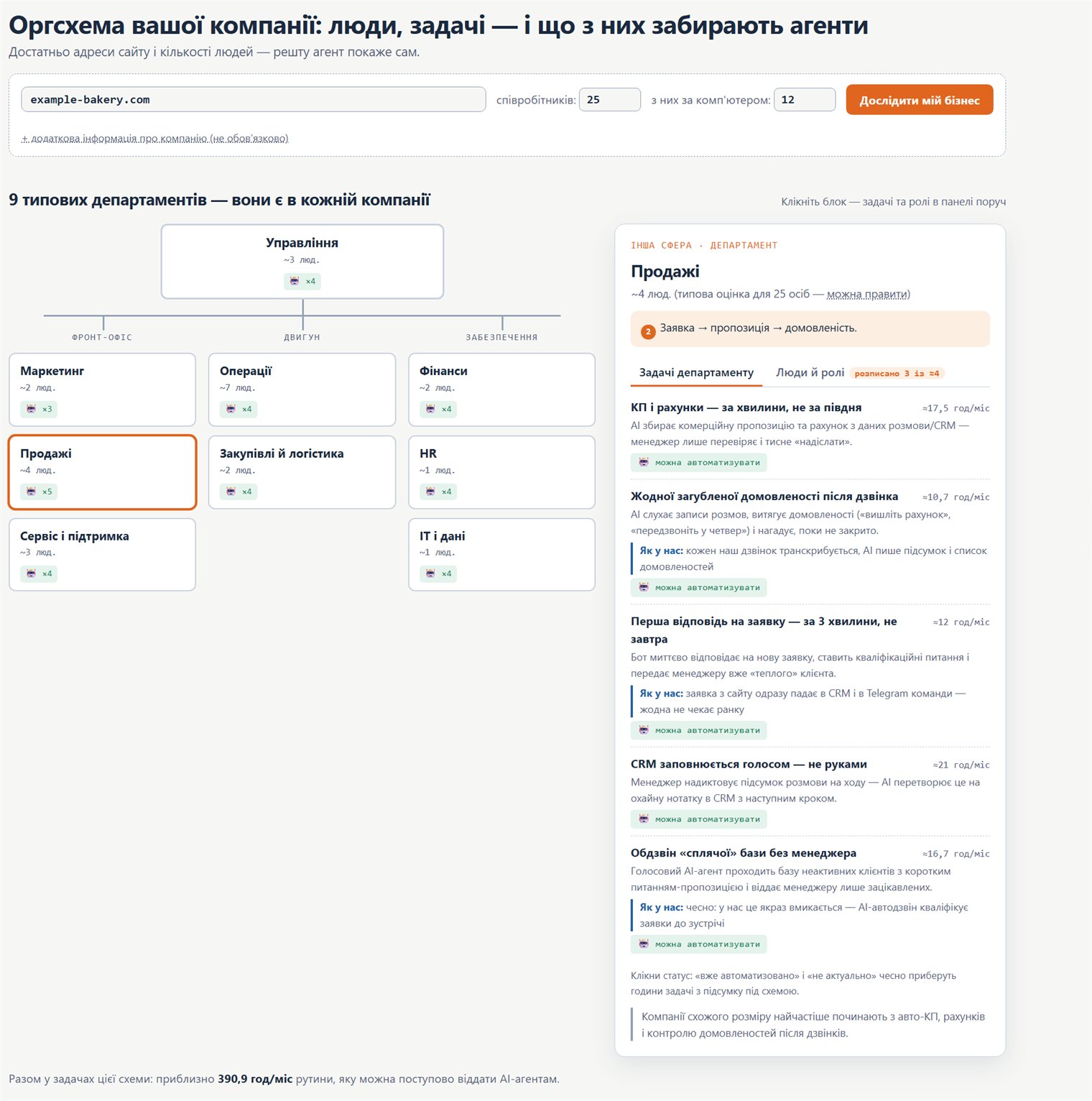
Org chart: how to move your company onto AI
A practical map: which company roles and processes AI agents can take over, where to start, and in what order to roll it out.