Grok 3 Mini Fast
At a glance
- Price per 1M tokens (input)
- $1.25
- Price per 1M tokens (output)
- $2.50
- Context
- 131,072 tokens
- Free access
- yes (see below)
Refreshed daily; data verified September 29, 2026. Published August 12, 2026, last price change August 30, 2026.
Grok 3 Mini Fast is designed for developers and technical teams who need a responsive, cost-conscious model for production workflows that require structured interactions with external systems. It excels at tasks like API orchestration, database queries, and multi-step automation, where its tool calling (the ability to invoke external functions or services during a conversation) lets you build reliable agents without heavy prompt engineering. The model also performs step-by-step reasoning, making it suitable for debugging, data transformation, and decision trees where transparency of logic matters. xAI’s approach emphasizes efficiency and directness, favoring pragmatic outputs over verbose explanations, and the model is optimized for latency-sensitive applications where speed is a functional requirement rather than a luxury.
Specifications & pricing
| Input (per 1M tokens) | $1.25 |
|---|---|
| Output (per 1M tokens) | $2.50 |
| Cache read (per 1M tokens) | $0.20 |
| Context window | 131,072 tokens |
| Max output | 131,072 tokens |
| Capabilities | tool calling, reasoning |
LiteLLM community dataset (MIT), verified September 22, 2026. Official xAI pricing.
What Grok 3 Mini Fast would cost on your workload — run it through the cost calculator →
Price history
| Date | Input / 1M | Output / 1M |
|---|---|---|
| August 9, 2026 (first record) | $0.60 | $4.00 |
| August 30, 2026 | $1.25 | $2.50 |
Where to try Grok 3 Mini Fast for free
- xAI offers a free chat — Grok (limited free access). A vendor's free chat may run a different model from the same family — the exact model is not guaranteed.
Frequently asked questions
What is this model best used for in a business context?+
It is ideal for automating repetitive, structured tasks that involve integrating with third-party APIs, parsing and formatting data, or executing conditional workflows. Common use cases include customer support triage, internal dashboard queries, and backend process orchestration where the model must reliably call functions and return machine-readable results.
How do I get started with integrating it into my application?+
You access it through the xAI API, which supports standard REST endpoints and developer SDKs. Begin by defining the functions or tools you want the model to call, then provide clear descriptions of each tool’s inputs and outputs. The model will handle the reasoning to decide when and how to invoke those tools based on your prompt.
How does this differ from the other models in the Grok line?+
The Mini Fast variant prioritizes lower latency and more economical compute usage compared to larger siblings, making it suitable for high-frequency, real-time interactions. It trades some depth of reasoning and creative breadth for speed and consistency in structured tasks. If your workload involves open-ended analysis or complex multi-step problem solving without strict time constraints, a larger model may be preferable.
What are its practical limitations I should plan for?+
It is not designed for long-form creative writing, nuanced legal or medical advice, or tasks requiring deep world knowledge. Its reasoning is stepwise but can be brittle when instructions are ambiguous, so you should provide explicit formats and edge-case handling. Also, tool calling requires careful error handling on your side, as the model may occasionally mis-specify arguments or choose an inefficient sequence of calls.
Compare with others
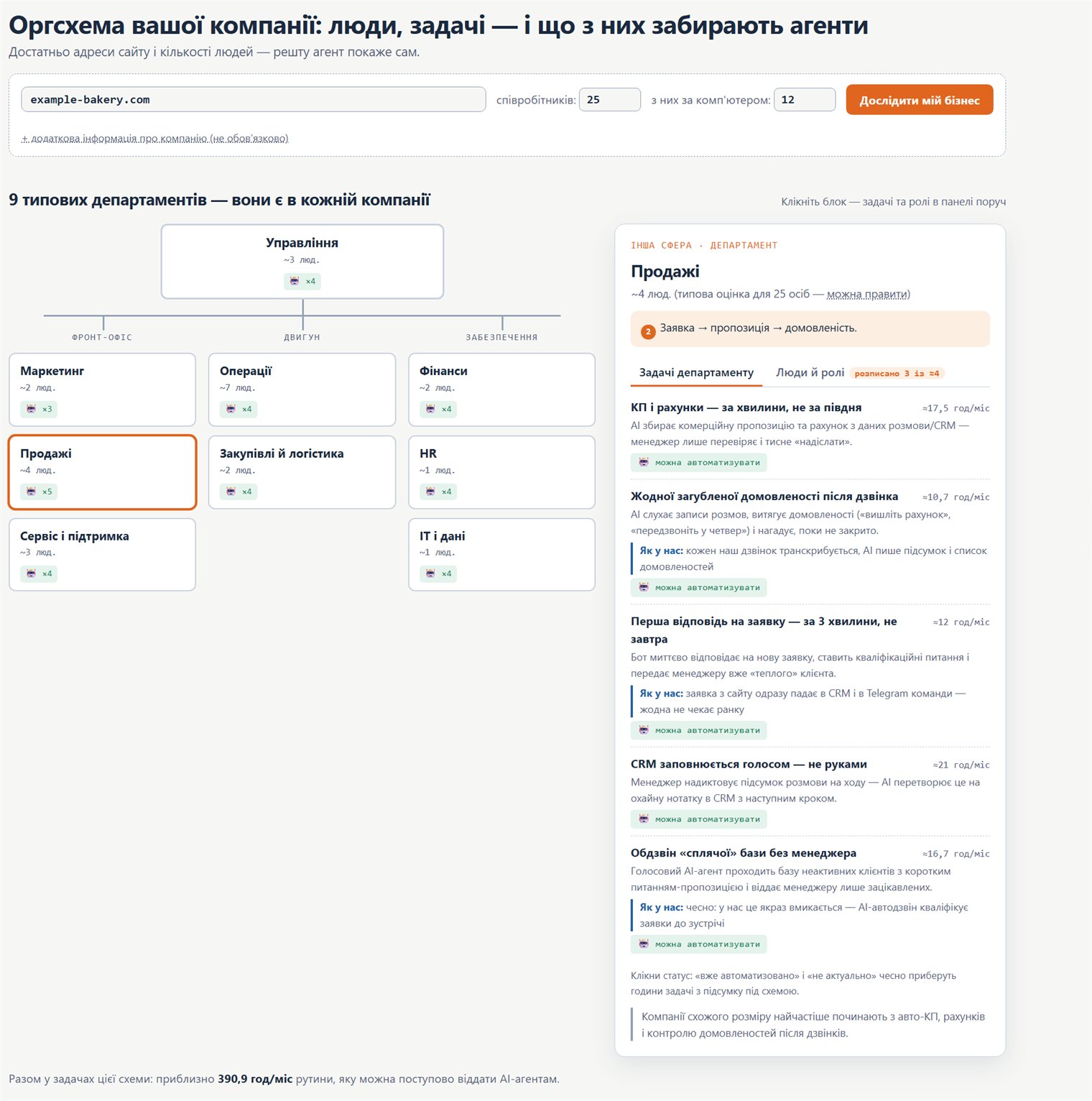
Org chart: how to move your company onto AI
A practical map: which company roles and processes AI agents can take over, where to start, and in what order to roll it out.