Grok 4.1 Fast
At a glance
- Price per 1M tokens (input)
- $1.25
- Price per 1M tokens (output)
- $2.50
- Context
- 2,000,000 tokens
- Free access
- yes (see below)
Refreshed daily; data verified September 29, 2026. Published August 12, 2026, last price change August 30, 2026.
Grok 4.1 Fast is built for engineering teams and product builders who need a responsive model that can both interpret visual inputs and take actions through tool calling, which lets the model invoke external functions or APIs on demand. It suits tasks like real-time data enrichment, image-grounded support automation, and multi-step workflows where a model must reason through a problem before acting. What distinguishes xAI's approach is a focus on efficiency without sacrificing structured reasoning: the model is designed to produce explicit step-by-step traces that are auditable, rather than treating speed as an excuse for opaque outputs. For teams that want a balance of perception, action, and explainability in a single deployment, this model offers a pragmatic middle ground.
Specifications & pricing
| Input (per 1M tokens) | $1.25 |
|---|---|
| Output (per 1M tokens) | $2.50 |
| Cache read (per 1M tokens) | $0.20 |
| Context window | 2,000,000 tokens |
| Max output | 2,000,000 tokens |
| Capabilities | images, tool calling, reasoning |
LiteLLM community dataset (MIT), verified September 22, 2026. Official xAI pricing.
What Grok 4.1 Fast would cost on your workload — run it through the cost calculator →
Price history
| Date | Input / 1M | Output / 1M |
|---|---|---|
| August 9, 2026 (first record) | $0.20 | $0.50 |
| August 30, 2026 | $1.25 | $2.50 |
Where to try Grok 4.1 Fast for free
- xAI offers a free chat — Grok (limited free access). A vendor's free chat may run a different model from the same family — the exact model is not guaranteed.
Frequently asked questions
What is this model best used for in a business context?+
It excels at tasks that combine visual input with follow-up actions, such as scanning an image, extracting relevant details, and then calling a database or CRM tool to update a record. It is also strong for workflow automation where you need the model to reason through conditional logic and decide which external function to invoke next. If your use case is purely text generation or creative writing, a general-purpose model may be a better fit.
How do I get started with integrating it?+
You access it through the xAI API, similar to other models in the catalog. The key integration step is defining your custom functions with clear schemas so the model knows what tools are available and how to call them. For image understanding, you pass the image as part of the input payload, and the model will return both a textual analysis and any tool calls it deems necessary. Start with a small pilot on a single workflow to test reliability before scaling.
How does it differ from the other Grok models in the line?+
The 'Fast' designation indicates a priority on lower latency for interactive use cases, whereas sibling models may emphasize deeper reasoning or broader knowledge at the cost of response time. This model still supports step-by-step reasoning, but it is optimized to produce those steps quickly, making it suitable for real-time assistant experiences. If you need maximum depth on complex mathematical or scientific problems, a non-fast variant might be preferable, but for operational tasks, this one offers a better speed-to-accuracy trade-off.
What are its practical limitations I should plan for?+
While it handles image understanding well, it is not designed for high-resolution image generation or detailed visual editing—those are separate capabilities. The step-by-step reasoning is explicit but may be shorter than what a research-focused model would produce, so for highly intricate proofs or long-horizon planning, you might need to chain multiple calls. Also, tool calling requires that your external systems have stable, well-documented APIs; the model will fail gracefully if a function is missing or malformed, but you should implement retry logic for production.
Compare with others
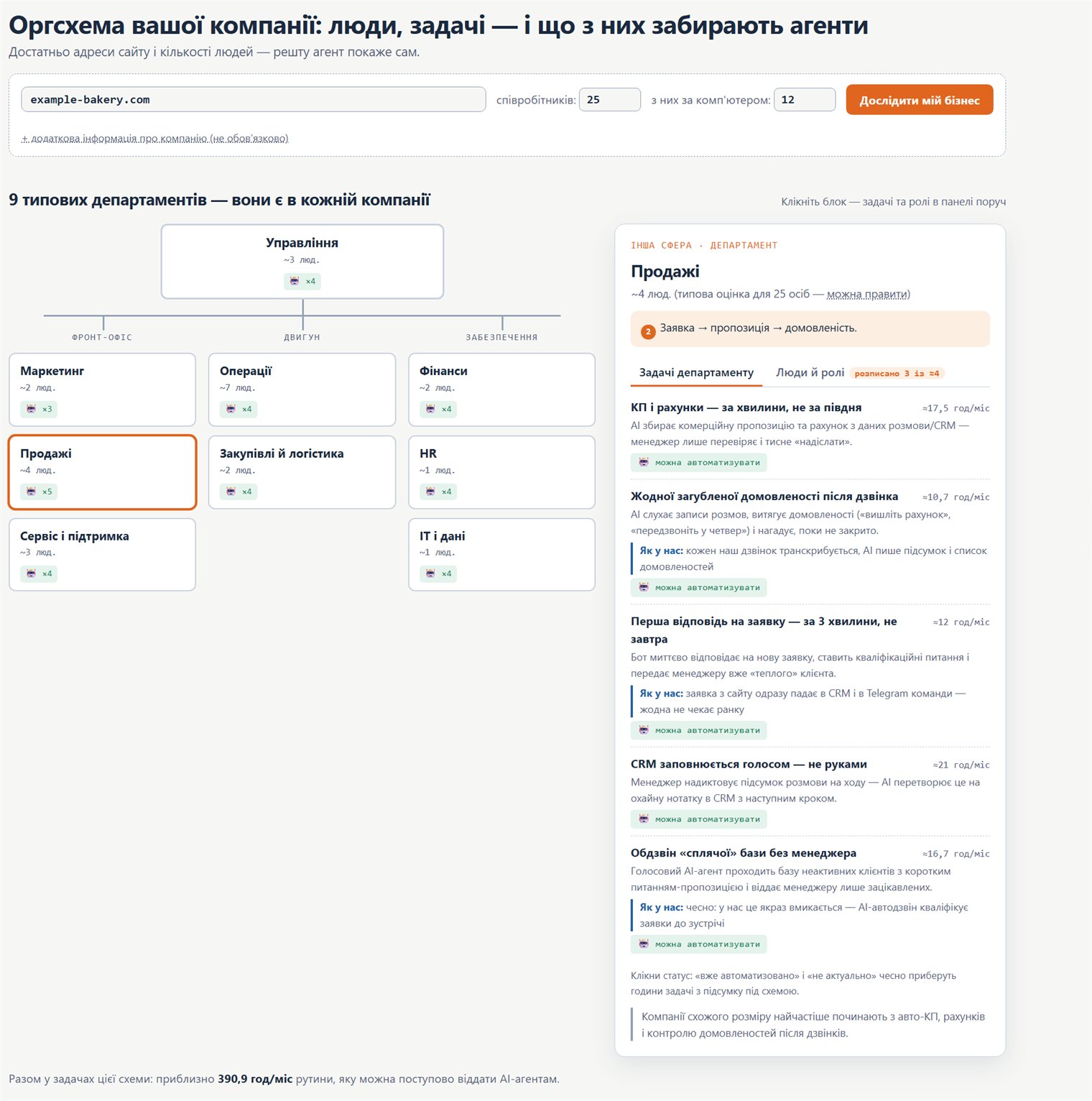
Org chart: how to move your company onto AI
A practical map: which company roles and processes AI agents can take over, where to start, and in what order to roll it out.