Grok 4 Fast Reasoning
At a glance
- Price per 1M tokens (input)
- $1.25
- Price per 1M tokens (output)
- $2.50
- Context
- 2,000,000 tokens
- Free access
- yes (see below)
Refreshed daily; data verified September 29, 2026. Published August 12, 2026, last price change August 30, 2026.
Grok 4 Fast Reasoning is designed for business users who need rapid, reliable answers from their own data and tools. It excels at tasks that require structured decision-making, such as routing support tickets, extracting data from documents, or triggering automated workflows. The vendor's approach focuses on speed and efficiency, pairing a lean reasoning engine with native tool calling, which lets the model invoke external functions like database queries or API calls. This makes it a practical choice for teams that want to embed AI into existing operational processes without heavy customization.
Specifications & pricing
| Input (per 1M tokens) | $1.25 |
|---|---|
| Output (per 1M tokens) | $2.50 |
| Cache read (per 1M tokens) | $0.20 |
| Context window | 2,000,000 tokens |
| Max output | 2,000,000 tokens |
| Capabilities | tool calling |
LiteLLM community dataset (MIT), verified September 22, 2026. Official xAI pricing.
What Grok 4 Fast Reasoning would cost on your workload — run it through the cost calculator →
Price history
| Date | Input / 1M | Output / 1M |
|---|---|---|
| August 9, 2026 (first record) | $0.20 | $0.50 |
| August 30, 2026 | $1.25 | $2.50 |
Where to try Grok 4 Fast Reasoning for free
- xAI offers a free chat — Grok (limited free access). A vendor's free chat may run a different model from the same family — the exact model is not guaranteed.
Frequently asked questions
What is this model best used for in a business context?+
It is ideal for tasks that combine natural language understanding with structured actions. Common use cases include automating customer service responses, summarizing internal reports, and generating code snippets for data pipelines. The model's tool calling capability means it can fetch live information from your systems and act on it, rather than just generating text.
How do I get started with using Grok 4 Fast Reasoning?+
You can access it through the xAI API or a supported cloud platform. Start by defining the tools you want the model to use, such as a database query function or a web search endpoint, then provide clear instructions in the system prompt. The API supports standard function-calling schemas, so you can integrate it with your existing backend in a few hours.
How does this model differ from other models in the Grok line?+
The 'Fast Reasoning' variant prioritizes low latency and efficient tool use over broad open-ended conversation. Sibling models may offer larger knowledge bases or more creative writing, but this one is tuned for deterministic, action-oriented responses. If you need quick, reliable function calls in production, this is the focused choice.
What are the limitations I should be aware of?+
It is not designed for deep creative writing or long-form analysis; it may give shorter, more direct answers that lack nuance. The model's knowledge is static and does not update in real time, so it relies on tool calling to access current data. Also, while it handles structured tasks well, it may struggle with ambiguous or highly abstract prompts that require extensive world knowledge.
Comparisons
Compare with others
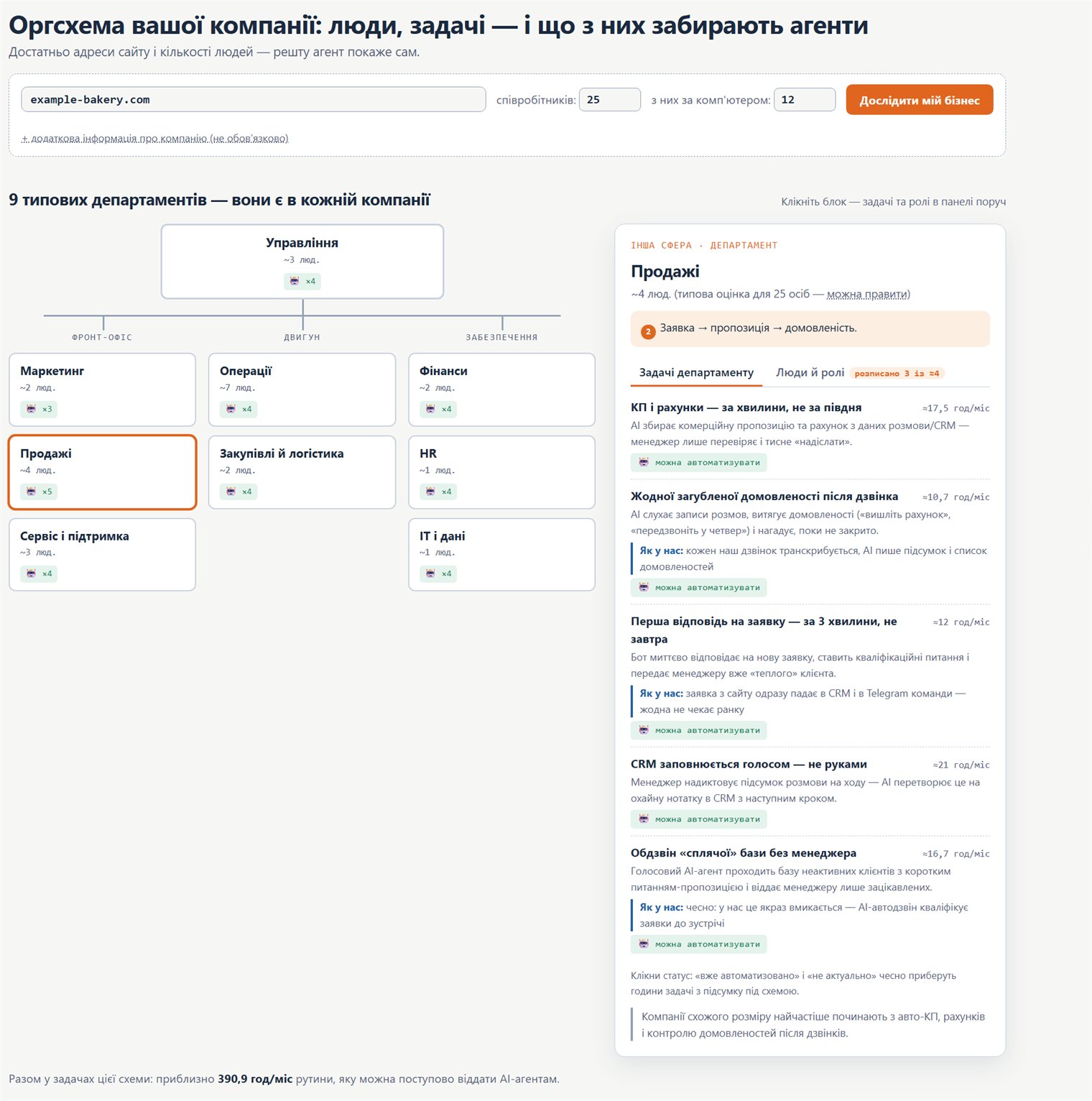
Org chart: how to move your company onto AI
A practical map: which company roles and processes AI agents can take over, where to start, and in what order to roll it out.